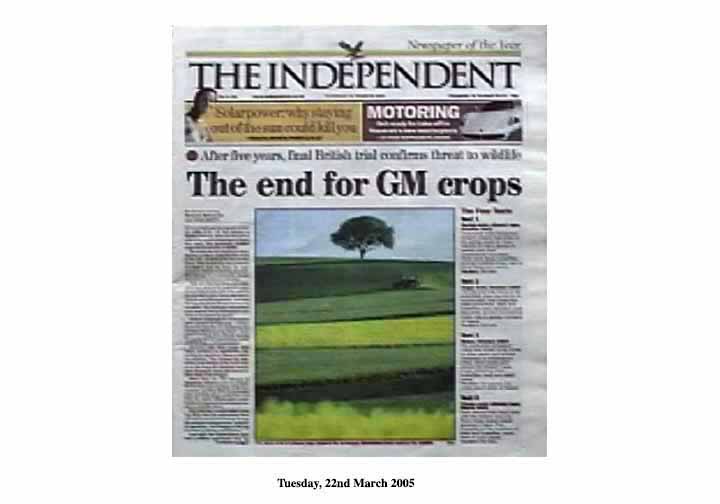
|
www.munlochygmvigil.org.uk UK - 2006 to 2003
|

|
| GO TO News OR GO ON TO INTERNATIONAL OR SCOTLAND OR TO EUROPE |
|
|
www.munlochygmvigil.org.uk UK - 2006 to 2003
|
|
| GO TO News OR GO ON TO INTERNATIONAL OR SCOTLAND OR TO EUROPE |
GM potato trials will go ahead despite location withdrawal
Chip makers oppose GM potato trial
Fury as genetically modified potatoes given go-ahead in UK
Irish Showed the way to mash GM Spuds but Defra throw caution to the wind
GM potato trials given go-ahead - Some farmers fear other crops will become contaminated
Key wildlife species and habitats excluded from proposed GM environmental liability laws
JUDGE GIVES GO AHEAD TO FSA HIGH COURT CHALLENGE OVER GM RICE
Finnie warned on legality of GM guidelines
GM RICE LEGAL CHALLENGE ISSUED AGAINST FOOD STANDARDS AGENCY
Defra accused of introducing GM through back door
Friends of the Earth's response to BASF's application to trial GM blight-resistant potatoes in the UK
Defra airbrush gardeners in GM proposals
Stores told to remove GM rice from shelves
GM POTATOES - FACTS AND FICTIONS
Britons eating GM rice as watchdog fails to test imports
Take US rice off sale, urges watchdog
Legal challenge plan over GM rice
FRIENDS OF THE EARTH FINDS ILLEGAL US GM RICE IN UK SUPERMARKET
GM: The cover-up - Revealed: Government food watchdog gave green light to supermarkets to sell 'illegal' genetically modified rice
Key Questions for FSA on GM Rice Contamination
Rice contaminated by GM has been on sale for months
Summary of the risks of GM potatoes
GOVERNMENT MUST REJECT PLANS TO GROW GM POTATOES
CALL FOR BAN ON IMPORTS OF US RICE AFTER CONTAMINATION REVEALED
Plans to allow GM farming in secret 'are irresponsible'
DEFRA GM Growing Proposals Condemned As Charter for Contamination
GOVERNMENT GM CONSULTATION SLAMMED
Biotech boss slams GM-free Wales
Sainsbury in row over GM research funding
Bt Documents Reveal Lack of Urgency in Food Standards Agency Response
Defra is sowing the seeds of poor farmers' destruction
Ministers back 'terminator' GM crops
GM Labelling Watch Dogs Need Better Leadership and More Cash
GM crop 'ruins fields for 15 years'
GM Oilseed survives longer in soil - new blow to EU coexistence plans
NEW STUDY RAISES FEARS OVER LONG TERM IMPACTS OF GM CROPS
Campaigners reveal illegal varieties of GM are being imported into UK
Greenpeace GM protesters cleared
GM protest 'was public nuisance'
'Secret' GM milk sale attacked
BRITISH RETAIL CONSORTIUM POSITION ON BRAZILIAN NON-GM SOYBEAN
Played for fools in this silence over our milk
From the National Federation of Women's Institutes
EU Governments Maintain GM Crop Bans
Mrs Beckett Urged to Support GM free Zones
Food agency accused of Stalinist tactics over GM maize cover-up
Sainsbury's exposed to naked outrage on GM stance
Mandelson wants to fast-track GM
FIRST ON-LINE WORLDWIDE REGISTER OF GM CONTAMINATION INCIDENTS LAUNCHED TODAY
Pressure groups release first international register of contamination mishaps as governments meet to discuss problem
The Pieces of the New “Model” are Becoming Visible
Revealed: health fears over secret study into GM food
US sent banned corn to Europe for four years
UK Backs Emergency Curbs on U.S. Animal Feeds
Unlicensed GM rice may be in UK food chain
China Seeks Probe of Greenpeace Rice Claim
Food watchdog is 'biased against organic food', says its own review
Dick Taverne inveighs against the doomsayers in The March of Unreason. A little knowledge and a lot of bombast are dangerous things, says Margaret Cook
The end for GM crops: Final British trial confirms threat to wildlife
Conservatives would ban commercial planting of GM crops
BIOTECH FIRM REJECTS GM CROP - 19th March 2005
Claimed wildlife benefits of GM crops in BRIGHT trials overturned by new study
Supermarkets remain defiant as GM milk row rumbles on
Ex-Minister: Only Blair and Beckett Support GM
RICS Calls For GM Land Register To Protect The Consumer - 23/02/05
GM firms finally give up on planting in Britain - 21 November 2004
Food Firms Reject GM Ingredients - 15th April 2004
Biotech firms linked to Sainsbury trust hit cash trouble - Daily Telegraph - 15/04/2004
Beckett is blamed as Bayer bins GM plan - The Financial Times - 30th March 2004
GM giant abandons bid to grow crops in Britain - The Independent - 31 March 2004
AEBC RESPONDS TO THE UK GOVERNMENT ANNOUNCEMENT ON GM CROPS - 9th MARCH 2004
IN THE UK PARLIAMENT, MARCH 2004
Wales blocks go-ahead for Britain's first GM crop - 9th February 2004
The Evening Standard - Letters to the Editor, 5th February 2004
ACRE's advice to the UK government on the results of the spring sown farm scale evaluation crops published on 13/1/04
Mixed message on GM crops leaves ministers in quandary - 14/1/04
Ministers to approve commercial growth of GM crops next month - 16/1/04
'GM Crops? Coexistence and Liability ' - published by AEBC, 25/11/03
The Farm Scale Evaluation results for spring sown GM herbicide tolerant varieties - October 2003
GM crops giant Monsanto pulls out of Europe
The GM Nation? Public Debate Report
Deplorable Attack on GM Critic
11th July 2003 STRATEGY UNIT REPORT CONFIRMS THERE IS NO RUSH TO COMMERCIALISE GM CROPS IN THE UK
Michael Meacher: Are GM crops safe? Who can say? Not Blair - Independent on Sunday, 22 June 2003
REALISTIC OBSERVATIONS FROM THE NIAB (National Institute of Arable Botany)
GM crops could harm property values, surveyors warn - 4 June 2003
'Genetically Modified Foods: Potential Human Health Effects'
Ministers briefed to back off GM crops.
Peter Melchett tells it how it is
FOOD STANDARDS AGENCY CONSUMER COMMITTEE - Report to Board, May 6th 2003
GM potato trials will go ahead despite location withdrawal - Farmers Weekly, 22 December 2006
http://www.fwi.co.uk/Articles/2006/12/22/100371/gm-potato-trials-will-go-ahead-despite-location-withdrawal.html
On-farm trials of genetically modified potatoes will go ahead in 2007 despite the withdrawal of the proposed site near Borrowash in Derbyshire. The farm owner had agreed to host the trial of chemical company BASF's late blight resistant potatoes but he pulled out saying that he feared for his personal security. A spokesman for Derbyshire Police said the force was aware that the intense publicity surrounding the GM trial had made the farmer concerned about his family's safety. Although, the spokesman said, it was understood that no specific threat had been made to the farmer. BASF, the chemical company behind the potato trial, described the farmer's withdrawal as "disappointing and a setback" for the company.
'Procedures'
"It was particularly disappointing because we had got so far through the required procedures," a BASF spokesman told Farmers Weekly. He was angry that the farmer had felt pressured into pulling out and he criticised the requirement to publish Ordnance Survey map grid references for on-farm GM sites. "We have to provide four-figure grid references and later in the procedures a six-figure reference in the interest of openness and transparency.......That exposes anyone hosting the trial to publicity and makes it difficult for all concerned."
New site
But he announced that BASF was on the verge of agreeing a new site for the potato trial. "We have been searching for a new site and there will be an on-farm GM potato trial planted next spring," he told Farmers Weekly. "We will be making an announcement fairly shortly into the New Year," he added.
Anti-GM campaigner Pete Riley joined BASF in decrying those who used intimidation as a means of getting GM trials stopped. But he questioned that there was any need for blight resistant GM potatoes. "The trials are unnecessary because there are already many blight resistant potato varieties on the market and in the pipeline that are produced by conventional breeding," said Mr Riley of GM Freeze.....All GM potatoes will do is jeopardise consumer confidence in the British potato. Farmers do not need to have their market undermined. We don't need GM spuds."
Chip makers oppose GM potato trial - By Charles Clover Environment Editor - The Daily Telegraph, 2 December 2006
http://www.telegraph.co.uk/news/main.jhtml?xml=/news/2006/12/02/nchips02.xml
The Government's decision yesterday to allow trials of a new strain of genetically modified potato has been met with strong opposition by the potato industry and the country's largest maker of chips. The British Potato Council said its refusal to endorse trials of a potato modified to be resistant to late blight, which caused the Irish potato famine of the 1840s, was based on consumers' mistrust of GM technology. The council said it was "paramount" that public concerns over GM trials were addressed and fears about possible cross-contamination were allayed before the trials began.
The Government has given permission for five-acre plots of GM potatoes produced by the company BASF to be grown in Derbyshire and Cambridgeshire next year. The conditions stipulate that the plots must be left fallow after the five-year trial so that overlooked tubers can be destroyed and that none of the potatoes harvested enters the food chain. Helen Priestley, the BPC's chief executive, said: "While we welcome steps to further understanding of this technology, the public must be comfortable with whatever steps are taken to introduce it and we didn't feel the time was right. "However, there are rigorous procedures in place to ensure that commercial crops are not contaminated with GM material and that no GM material enters the human food chain. The public must be left in no doubt that the procedures are effective, that they are maintained and that the trials process is open and transparent....It is crucial consumers understand that potatoes on sale through retail or food service outlets will continue to be GM-free."
Bill Bartlett, the corporate affairs director of McCain Foods (GB) which is the largest manufacturer of chips in Britain, said: "McCain Foods is disappointed with this decision at a tie when consumer attitudes do not support GM foods." Lord Melchett, the policy director of the Soil Association, said that the Government is "ignoring what consumers want to eat and their health and safety". He said: "Even in America, McDonald's, McCain, Pringles and Burger King rejected GM potatoes years ago. The chances of anyone in the UK willingly buying GM potato crisps or chips are zero. This trial is a monumental waste of time and money." The association claims that GM potatoes are one of the few crops where there is any scientific evidence of potential risks to human health, though the Government-sponsored research which found stomach lesions in rats fed on GM potatoes was widely criticised in the scientific community. Experts say the use of a natural resistance gene, from wild relatives of the potato in Mexico to give a commercial strain resistance to fungal attack represents a new departure for the GM industry.
The first generation of crops submitted for trial in Britain either contained natural pesticides, such as BT toxin, or were herbicide resistant. Representatives of companies such as Monsanto were famously unable to think of any advantage to the public, other than cost savings for farmers, of the first generation of GM crops. Government field trials in 2003 showed that the herbicide use they encouraged was often worse for wildlife than current practices. Built-in resistance to disease for one of the world's staple crops, however, is one of the potential benefits of GM technology discussed before the means became widely available. Chris Leaver, Sibthorpian professor of plant sciences at Oxford University, said the spreading of genes was not a problem because potatoes do not reproduce sexually, but are propagated by using tubers. Prof Joe Perry, of Rothamsted Research, said: "Under EU law, GM crops can only be banned if scientists can find evidence of harm to human health or the environment. Trials are therefore the only way to gather evidence to demonstrate actual harm."
Fury as genetically modified potatoes given go-ahead in UK - GM trial given go-ahead, but first food crop is 10 years away
http://www.dailymail.co.uk/pages/live/articles/news/news.html?in_article_id=419808&in_page_id=1770&ct=5
Ministers have been accused of ignoring consumers and risking contamination of the countryside after giving the green light for genetically modified potatoes to be grown in the UK. The Government granted permission for the GM variety to be cultivated at two trial sites, prompting claims that they are stealthily trying to reintroduce the technology after previously being forced to back away from it by public opposition.
Plans to grow Britain's first commercial GM crop - a bioengineered maize - were abandoned two-and-a-half years ago in the face of consumer protests. Dr Arpad Pusztai, the nutritionist who prompted the initial furore over GM crops said the move showed Britain was a 'soft touch' because Tony Blair believes the 'moon shines out of the backside of the biotech industry'. Campaigners said the new trials were pointless because food firms had already rejected GM potatoes.
But the Environment Department said trials of a new GM potato would go ahead at two sites - one in Derbyshire and one in Cambridgeshire. The crop has been engineered so that it includes a gene from a wild species of potato in a bid to make it resistant to blight, a disease that costs growers £70m a year.
Although the GM potatoes have been trialled in Germany and Sweden, they have yet to be planted here. German biotech company BASF Plant Sciences will start growing the GM potatoes in spring 2007. As many as 450,000 GM potato plants can be cultivated at the two sites near Borrowash, Derbyshire, and Girton, Cambridgeshire, over the course of the five-year project. The first commercially available crops could be on the shelves within a decade.
Chris Wilson, of BASF, said: 'The trial is to evaluate the new blight-resistant GM potato under UK farming and climate conditions. 'Nothing from these trials will be eaten. The potatoes grown will be tested under carefully controlled conditions and then destroyed. 'The possibility of a food crop from it is maybe ten years down the line.'
Ministers said independent experts had advised that the trials posed no risk to human health or the environment. GM potatoes present a low risk of contaminating other plants because they cannot cross with any wild species present in the UK, they said. The land will be left fallow and unploughed for two years after the trials in an attempt to prevent the GM varieties contaminating an ordinary crop grown later on the same site. But Lord Melchett, of the organic industry body the Soil Association, said: 'The Government is ignoring what consumers want to eat and their health and safety. 'Even in America, McDonald's, McCain, Pringles and Burger King, rejected GM potatoes years ago. The chances of anyone in the UK willingly buying GM potato crisps or chips are zero. This trial is a monumental waste of time and money. 'Worse than that, GM potatoes are one of the GM crops where there is scientific evidence of potential risks to human health.'
Friends of the Earth GM campaigner Clare Oxborrow said despite the reassurances, the trials posed a 'significant' contamination threat to future potato crops. 'We don't need GM potatoes and there is no consumer demand for them,' she said. 'The Government should promote safe and sustainable agriculture, not this half-baked GM potato plan.' For the Tories, shadow environment secretary Peter Ainsworth said: 'Given that the public shows no appetite at all for GM food, this trial seems somewhat academic.'
Ministers were also accused of letting biotech companies off the hook over any environmental harm caused by GM crops. Campaigners said proposed protections also unveiled yesterday were the 'weakest possible' and would fail to protect many important sites and species, including butterflies and moths. Dr Sue Mayer, director of the pressure group GeneWatch, said: 'These proposals are too weak to be effective and are dangerous because they create the impression that laws exist when they are a sham. 'It is highly unlikely that a biotechnology company or person using GMOs would be required to pay for remediation of any environmental damage that may arise unless they were proven to be negligent.'
Environment Minister Ian Pearson said: 'Our top priority on this issue remains protecting consumers and the environment, and a rigorous independent assessment has concluded that these trials do not give rise to any safety concerns......Based on the independent advice we have received, appropriate conditions have been specified for the conduct of the trials, and our GM Inspectorate will ensure that these are met......As the GM potatoes are being grown for research purposes, they will not be used for food or animal feed.'
Campaigners complain that the Government is continuing to attempt to foist GM technology on Britain despite the total lack of appetite for it from voters. Dr Pusztai said the latest approval for more trials looked like an attempt by ministers to sneak commercial cultivation in 'by the back door' after waiting for a period in the hope that opposition would die away. Last month, it emerged that rice being imported from America was widely contaminated with GM material. One in ten samples of American long grain rice tested at British mills was found to contain GM varieties. Selling GM rice is illegal in Europe because it has not been cleared for human consumption. Last year, the European Commission also cleared imports of genetically modified maize produced by the US biotechnology firm Monsanto for use as animal feed, despite safety concerns.
Irish Showed the way to mash GM Spuds but Defra throw caution to the wind - 1st December 2006
GM Freeze have described the approaches to licensing test sites for GM potatoes on either side of the Irish Sea as being “light years apart” following today’s approval of BASF’s GM trials in 2007 and beyond by Defra.
The giant German chemical company BASF applied to Defra in the summer to carry out tests of GM blight resistant potatoes from 2007 in Derbyshire and Cambridgeshire. They were granted approval for the same trials in Ireland last summer but they refused to proceed after the Irish Environmental Protection Agency (EPA) imposed 10 conditions in the license for the trial. The conditions on the license issued today by Defra are no where near as tough as those required in Ireland
The major differences between the Irish EPA (1) and Defra (2) include:
• The EPA required all berries (fruit containing seeds) to be collected in sealed bags and removed from Ireland. Defra require tops including berries to be chopped or sprayed with weedkiller.
• The EPA required potatoes exposed during cultivation to be removed or re-buried. Defra make no recommendations on this point.
• The EPA required a number of harvest operations to ensure the maximum number of GM tubers were removed. Defra require one harvesting operation.
• The EPA wanted a 40 metres separation distance between GM and non-GM neighbours. Defra have allowed 20 metres.
• The EPA required the site to be inspected for four years after the trail and volunteers potatoes or seedlings removed. Defra require only 2 years inspection
• The EPA insisted on an independent body (agreed by them) carrying out post release monitoring of the site. Defra are happy for BASF to monitor their own trial and report on it.
GM Freeze objected to the application because of the risk of GM materials spreading to neighbouring crops, lack of food safety data and because the trail was unnecessary given that many current potato varieties are already resistant to blight through conventional breeding making the GM varieties unnecessary. GM Freeze also pointed out that potato blight has many different strains and evolves rapidly so that GM resistance traits may not be effective for very long. Other objectors included the British Potato Council and McCains who were concerned about contamination and the impact on the UK potato industry.
Pete Riley of GM Freeze commented
“The approach taken by Defra and the Irish EPA are light years apart. Given the opposition of the UK potato growers' trade body, you would have expected Defra to follow Ireland’s lead and take a very precautionary approach with much tighter controls to try and prevent any GM materials escaping from the field or in the years following the trial. The huge irony of the BASF trials is that conventional plant breeders have already succeeded in developing resistance in 20% of potato varieties. New varieties bred from Hungarian stock are already proving to be very robust against blight in the UK. BASF’s experiment is pointless because we already well on the way to tackling the problem and there will be no market for GM spuds in the foreseeable future”.
Calls to Pete Riley 07903 341065
Notes
1. The full conditions required under the Irish approval which BASF did not take up are at http://www.epa.ie/Licensing/GMOLicensing/DeliberateReleaseofGMOs/FieldTrialwithGMPotatoes/FileUpload,9237,en.pdf
2. Defra’s condition can be found here http://www.defra.gov.uk/environment/gm/regulation/consents/pdf/06-r42-01.pdf
MUNLOCHY GM VIGILRESPONSE TO DEFRA'S CONSULTATION
GM potato trials given go-ahead - Some farmers fear other crops will become contaminated - http://news.bbc.co.uk/1/hi/sci/tech/6197768.stm
The government has allowed the planting of genetically modified potatoes on two trial sites in England. Defra granted permission for BASF Plant Sciences to grow crops in fields in Cambridgeshire and Derbyshire. The crops have been modified to include a gene from a wild species of potato in a bid to make them resistant to blight, a disease costing growers £70m a year. But the Soil Association said it was "a stupid decision" and warned other crops risked contamination by GM.
Previous GM potato trials were carried out in the UK in 2003. BASF aims to develop potatoes resistant to phytophthora infestans, known as late blight. It says it has found a trait in a wild potato that causes resistance to the fungal disease. The biotechnology firm applied to the Department for Environment, Food and Rural Affairs (Defra) to hold trials at the headquarters of the National Institute of Agricultural Botany (NIAB) in Cambridge and on a Derbyshire farm. The GM potato crops are to be planted next spring and trials will last several years. BASF said the trials would take up a maximum of one hectare within a plot of two hectares at each site per year.
'Not eaten'
BASF corporate communications manager Chris Wilson said: "Nothing from these trials will be eaten. The potatoes grown will be tested under carefully controlled conditions and then destroyed. "The possibility of a food crop from it is maybe 10 years down the line." Similar scientific tests are already under way in Germany, Sweden and the Netherlands, but BASF want to be sure their GM potato variety is resistant to blight under UK growing conditions.
Defra held a public consultation on the firm's application between September and October. However, the Soil Association's policy director Lord Peter Melchett told BBC's Five Live: "Nobody thinks that GM potatoes will seriously be used by British consumers or bought by them." He dismissed the idea scientists would be able to prevent contamination of other crops by GM. "Well there aren't any such guarantees," he said. "You can't do that. "American farmers have found this year that the whole of their long grain rice crop has been contaminated as the result of a trial which took place and finished over five years ago. " Lord Melchett also said the idea it would deal with the problem of blight was "fantasy". Blight is a disease which evolves very quickly you knock it back one way it comes back another," he said.
Key wildlife species and habitats excluded from proposed GM environmental liability laws - GeneWatch press release, 30 November 2006
http://www.genewatch.org/article.shtml?als[cid]=492860&als[itemid]=546615
Tomorrow, the [UK] Government is launching its consultation on the implementation of the Environmental Liability Directive (1). This includes the proposals for laws that will govern whether biotech companies have to pay for environmental harm caused by GMOs (2). The Government's proposals, seen by GeneWatch UK, are the weakest possible and will fail to protect important sites and species. "For GMOs, the Government doesn't intend to make the polluter pay," said Dr Sue Mayer, GeneWatch's Director. "These proposals are too weak to be effective and are dangerous because they create the impression that laws exist when they are a sham. While the public pay millions to protect species like the red squirrel and water vole, any damage that may be done by GMOs will not be paid for by the biotech industry".
Of the 566 Biodiversity Action Plan species, three hundred and seventy five (66%) will not be covered (3). A full list is published on the GeneWatch web site and includes:
the cirl bunting, corn bunting, tree sparrow, bullfinch; the water vole, the red squirrel, and the brown hare; and many butterflies and moths. Three thousand three hundred Sites of Special Scientific Interest (SSSIs), forming 25% of the land area of biological SSSIs in the UK will not be included. The SSSI system is an important pillar of nature conservation in the UK. GeneWatch has published a full list of these sites on its web site. (4) The proposals also make it difficult to ensure the biotech industry pays out, even when harm occurs to species that are covered.
"It is highly unlikely that a biotechnology company or person using GMOs would be required to pay for remediation of any environmental damage that may arise unless they were proven to be negligent. Either damage will not be repaired or the state will have to pay. This is not what people said they wanted during the Government's own 'GM Nation?' debate. The proposals could have been written by the biotech industry", said Dr Mayer
For further information contact Sue Mayer on 01298 871898 (office) or 07930 308807 (mobile)
Notes to editors
1.The DEFRA consultation 'Environmental Liability Directive. Consultation on options for implementation of the Directive' will be launched on Friday 1st December 2006 and will be available at: www.defra.gov.uk/environment/eldcon. The closing date for submissions will be the 22nd February 2007
2.The Environmental Liability Directive (ELD - 2004/35) provides the liability regime for environmental harm arising from the use of genetically modified organisms (GMOs). This is the regime that was promised during the negotiation of the Deliberate Release Directive (2001/18 - Recital 16), but it also includes environmental damage caused by other activities that are not addressed here. If environmental damage takes place as a result of using a GM organism, the company or person responsible should have to pay the costs of remediation (putting things right). For briefings about the Environmental Liability Directive and GMOs: http://www.genewatch.org/sub.shtml?als[cid]=530853%20
3.In the UK, a Biodiversity Action Plan was launched in 1994. Species and habitats of conservation concern were identified and plans established to protect and improve their status. For a full list of those species not covered under the Government's proposals: http://www.genewatch.org/sub.shtml?als[cid]=530853%20
4.For a full list of SSSIs that the Government does not intend to be included in the environmental liability laws: http://www.genewatch.org/uploads/f03c6d66a9b354535738483c1c3d49e4/SSSIsnotELD_bycounty.xls
JUDGE GIVES GO AHEAD TO FSA HIGH COURT CHALLENGE OVER GM RICE - Friends of the Earth UK, 21 November 2006
http://www.foe.co.uk/resource/press_releases/judge_gives_go_ahead_to_fs_21112006.html
A High Court judge has given Friends of the Earth permission to take its legal challenge against the Food Standards Agency (FSA) to a full hearing in the High Court. The environmental campaign group says that the FSA failed to take appropriate action to prevent unauthorised GM rice entering the UK food chain. The FSA had claimed that Friends of the Earth's challenge should not be allowed to proceed to a hearing because its case was 'unarguable'.
Friends of the Earth also argued that the case needs to be heard urgently to ensure that the FSA acts while GM-contaminated rice is still on the market. The FSA has argued that the case is not urgent. The Court [1] has ordered a hearing be held "as soon as possible" to decide the next steps in the case.
The Court's initial decision follows Friends of the Earth's application for judicial review of the Food Standards Agency's (FSA) failure to take necessary action to prevent UK consumers being exposed to unapproved GM rice in their food. The illegal GM presence stems from an incident in the US where GM rice grown experimentally (BayerCropScience's LL Rice 601) has contaminated commercial long grain rice supplies and been exported around the world. The rice is not approved for human consumption or cultivation anywhere in the world.
Friends of the Earth's Head of Legal, Phil Michaels said:
"The High Court has recognised that this is a serious case which requires a full hearing by the High Court. Three months after the Emergency Decision the Food Standards Agency is still not taking the UK's legal obligations seriously. The FSA's response to the case has been to point the finger at everyone else and to deny that it has any responsibility. Rather than seeking to avoid responsibility the FSA should instead be taking steps to comply with the law and to make sure that proper testing and analysis is carried out throughout the UK so that consumers are not exposed to illegal GM rice."
The Court's decision follows the publication by the FSA last week of its findings that just under 10% of samples collected in UK rice mills were contaminated with the illegal GM rice [2]. Illegal GM material has already been detected in long grain rice from Tesco, Sainsbury's, Morrisons, Somerfield and the Co-op.
According to the European Commission's amended Emergency Decision any long grain rice imported into the EU from the US must be tested to be demonstrated free of the illegal rice [3]. Furthermore, Member States must take appropriate steps to test rice products already on the market to make sure the illegal variety is not present.
Friends of the Earth claims that the FSA:
has failed to take actions necessary to comply with the requirements of the Emergency Decision to test rice already on the market in the UK;
has failed to ensure that local food authorities investigate or take enforcement action;
has encouraged food businesses to carry on as normal and not to test their rice for contamination or withdraw product.
Notes:
[1] Mr Justice Crane
[2]http://www.food.gov.uk/science/surveillance/fsisbranch2006/fsis1906
[3]http://europa.eu.int/rapid/pressReleasesAction.do?reference=IP/06/1120&format=HTML&aged=0&language=EN&guiLanguage=en
Finnie warned on legality of GM guidelines - By Rob Edwards - The Sunday Herald - 29 October 2006 - http://www.sundayherald.com/58739
IF Scottish ministers follow the example of Westminster on new rules for growing GM crops they will break European law. Legal experts have concluded that the regime proposed by the Department of Environment, Food and Rural Affairs (Defra) in London to prevent organic food from being contaminated by GM crops grown nearby is "fundamentally flawed". The Scottish environment minister, Ross Finnie, has long been expected to publish GM "co-existence" rules similar to Defra's. But although Defra's consultation finished more than a week ago, Finnie's has yet to begin.
Oddly, an announcement that Finnie's consultation had opened was posted on the Scottish Executive's website a month ago, but removed within hours. It was an "administrative error", according to the Scottish Executive. Now the campaign group, GM Freeze, has obtained a legal opinion on Defra's plans from two of the UK's leading specialists on European law, Paul Lasok and Rebecca Haynes. Defra plans were "inconsistent with community law", they concluded. Defra proposed to "minimise" GM contamination though the law required the government to "avoid" it. Defra's suggestion that no public register of GM crops was necessary ignored a European directive, the lawyers said.
GM Freeze will be writing to the Executive this week, warning ministers not to make the same mistakes as Defra. "The Executive needs to consider the legal flaws in Defra's consultation very carefully if it is to avoid making proposals that are at odds with European law," said Pete Riley, campaign director of GM Freeze. Green MSP Mark Ruskell added: "It's time for Finnie to show his hand on GM once and for all and not make the same pro-GM mistakes as Defra."
The Scottish Executive promised it would respond to GM Freeze. "We will also be issuing a consultation in due course and will consider all responses," said an Executive spokesperson.
GM RICE LEGAL CHALLENGE ISSUED AGAINST FOOD STANDARDS AGENCY
Friends of the Earth Press Release - Friday 27 October 2006
Friends of the Earth has filed a legal challenge against the Food Standards Agency (FSA) over its failure to take necessary action to prevent UK consumers being exposed to illegal GM rice in their food. The action comes two months after it was revealed that an experimental and unapproved GM rice had contaminated food supplies in the US and been exported to the UK and Europe. The application for Judicial Review was filed with the High Court challenging the Food Standards Agency's response to the incident.
According to the Emergency Decision issued by the European Commission shortly after the contamination incident was announced, any long grain rice imported into the EU must be certified as free of the illegal rice (BayerCropScience's LL Rice 601) [1]. Furthermore, member states must test rice products already on the market to make sure the illegal variety is not present.
Friends of the Earth claims that the FSA:
* has failed to take actions necessary to comply with the requirements of the Emergency Decision to test rice already on the market in the UK;
* to investigate or take enforcement action;
* encouraged food businesses to carry on as normal and not to worry about taking steps to test their rice for contamination or to withdraw any contaminated rice that they found.
No strains of GM rice have been approved in Europe, and no GM rice varieties are being grown commercially anywhere in the world. However, experimental trials are being carried out in a number of countries, including the US. In August, US Authorities announced that the illegal LL Rice 601, grown experimentally from 1998-2001 had contaminated commercial long grain rice supplies. Since then, over 90 incidents of illegal GM rice contamination has been detected in 15 European countries[2]. In the UK illegal GM material has been detected in long grain rice from Tesco, Sainsbury's, Morrisons, Somerfield and the Co-op.
Friends of the Earth's Head of Legal, Phil Michaels said: "The Food Standards Agency is not taking the UK's legal obligations seriously. It has failed to take necessary steps to verify that illegal GM rice is not on the market. It has effectively told business and local food authorities that no action is required. The Agency needs to take steps to check the food chain to ensure that this GM rice is not present and, where it is present, ensure that it is removed. It is failing to do so. Despite providing the FSA with repeated opportunities to reconsider its position it has failed to take the necessary steps. That is why Friends of the Earth feels it has no choice but to take urgent legal action."
On Monday, member states in the EU agreed to stricter measures requiring all long grain rice from the US to be re-tested at the point of entry into the EU, following a mix up where a number of consignments of rice that had entered Rotterdam port and were certified by the US as GM-free, were tested by Dutch authorities and subsequently found to be contaminated [3].
Notes:
[1] http://europa.eu.int/rapid/pressReleasesAction.do?reference=IP/06/1120&format=HTML&aged=0&language=EN&guiLanguage=en
[2] http://www.foeeurope.org/GMOs/rice_contamination.htm
[3] GM rice: Standing Committee backs Commission Decision on strict counter testing of US rice imports:
http://europa.eu.int/rapid/middayExpressAction.do?date=25/10/2006&direction=0&guiLanguage=en
RESIST THIS RUSH FOR GM CROPS - Western Morning News, 21 October 2006
The government's supposed consultation over the future of genetically modified crops in Britain smacks of a sham exercise. Tony Blair's view on the matter is well known and - as we have seen before - if Mr Blair is resolved on something he is not too bothered what the public thinks.That is not the spin that is being put on this process, of course. Ostensibly, all opinions will be taken into account, due weight will be given to arguments both for and against, then a balanced and considered decision will be made. Excuse us for sounding cynical, but we do not believe it.
The former Environment Minister, Michael Meacher, is closer to the mark when he says that public opinion is being overridden. Despite trials that provoked outrage among organic and non-GM farmers in the countryside, despite the militant uprooting of experimental crops, and despite the very well-founded fears about cross-pollination, the Government still has the audacity to claim that there is "no scientific case" for a ban. That is a preposterous argument that owes more to this Government's all too comfortable relationship with big business than with any objective analysis of the facts.
For every argument that GM does not pose a threat to human health, there are opponents in the farming and scientific community who can point to the contrary. For every insistence that GM crops cannot compromise nearby organic fields, there is evidence to make a mockery of it.
The stark fact of the matter is the Government has decided on a technology which could have long-term effects on agriculture over which there is little control. In its haste, it could be opening a Pandora's Box which lets loose a trail of damage stretching far into the future. If it then transpires that ministers got it disastrously wrong - as they are being warned they have - it may be too late to reverse the damage. It is confusing as to what are the Government's motives in this matter. It may be that vested interest has influenced opinion; it may even be Mr Blair and senior colleagues at Defra are persuaded of the long-term benefits of GM to the food market and the consumer. Whatever the Government's reasoning, we believe its conclusions are both wrong-headed and dangerous. If that means it must be challenged in law, then good. If it means public demonstrations against the crude imposition of GM, then so much the better. We would expect that those protests would be particularly widespread in the Westcountry, which has such a high concentration of organic farms.
Farmers cannot afford to be used as the guinea pigs for a Government experiment in genetic technology. The health of the public must not be compromised by an expansion of the market in tainted food. There is enough of that already to contend with and overcome without the situation being worsened. Nor must opponents of GM be brow-beaten or intimidated by accusations of their being "anti-science". We are very much in favour of science when it is to the benefit of human health and progress.
If the Government is not in the mood to listen to that, then it must be made to listen. One word sums up our message on GM crops: no!
Defra accused of introducing GM through back door - By Andy McSmith - The Independent, 20 October 2006
http://news.independent.co.uk/uk/politics/article1904982.ece
Public opposition to GM crops is being overridden by a government determined to back the industry, Michael Meacher, the former environment minister, has claimed. His remarks came yesterday in response to the launch of a government consultation over whether GM crops can "co-exist" with non-GM crops in the British countryside. Those who want to take part must have their answers in by today.
Early GM experiments met huge opposition in the UK, with the result that no GM crops have been grown commercially in Britain. The same is true through most of Europe, and environmental groups claimed yesterday that what the government is now proposing could be illegal under EU law. But the government's view is that there is "no scientific case" for a total ban. Mr Meacher, and other campaigners, suspect that the Environment Secretary, David Miliband, is looking for a way to overcome public opposition. "This consultation is the Government's latest attempt to back the GM industry over the wishes of the British public," Mr Meacher claimed. "Instead of paving the way for GM crops to be grown in England, David Miliband must take on board the thousands of responses rejecting the Government's GM contamination plans and put in place policies that protect GM-free food and truly promise his vision of sustainable farming."
Three pressure groups yesterday published a legal opinion claiming that the government plans are "fundamentally flawed". The opinion said that Mr Miliband's department is wrong to assume that it is permitted under EU law to seek to "minimise" rather than "avoid" the risk that other crops will be contaminated if there are GM crops growing nearby. They also say that the Department for Environment, Food and Rural Affairs was wrong to think that EU law does not require it to publish a register of sites where GM crops are grown, and to assume that gardeners and allotment holders do not have a right under EU law to know whether GM crops are being grown near their land. The legal opinion was prepared for Friends of the Earth, The Soil Association and GM Freeze.
Soil Association policy director Peter Melchett said: "The Government's proposals to deny organic and other farmers the choice of staying free of GM contamination break their repeated promises." Friends of the Earth's GM campaigner Clare Oxborrow said: "Government proposals for rules that allow GM crops to be grown alongside conventional and organic crops are a thinly veiled attempt to introduce GM crops through the back door. Allowing routine, unlabelled, GM contamination of conventional and organic crops is not only unacceptable to the public, it is legally flawed." GM Freeze director Pete Riley said: "The Government appears to be willing to rewrite EU law."
Public opposition to GM crops is being overridden by a government determined to back the industry, Michael Meacher, the former environment minister, has claimed. His remarks came yesterday in response to the launch of a government consultation over whether GM crops can "co-exist" with non-GM crops in the British countryside. Those who want to take part must have their answers in by today.
Friends of the Earth's response to BASF's application to trial GM blight-resistant potatoes in the UK is pasted below.
Don't forget, all responses have to be in by this Thursday, 19th October, 2006!
If you want to respond, full details are at http://www.defra.gov.uk/environment/gm/regulation/applications/06-r42-01.htm
Best wishes,
Liz Wright
Representation from Friends of the Earth on application for a part B consent from BASF Plant Science to release genetically modified potatoes with improved resistance to Phytophthora infestans (Application Reference 06/R42/01)
October 2006
Friends of the Earth inspires solutions to environmental problems, which make life better for people. Friends of the Earth is:
* the UK's most influential national environmental campaigning organisation
* the most extensive environmental network in the world, with around 1 million supporters across five continents, and more than 70 national organisations worldwide
* a unique network of campaigning local groups, working in more than 200 communities throughout England, Wales and Northern Ireland
* dependent on individuals for over 90 per cent of its income.
Friends of the Earth objects to this application from BASF Plant Science to release blight resistant genetically modified potatoes into the environment in experimental trials.
Our grounds for objection are as follows:
GM contamination
Although commercial potatoes are propagated via tubers, true potato seed production can also occur, and while not affecting the current tubers, it can create GM volunteers in future crops. Rates of outcrossing recorded under field conditions for potatoes range from 0 to 20%, with both wind and insect pollination likely to be involved [1]. Some studies have detected pollen up to 20m from the source [2], but one study recorded outcrossing levels of 31% at 1000m, thought to be due to pollen beetles [3].
Of the three varieties BASF will be using in the trials, P835 and P880 produce abundant flowers, while P698 is middling. P880 frequently sets berries, P835 sets few, and P698 rarely does, but no information on the viability or longevity of the seeds is given.
Groundkeeper control will be crucial to prevent contamination. True seed, unharvested tubers and damaged tuber pieces can all sprout in the following year to produce weed plants in subsequent crops, which will in turn produce small tubers which can persist to contaminate crops in future years. Control with herbicides is difficult in following broad leaved crops. BASF say that groundkeepers will be quickly killed by frosts, but as a 2002 European Environment Agency report [4] explains, "in recent years, the combination of reduced herbicide rates throughout the rotation due to declining arable margins, a succession of mild winters and the use of vigorous potato varieties has increased the numbers of volunteer potatoes."
Friends of the Earth therefore objects to this application for growing experimental GM potatoes in the open air on the basis that it will be very difficult to prevent them contaminating other non-GM potato crops. Should Defra give the go ahead for these trials, strict measures must be put in place to ensure that these experimental potatoes cannot contaminate future crops via groundkeepers or volunteers derived from seed production. Nearby potato crops must also be protected from pollen transfer from the GM potatoes.
Safety
No evidence is provided in the application to rule out unexpected effects due to the GM insertion, and no safety data is provided on the potatoes. Yet experimental GM potatoes have resulted in entirely unpredicted outcomes in the past - for example a potato modified to have low levels of the NAD-malic enzyme showed increase starch content, which the researchers could not explain [5]. And an attempt to introduce yeast and bacterial genes into potatoes to increase starch content actually reduced starch content and produced unexpected compounds due to disruption of the plant metabolism [6]. Research on GM potatoes modified to produce GNA lectin [7] suggested impacts on the gastrointestinal tract of rats, provoking scientific controversy [8], yet no follow up research has ever been carried out.
Although BASF do not intend for these potatoes to enter the food chain, and crops are intended to be destroyed at the end of the trials, the experience of LL601 rice in the USA, where an experimental GM rice line has contaminated worldwide rice supplies, illustrates that these experiments are not always containable. Rice, like potatoes, has always peviously been considered a 'low risk' GM crop for contamination, due to the low levels of cross pollination expected. Yet recent events would indicate that even 'low risk' crops can be involved in serious GM contamination incidents.
Friends of the Earth does not believe that these open-air GM trials should go ahead, but should permission be granted then publicly available safety data would help to provide reassurance in the event of a contamination incident similar to the US experience.
Lack of need
Genetic modification is not the only way of producing blight resistant potatoes - breeding programmes have already produced a range of blight-resistant potatoes that are currently in use in the UK, and there are many more in the pipeline. The Sarvari Research Trust has developed the Sarpo blight-resistant varieties which are performing well in UK trials and taste tests.
Phytophthora infestans is constantly mutating, existing as a large population with much genetic variation. Some blight resistant potatoes may have only short-lived resistance, while some individual varieties can last for several decades - the rate at which the pathogen can overcome resistance is impossible to predict. A single genetically modified variety of potato may not therefore offer a long-term solution for late blight. Plant breeders need to stay one step ahead of the pathogen, and given the tight regulations around the deliberate release of genetically modified organisms, and long periods of time required for approval, traditional breeding may in fact offer a speedier option.
Furthermore, it is unclear what level of reduction in fungicide use GM blight-resistant potatoes would actually deliver. Figures on reasons for use of fungicides do not appear to have been collected since 1998, when blight accounted for just 34% of fungicide use for ware potatoes [9]. The genuine level of reduction of fungicide use must be investigated before any approval is given for these trials.
Lack of demand
Consumers have made it clear that they do not want to eat genetically modified food in numerous surveys, debates, and by voting with their feet - supermarkets have removed almost all genetically modified foods from their shelves due to consumer demand. The latest Eurobarometer poll reports that "Europeans think that GM food should not be encouraged. GM food is widely seen as not being useful, as morally unacceptable and as a risk for society" [10].
It is unclear who BASF expects to eat these GM potatoes should they eventually make it onto the market. These trials therefore represent an unnecessary risk to the environment and could threaten the integrity of GM-free potato supplies in the UK.
Conditions
Friends of the Earth objects to this application, and urges Defra to reject it. Should the application be accepted, very strict conditions must be included in the consent, including:
Detailed written instructions and procedures for trial management, which must include:
Removal of flowers prior to pollination
A separation distance of 1.5km between the trial and the nearest non-GM potato crop, including allotments or gardens.
Complete removal of tubers post-harvest with measures to minimise any remaining tubers
Complete destruction of both GM and non-GM potatoes post-harvest
Secure storage separate from non-GM potatoes prior to planting and after harvest, with detailed and accurate record-keeping
Thorough cleaning of all farm machinery and equipment after sowing, field operations and harvesting
Checking of all vehicles used for transport to ensure no spillage can occur
Planting of a spring cereal crop after the trial and complete destruction of any sprouting tubers with herbicide
Trial site must be monitored post-harvest for eight years for any sign of emergence of groundkeepers or true potato seed
Planting of commercial non-GM potatoes in trial area prohibited for ten years
Trial site must be secured to prevent wild mammals entering the site
A validated protocol for identification of the GM potato must be provided, together with positive and negative control samples
Post release monitoring of impacts on biodiversity, gene flow, and persistence of tubers and true potato seed.
References
[1] Treu R & Emberlin J (2000). Pollen dispersal in the crops maize (Zea mays), oilseed rape (Brassica napus ssp oleifera), potatoes (Solanum tuberosum), sugar beet (Beta vulgaris ssp. Vulgaris) and wheat (Triticum aestivum). Evidence from publications. A report for the Soil Association from the National Pollen Research Unit.
[2] Eastham K & Sweet J (2002). Genetically Modified Organisms (GMOs): The significance of gene flow through pollen transfer. European Environment Agency
[3] Skogsmyr, I. (1994) Gene dispersal from transgenic potatoes to conspecifics: A field trial. Theoretical and Applied Genetics 88: 770 - 774.
[4] Eastham K & Sweet J (2002). Genetically Modified Organisms (GMOs): The significance of gene flow through pollen transfer. European Environment Agency
[5] BBSRC Business, Jan 1998. Making crops make more starch p6-7
[6] Gura, T (2000) Reaping the plant gene harvest. Science 287 412-414
[7] Ewan, S.W.B. & Pusztai, A. (1999) Effect of diets containing genetically modified potatoes expressing Galanthus nivalis lectin on rat small intestine. The Lancet 354: 1353-1354.
[8] The Royal Society (1999) Review of data on possible toxicity of GM potatoes.
[9] Garthwaite DG & Thomas MR (1998). Pesticide Usage Survey Report 159: Arable crops in Great Britain 1998. PUSG/CSL. http://www.csl.gov.uk/science/organ/pvm/puskm/arable1998.pdf
[10] http://www.ec.europa.eu/research/press/2006/pr1906en.cfm
Defra airbrush gardeners in GM proposals - GM FREEZE, Press Release
[DEFRA is the UK Govt. Dept. of Environment, Food and Rural Affairs]
Gardeners and beekeepers will not be told if GM crops are to be grown near by their land or hives if Defra's proposals for growing GM crops in England are accepted. In a consultation paper issued in the summer [1], Defra proposed that land owners within certain distances will be legally required to be informed if a GM crop is to be grown. However, "Defra's proposals are not intended to cover the situation where:
GM crops may cross-pollinate plants grown in allotments or domestic gardens intended for private consumption". (paragraph 39.V) And "Defra does not propose any specific action in relation to the coexistence of GM crops and commercial honey production" (paragraph 107).
Defra has decided to exclude an estimated 500,000 allotment holders and vegetable gardeners from the list of land owners who will legally be required to be informed if a GM crop is planned near by because their produce is for private consumption and will not be placed on the market. Many gardeners grow sweet corn which could cross pollinate with GM maize. Many give away surplus produce or sell it. In the future vegetable crops could also be genetically modified and gardeners will need to know what?s being grown near by.
The decision to exclude the 15,000 to 20,000 hobby and commercial beekeepers in England from those who will be required to be informed about GM growing sites is based on the fact that GM pollen will never exceed 0.9% by weight in a jar of honey and that the presence of GM pollen is considered to be "adventitious and unavoidable". The most recent poll found 63% of regular honey buyers wanted it to be GM free [2]. The value of pollination provided by beekeepers is up to £200 million per year and honey £10-30 million per annum [3].
GM Freeze and Friends of the Earth have published a guide to responding to the Defra consultation [4].
Commenting Pete Riley of GM Freeze said: "Defra's attempt to airbrush gardeners and beekeepers is an insult. Many people grow their own veg. to keep control over what they and their families eat, especially to avoid GM. Many sell or give away surplus produce. GM contamination threatens that right and now Ministers want to keep gardeners in the dark about GM crop sites. Honey is a pure product and the presence of GM pollen would seriously undermine its image and sales. Bees travel miles to collect nectar and pollen and at the same time pollinate important crops - Defra's proposals to ignore the views of beekeepers about where GM crops are grown is incredibly short sighted and betrays a lack of knowledge amongst Ministers about the importance of honey bees to the countryside"
Calls to Pete Riley 07903 341065 or Carrie Stebbings 0207 837 0642
1.http://www.defra.gov.uk/corporate/consult/gmnongm-coexist/consultdoc.pdf
2.http://www.foe.co.uk/resource/press_releases/20020920000136.html
3.http://www.defra.govuk/hort/Bees/index.htm
4.See www.stopgmcontamination.org
Carrie Stebbings, Co-ordinator, GM FREEZE CAMPAIGN, 94 White Lion Street, London, N1 9PF
Tel: 020 7837 0642, Fax: 020 7837 1141, carrie@gmfreeze.org - www.gmfreeze.org
Stores told to remove GM rice from shelves - Press Association - The Guardian, October 6, 2006
http://www.guardian.co.uk/gmdebate/Story/0,,1889503,00.html
The government's food watchdog has changed its advice to retailers about genetically modified rice. Stores must remove any rice known to contain GM strains from their shelves, the Food Standards Agency said. The move follows ongoing concerns over the presence of GM strains in batches of long-grain rice from the US. Selling products known to be contaminated with GM material is illegal in the UK, but the FSA previously told businesses that actively tracking down and removing contaminated rice products was unnecessary because they didn't pose an "imminent" health risk. The watchdog's updated advice follows the European Food Safety Authority's (EFSA) assessment of safety implications of GM material in rice.
EFSA experts said rice containing traces of GM material was "not likely" to pose an imminent safety concern, but they found insufficient information to complete a full risk assessment of the issue. The FSA's advice to consumers is unchanged. Anyone who has US long-grain rice at home can continue to eat it. An FSA spokesman said today: "We are doing this because there is new information."
The environmental group Friends of the Earth complained that the stepped-up advice had come too late. The group's GM campaigner, Clare Oxborrow, said: "The FSA should have issued this advice right from the start, instead of playing down the seriousness of the issue. "The agency is still refusing to carry out any testing of rice on shelves and still failing to require retailers to carry out such testing themselves."
The US government confirmed in August that a genetically modified strain of long-grain rice was found in samples. In response, the EU introduced emergency measures to stop contaminated rice entering the food chain. Friends of the Earth researchers claim they have found GM strains in packets of rice and noodles on sale in a number of UK stores.
GM POTATOES - FACTS AND FICTIONS - Author: Andy Rees - The Ecolgist, 22 September 2006
http://www.theecologist.org/archive_detail.asp?content_id=612
In August 2006, German chemicals company BASF applied to start GM potato field trials in Cambridge and Derbyshire as early as next spring. The GM industry is making many claims about this product, but are these based on the truth? Andy Rees investigates
ARGUMENT NO. 1: WE NEED THIS PRODUCT
Late blight (Phytophthora infestans) costs UK farmers around GBP50m each year, even with regular application of fungicides. BASF claims that its GM potato would reduce fungicide spraying from around 15 times a year to just two. This sounds impressive, until you realise that just 1,300 of the 12,000 tonnes of agrochemicals used on UK potatoes are fungicides ? meaning that, at most, pesticide usage would be reduced by only 10 per cent.
As far as actually reducing pesticide usage is concerned, Robert Vint of Genetix Food Alert observes that "such claims ... usually [soon] prove to be extreme exaggerations". The biotech industry has a long track record of first exaggerating a problem, then offering an unproven and oversold GM solution. A classic example of this was Monsanto's showcase project in Africa, the GM sweet potato. It was claimed that the GM potato would be virus resistant, that it would increase yields from four to 10 tonnes per hectare, and that it would lift the poor of Africa out of poverty.
However, this crop not only wasn't virus-resistant, it yielded much less than its non-GM counterpart. Moreover, the virus it targeted was not a major factor affecting yield in Africa. The claims were made without any peer-reviewed data to back them up. And the assertion that yields would increase from four to 10 tonnes per hectare relied upon a lie - according to FAO statistics, non-GM potatoes typically yield not four but 10 tonnes. Furthermore, a poorly resourced Ugandan virus-resistant sweet potato, that really was roughly doubling yields, was studiously ignored by the biotech lobby.
Also conveniently overlooked are any non-GM solutions to blight. Many conventional potato varieties are naturally blight-resistant, some of which the organic sector are currently trialling. Another non-GM control, used by organic farmers against late blight in potatoes, is the use of copper sprays in low doses. This is applied to the foliage of the plant and does not contaminate the tuber.
ARGUMENT NO. 2: MINIMAL CONTAMINATION
An article in The Guardian, which reads more like a BASF press release (the corporate takeover of the media is a subject covered in my forthcoming book), reports that "Andy Beadle, an expert in fungal resistance at BASF, said the risks of contamination from GM crops are minimal because potatoes reproduce through the production of tubers, unlike other crops such as oil seed rape [canola], which produces pollen that can be carried for miles on the wind." Not only is this remark economical with the facts, it seems a little brazen given the biotech industry's rather prolific history on contamination issues, which has resulted in at least 105 contamination incidents (some of them major), over 10 years, and in as many as 39 countries.
Amongst many other things, Mr Beadle forgot to mention that there is less direct risk of contamination by cross-pollination, not no risk. Furthermore, cross-pollination is much higher when the GM and non-GM potato varieties are different; one study showed that, even at plot-scale, 31 per cent of plants had become hybrids as far as 1km from a GM variety. Crosspollination also increases greatly when the chief pollinator is the 'very common' pollen beetle, which travels considerably further than another potato pollinator, the bumble bee. Years later, cross-pollination is still possible through potato volunteers (plants from a previous year's dropped tubers or seed); Defra itself has acknowledged this problem. And similarly, 'relic' plants can persist in fields or waste ground. What is more, blight-resistant varieties create a far greater risk of GM contamination because the flowering tops are more likely to be left on than with non-blightresistant varieties. This is because tops are usually removed from non-blight-resistant varieties to reduce disease incidence. Also, a number of modern strains can produce considerable numbers of berries, each producing 400 seeds; these can lay dormant for seven years, before becoming mature tuber-producing plants.
And if all that isn't enough to suggest that 'minimal' contamination is the figment of the corporate imagination, then it is well worth checking out the March 2006 GM Contamination Register, set up by Greenpeace and GeneWatch UK, and available at www. gmcontaminationregister.org. This includes some of the worst contamination incidents to date, including the following three. In October 2000, in the US, GM StarLink corn, approved only as animal feed, ended up in taco shells and other food products. It led to a massive recall of more than 300 food brands and cost Aventis an immense $1 billion to clear up. StarLink corn was just one per cent of the total crop, but it tainted 50 per cent of the harvest. In March 2005, Syngenta admitted that it had accidentally produced and disseminated - between 2001 and 2004 - 'several hundred tonnes' of an unapproved corn called Bt10 and sold the seed as approved corn, Bt11. In the US, 150,000 tonnes of Bt10 were harvested and went into the food chain. And in April 2005, unauthorised GM Bt rice was discovered to have been sold and grown unlawfully for the past two years in the Chinese province of Hubei. An estimated 950 to 1200 tons of the rice entered the food chain after the 2004 harvest, with the risk of up to 13,500 tons entering the food chain in 2005. The rice may also have contaminated China's rice exports. And now, in 2006, BASF's application comes amidst the latest biotech scandal, that of US rice contamination by an unauthorised, experimental GM strain, Bayer's LLRice 601.
ARGUMENT NO. 3: SEPARATION DISTANCES
The GM lobby have proposed a buffer zone of 2-5m of fallow land around the GM potato crop, together with a 20m separation with non-GM potato crops. The National Pollen Research Unit (NPRU), on the other hand, has recommended separation distances of 500m. Interestingly, pro-industry sources have always claimed that only very small separation distances are necessary, with buffer zones for rape set at a derisory 200m in the UK crop trials. Judith Jordan (later Rylott) of AgrEvo (now Bayer) gave evidence under oath that the chances of cross-pollination beyond 50m were as likely as getting pregnant from a lavatory seat. Well, you have been warned. But oilseed rape pollen has been found to travel 26km, maize pollen 5km, and GM grass pollen 21km. Meanwhile, good ol' Defra is once again paving the way for the biotech industry, with its so-called 'co-existence' paper of August 2006. This will determine the rules for commercial GM crop growing in England - yet astonishingly, it proposes no separation distances. GM contamination prevention measures will be left in the slippery hands of the GM industry in the form of a voluntary code of practice.
ARGUMENT NO. 4: THIS PRODUCT IS SAFE
The biotech industry has from the very beginning assured us that their products are entirely safe. This is because, they claim, they are so similar to conventional crops as to be 'Substantially Equivalent', a discredited concept that led to GM crop approval in the US (and thence the EU). The truth is that, as far as human health goes, the biotech industry cannot know that their products are safe, because there has only been one published human health study - the Newcastle Study, which was published in 2004. And although this research project was very limited in scope, studying the effects of just one GM meal taken by seven individuals, it nonetheless found GM DNA transferring to gut bacteria in the human subjects.
As for tests of the effects of GM crops on animals, there are only around 20 published studies that look at the health effects of GM food (not hundreds, as claimed by the biotech lobby), as well as some unpublished ones. The findings of many of these are quite alarming. The unpublished study on the FlavrSavr tomato fed to rats, resulted in lesions and gastritis in these animals. Monsanto's unpublished 90-day study of rats fed MON863 maize resulted in smaller kidney sizes and a raised white blood cell count. And when it comes to GM potatoes, Dr Ewen and Dr Pusztai's 1999 10-day study on male rats fed GM potatoes, published in the highly respected medical journal The Lancet, showed that feeding GM potatoes to rats led to many abnormalities, including: gut lesions; damaged immune systems; less developed brains, livers, and testicles; enlarged tissues, including the pancreas and intestines; a proliferation of cells in the stomach and intestines, which may have signalled an increased potential for cancer; and the partial atrophy of the liver in some animals. And this is in an animal that is virtually indestructible.
ARGUMENT NO. 5: INCREASING CHOICE
The proposed UK trials would follow those being carried out in Germany, Sweden and the Netherlands. Barry Stickings of BASF explains: "We need to conduct these [in the UK] to see how the crop grows in different conditions. I hope that society, including the NGOs, realise that all we are doing is increasing choice." So, how much choice has GM crops given farmers? Well, in Canada, within a few years, the organic canola industry was pretty much wiped out by GM contamination. And in the US, a 2004 study showed that, after just eight years of commercial growing, at least 50 per cent of conventional maize and soy and 83 per cent of conventional canola were GM-contaminated - again dooming non-GM agriculture.
ARGUMENT NO. 6: PUBLIC OPINION
Regarding BASF's application to trial GM potatoes, the Financial Times reported that "Barry Stickings of BASF said he did not expect too much opposition to the application". What had clearly slipped Stickings' mind was that BASF had already faced protests with this product in Sweden, where it is in its second year of production. In Ireland, where one may have expected more enthusiasm for the project, given the history of blight during the 1840s famine, BASF was given the go-ahead earlier this year for trials of its GM blight-resistant potato, only to face stiff public resistance and rigorous conditions enforced by the Irish Environmental Protection Agency. BASF later discontinued the trials.
In the UK and Europe, as Friends of the Earth points out: "Consumers ... have made it clear that they do not want ... GM food." In fact, the British Retail Consortium, which represents British supermarkets, has already stated that they 'won't be stocking GM potatoes for the conceivable future' because 'people remain suspicious of GM.' My forthcoming book goes into the rejection of GM crops in more depth. And even more surprisingly, in the US, where 55 per cent of the world's GM crops are grown, GM potatoes were taken off the market back in 2000 when McDonald's, Burger King, McCain's and Pringles all refused to use them, for fear of losing customers.
So, having reviewed the claims made about BASF's GM potatoes, and having found them, well, somewhat lacking, there is only one course of action open to the government, and that is, as Friends of the Earth's GM Campaigner Liz Wright recently said, to "...reject this application and prevent any GM crops from being grown in the UK until it can guarantee that they won't contaminate our food, farming and environment."
Genetically Modified Food - A Short Guide For The Confused by Andy Rees (Pluto Press, GBP12.99) will be published on October 20. Ecologist readers can purchase copies of the book for only GBP10 by calling 01264 342932 or emailing your order to tps.pluto@thomson.com and quoting PLUREES1.
Defra consultation on GM potato trials closes on October 20. To have your say, visit www.defra.gov.uk
Britons eating GM rice as watchdog fails to test imports - By SEAN POULTER - Daily Mail, 21st September 2006
http://www.dailymail.co.uk/pages/live/articles/news/news.html?in_article_id=406376&in_page_id=1770
Official watchdogs have admitted that a huge gap in the policing of food imports allowed GM rice to end up on the nation's dinner tables. Millions of families are believed to have been eating American imported long-grain rice tainted with GM genes for at least eight months. Supplies of rice sold by Morrisons are known to have been contaminated and have recently been withdrawn. Tesco also withdrew its own-label American rice amid concerns it may be contaminated, while Sainsbury's has had to find alternative sources for its ready meals. However, this is just the tip of the iceberg. For the tainted rice will have been used in many other processed foods.
The Food Standards Agency,(FSA) which is responsible for policing the food system, yesterday admitted there has been no official state testing regime to prevent GM contamination of food imports. Instead, retailers are expected to make sure their products are not contaminated. This failure has allowed GM tainted rice and possibly many other contaminated crops to be imported into the UK. The government watchdog said it now intends to hold talks with the European Commission to improve GM testing.
The US authorities discovered GM contamination of long-grain rice in January this year, but it did not tell Britain and the rest of the world until August - eight months later. During this period GM tainted rice continued to be sold and eaten. The FSA is now testing all new rice imports. However, it has left the testing of products on the shelves to voluntary action by retailers. The watchdog's handling of the issue has been condemned as scandalous by politicians and green campaigners. They point out that the risk of illegal GM contamination of rice and other food crops was entirely predictable. And they argue the FSA has failed in its duty to prevent this law-breaking.
The Conservative shadow food, farming and environment Secretary, Peter Ainsworth MP is particularly critical. "The FSA is meant to be a custodian of public health and consumer interests in relation to food. Yet their reaction to the news that GM rice has been on sale in the UK seems astonishingly casual," he said. "The point is that we don't know if this rice is harmful or not." Friends of the Earth GM campaigner, Clare Oxborrow, said: "It is quite shocking that there is not a system in place looking for GM contamination of imports. It should have been in place a long time ago. The FSA should not be reduced to scrabbling to deal with the problem now. That is only shutting the stable door after the horse has bolted. This is not just a problem with American rice, for it is clear that there could also be GM contamination of rice and other crops from other regions." The biotech industry is now developing a raft of new GM crops containing pharmaceuticals. Peter Riley, of the GM Freeze organisation, warned that failure to check crop imports could allow food containing GM drugs to get on to plates. "If that happened, it would have very wide implications for public health," he said.
The FSA's chief scientist, Andrew Wadge, admitted gaps in knowledge about the food on our plates at an FSA board meeting in London yesterday. He said: "Are there things out there in the food that we don't know about? I think the honest answer is, 'Yes, sometimes there can be.'" Mr Wadge accepted that the GM rice contamination had highlighted the gap in testing of imports. And he said the FSA would be raising this with the European Commission. "This incident has raised questions as to what are the opportunities for this type of thing to happen again in future," he said. "This has shown, this is a possibility that could occur. Rather than being in a reactive mode, what we need to do across Europe is to discuss and make sure we have in place appropriate testing methodology." The FSA insist the trace levels of GM contamination found in the UK are not a health risk, however this is disputed.
Take US rice off sale, urges watchdog - Madeleine Brindley, Western Mail - Sep 19 2006
http://icwales.icnetwork.co.uk/0100news/0200wales/tm_objectid=17777143%26method=full%26siteid=50082%26headline =%2d%2dtake%2dus%2drice%2doff%2dsale%2d%2durges%2dwatchdog-name_page.html
A WATCHDOG is calling on ministers to intervene to stop the illegal sale of GM-contaminated rice in Wales. GM Free Cymru wants Health Minister Dr Brian Gibbons to advise the public not to eat American long grain rice. And it also wants the minister to take disciplinary action against the Food Standards Agency for failing to prevent the sale of such rice, after it was discovered that US imports had been contaminated with a strain of genetically modified rice. It is currently illegal for any GM rice to be sold to the public in the UK or Europe - no GM rice has yet been authorised for human consumption.
But tests by Friends of the Earth found that packets of Morrison's rice had been contaminated with the strain, which was developed in the US, but never put into full production. Dr Brian John, a member of GM Free Cymru's liaison group, said, "A few days ago it emerged that the FSA has advised supermarkets to leave this stuff on their shelves and, even if they found the product to be contaminated, they shouldn't bother to do anything. "The FSA's advice comes on the basis of virtually no evidence that this stuff is safe to eat. We want the Welsh public advised not to eat this rice and supermarkets told to take these products off their shelves as a precautionary measure. But we also think Dr Gibbons should take disciplinary action against the FSA board in Wales, because they did not do their duty."
It emerged a month ago that rice produced in the US had become contaminated with a GM strain, called LLRICE601. It was developed by Bayer CropScience to tolerate weed killer and was tested on US farms between 1998 and 2001. The company decided not to market it and withdrew it, but it has since been discovered in US rice, possibly because pollen from the GM rice spread to conventional crops. Bayer CropScience asked the US Food and Drug Administration to approve the GM rice for sale at the end of July, as a means of showing that it wasn't dangerous. But despite the approval in the US, the European Food Safety Agency has refused to give it safety clearance.
At the start of this month, the FSA announced that it was taking action to ensure that testing and monitoring is carried out on all consignments of American long grain rice in the UK.
Dr Andrew Wadge, FSA director of food safety said, at the time, "The presence of this GM material in rice on sale in the UK is illegal under European health law, even at extremely low levels. This is why we are taking steps to test American long grain rice and ensure future imports are GM free." But it emerged this weekend that Claire Baynton, a senior FSA official, had met major retailers and manufacturers on September 5 and said the agency did not expect companies to trace products and withdraw them.
Peter Ainsworth, the Conservative's Shadow Environment Secretary in Parliament, said on Sunday that he would be asking for an official investigation intowhether the FSA broke the law. And Friends of the Earth said it had taken the first step in bringing a judicial review against the FSA. A spokeswoman for the FSA said, "The agency has not condoned the selling of any product that is known to contain unauthorised GM material. "We would expect any food operator not to sell products which they know to be illegal. At a meeting held on September 5, the FSA made clear to retailers and food manufacturers that it was for them to decide on the action they wished to take, taking into account their legal responsibilities. However, because there is no risk to the health of consumers, and given the very low levels of GM rice, we suggested to industry that we didn't expect them to withdraw products on food safety grounds, based on the information available to us and the extremely low levels of GM rice which might be present."
Legal challenge plan over GM rice - http://news.bbc.co.uk/1/hi/uk/5354294.stm
GM rice has been banned in the European Union. Friends of the Earth has said it will start a legal challenge against the Food Standards Agency (FSA) over the sale of GM rice in UK supermarkets. It claims the agency privately told retailers they did not need to test for contamination of rice by GM products. GM rice is banned in the EU because of fears not enough research on possible health risks has been carried out. The FSA said: "It is the responsibility of retailers to ensure the food they put on the market is in compliance."
EU measures
Friends of the Earth said it had sent a number of rice samples for testing after reports in the US that long-grain rice had been contaminated by a type of GM rice - Bayer CropScience's LLRICE 601 - grown in experimental trials in August. The European Commission then introduced emergency measures to stop it entering Europe. No GM rice has yet been approved for consumption in the EU.
Friends of the Earth said a leaked memo revealed the FSA had told food retailers and manufacturers in private it did not expect them to carry out tests to see if rice was contaminated, or remove contaminated rice from sale. GM material was found in two types of own-brand rice for sale at Morrisons, Friends of the Earth said. The supermarket said it was withdrawing from sale 500g packets of American Long Grain Rice with a best before date of May 2008 and its 1kg pack of American Long Grain Brown Rice with a best before date of July 2008. We have now resorted to legal action to force the FSA to do its job properly, said Phil Michaels, Friends of the Earth. A Morrisons spokeswoman said: "Based on information received about tests carried out by Friends of the Earth, we have withdrawn the two products implicated as a precautionary measure."
The pressure group said the FSA had said in the memo it would only be testing for contaminated rice at mills, and any which had been sold to stores or was in warehouses would not be withdrawn. The FSA says the rice poses no threat to human health.
Friends of the Earth says it has written a formal legal letter before beginning action it hopes will lead to a judicial review. Friends of the Earth's head of legal Phil Michaels said: "The Food Standards Agency's response to this GM contamination incident is scandalous and, we believe, unlawful. It has failed to act adequately to prevent illegal GM rice reaching our plates and has failed to provide accurate advice and information as it is required to do by law." The FSA's spokesman said: "We haven't told retailers not to test, but we haven't required them to test." She said research by the European Food Standards Authority "does not suggest it poses a risk to health".
GMO rice found in Britain - Friends of the Earth - Scotsman Sun 17 Sep 2006 - http://news.scotsman.com/latest.cfm?id=1375792006
LONDON (Reuters) - Chain Morrison Supermarkets said on Sunday it had withdrawn two rice products after an environmental group said they contained unauthorised genetically modified (GMO) rice. Environmental group Friends of the Earth said in a statement the GMO strain had been found in two samples of rice from Morrisons stores. At present it
is forbidden to grow, sell or market any biotech rice in the European Union's 25 countries. "The discovery of GMO-contaminated rice on supermarket shelves is extremely worrying," Helen Holder, from Friends of the Earth Europe, said in Brussels. "GM rice is illegal, it has not even been properly investigated and there is no guarantee that it is safe for human consumption," she said.
Morrisons said it had taken the products off its shelves. "Based of the information received about tests carried out by Friends of the Earth we have withdrawn the two products implicated," a spokeswoman said. Friends of the Earth named the affected products as Morrisons American Long Grain Rice 500g, with a best before date of May 2008, and Morrisons American Long Grain Brown Rice 1kg, with a best before date of July 2008. The European Commission confirmed on Monday the presence of unauthorised
LL601 rice strain in 33 samples carried out by the industry although it did not specify that any had been found in Morrisons' products. A spokeswoman for Friends of the Earth said it was not clear yet if the GMO rice found in Britain was of that type. Friends of the Earth said it sent a number of samples to be tested after the European Commission decided in August to tighten requirements on U.S. long-grain rice.
France and Sweden have also detected the presence of GMO rice, a European Union diplomat said on Tuesday. Three bargeloads of U.S. rice have tested positive in Rotterdam.
(Additional reporting by Ingrid Melander in Brussels) (c) Reuters 2006.
FRIENDS OF THE EARTH FINDS ILLEGAL US GM RICE IN UK SUPERMARKET - EU Member States not doing enough to detect GM contamination
Friends of the Earth Europe - Press Release -17 September 2006
Brussels, 17 September 2006 - Illegal US genetically modified (GM) rice has been found on the shelves of a big UK supermarket, Friends of the Earth Europe revealed today. The environmental campaign group is calling for a full product recall and is mounting a legal challenge over the UK Food Standards Agency's woeful response to the
contamination incident. Helen Holder, GMO Campaigner at Friends of the Earth Europe said, "The discovery of GMO-contaminated rice on supermarket shelves is extremely worrying. GM rice is illegal, it has not even been properly investigated and there is no guarantee that it is safe for human consumption. Any supermarket that discovers that its rice is contaminated must take immediate action and remove the products from its shelves."
Genetically modified material has been found in two samples of rice from the store Morrisons - the fourth largest supermarket chain in the UK, with nine million customers a week.[1] Friends of the Earth sent a number of samples to be tested following August's food scandal, in which rice stocks in the US were found to be contaminated with an illegal GM strain. This GM variant is an experimental Bayer CropScience rice called LL601 that was grown at outdoor test sites in the US between 1999 and 2001. The rice has not been authorised for human consumption anywhere in the world. Indeed, the European Food Safety Authority (EFSA) admits that there is insufficient data on LL601 to be able to guarantee its safety.[3]
In response to the crisis last month, the European Commission introduced emergency measures to prevent imports of contaminated rice from the US from entering the EU, stressing that unauthorised GMOs must not enter the EU food and feed chain under any circumstances.[4] However, Friends of the Earth Europe has criticised the weak enforcement of these measures at a member state level. The European Commission advised member states to carry out controls on products already on the market, but little testing of rice already in shops has actually taken place. In the UK, the Food Standards Agency (FSA) has even advised the food industry that this is not a health and safety issue and has indicated that it does not expect the food industry to test for contaminated rice, or to remove any contaminated rice from its shelves. [5] The response of the FSA to the crisis is so inadequate that Friends of the Earth in the UK is mounting a legal challenge against it. Friends of the Earth has written a formal legal letter to the FSA, which is the first step of legal action.[6]
"National food safety authorities and food companies should be rigorously testing samples at each stage of the supply chain, in order to detect all incidences of contamination with genetically modified rice. It should not be left to civil society groups like Friends of the Earth to raise the alert." Ms Holder added. Friends of the Earth Europe would like detailed information about the exact testing that is being conducted in each member state and insists that this information should made publicly available. The environmental group also suggests that any positive contamination results should be publicised immediately. "This latest contamination incident highlights that the biotechnology industry is unable to keep its crops under control. The EU must respect the Polluter Pays principle and make industry cover the costs of testing and product recalls. It is not up to consumers and taxpayers to foot the bill for illegal contamination." Ms Holder concluded.
For more information, please contact:
Helen Holder, GMO Campaigner at Friends of the Earth Europe: Tel: 32 474 857 638, Email: Helen.holder@foeeurope.org
Rosemary Hall, Communications Officer at Friends of the Earth Europe: Tel: 32 485 930515, Email: rosemary.hall@foeeurope.org
NOTES
[1] http://www.nfuonline.com/x9464.xml , http://www.morrisons.co.uk/40.asp
[2] Testing was carried out by an independent laboratory. It reveals that two Morrisons samples are contaminated with GM traits. There is no GM rice approved in the EU, so any presence of GM rice is illegal. The test does not confirm that the GM contamination is LL601. The affected products are:
Morrisons American Long Grain Rice 500g, Best before May 2008. Morrisons American Long Grain Brown Rice 1kg, Best before: Jul 2008
[2] Letter available from Friends of the Earth
[3] http://www.efsa.europa.eu/en/press_room/press_release/llrice601.html
[4] Attention! Long link may be broken - copy and paste both lines into browser:
http://europa.eu.int/rapid/pressReleasesAction.do?reference=IP/06/1120&format=HTML&aged=0&language=EN&guiLanguage=en
[5] Statement from Tilda rice - available from Friends of the Earth Europe
[6] Letter available from Friends of the Earth Europe
GM: The cover-up - Revealed: Government food watchdog gave green light to supermarkets to sell 'illegal' genetically modified rice
By Geoffrey Lean, Environment Editor - The Independent on Sunday, 17 September 2006 - http://news.independent.co.uk/environment/article1604094.ece
Britain's official food safety watchdog has privately told supermarkets that it will not stop them selling an illegal GM rice to the public. Documents seen by this newspaper show that the Food Standards Agency assured major manufacturers and retailers 10 days ago that it would not make them withdraw the rice - at the same time as it was telling the public it should not be allowed to go on sale. The environmental group Friends of the Earth has already found GM material in two types of own-brand rice sold in Morrisons supermarkets - in direct contravention of food safety regulations - and believes the GM rice is likely to be widespread throughout Britain. But the agency has not carried out its own tests for modified rice in products on the market, and has not instructed retailers to do so. It says that the rice is safe, but some scientists disagree.
Last night, Peter Ainsworth, the shadow Environment Secretary, described the agency's conduct as "a massive scandal" and said it "smelt of a cover-up". He said he would be asking for an official investigation into whether the agency had broken the law. Legally, no GM material is allowed to go on sale in Britain or any other EU country. But last month the Bush administration admitted it had found a modified material, which had not even received safety clearance in the US, in long-grain rice intended for export. The unauthorised rice, which is listed as LLRICE601, was developed by Bayer CropScience to tolerate weedkiller, and tested on US farms between 1998 and 2001. The company decided not to market it. Nevertheless it has turned up widely in US rice, possibly because pollen from the tested rice spread to conventional crops. The European Commission says that it has been found in 33 of 162 samples of rice imported from the US. The EC last month banned any further imports unless they could be proved to be clear of the GM rice, and instructed governments to test products already on the market to make sure that they did not contain it. The European health and consumer protection commissioner, Markos Kyprianou, said it should not be allowed to enter the food chain "in any circumstances". Two big Swiss supermarket chains have already banned all US long-grain rice from sale.
The Food Standards Agency publicly announced that "the presence of this GM material in rice on sale in the UK is illegal under European food law", adding: "Food retailers are responsible for ensuring the food they sell does not contain unauthorised GM material." But on 5 September, a senior agency official, Claire Baynton, privately met major retailers and food manufacturers. According to records of the meeting seen by The Independent on Sunday, she said the agency did not expect companies to trace products and withdraw them. The agency says it told the companies at the meeting that it was their responsibility to ensure that the food they sold did not contain GM material, but that it would not "require" them to test for it or withdraw products if found. It says that it has "not carried out tests of products on the market" and "has not issued any instructions to retailers" to do so. The agency says that modified rice does not present a safety concern and is advising people who may have US rice at home to continue to eat it. But some scientists say it could give cause for "concern over its potential allergenicity".
Friends of the Earth has found GM material in two samples of Morrisons American long-grain rice and American long-grain brown rice, although it was not able to verify that it was LLRICE601. Morrisons accepts that selling any GM rice is illegal. It cleared its shelves of the products "as a precautionary measure" immediately after being informed of the findings. Clare Oxborrow, GM campaigner for Friends of the Earth, said: "The discovery of illegal GM ingredients is very worrying. The Food Standards Agency has failed to take action to identify and withdraw contaminated food, so it is likely that more illegal rice will reach the plates of unsuspecting customers. "Instead of down-playing this contamination incident, and delaying action, the agency should be taking urgent steps to prevent illegal GM rice from being sold in our shops."
Leading article: Time to guard the shelves - The Independent on Sunday, 17 September 2006
http://comment.independent.co.uk/leading_articles/article1604111.ece
Quis custodiet ipsos custodes? The question of who will guard the guards is raised again by our revelation today that the Food Standards Agency has privately told food manufacturers and retailers that it will not stop them selling an illegal GM rice. The Agency has already, in its short life, done much to undermine public confidence in its competence and impartiality, taking a seemingly uncritical approach to GM food despite evidence of cause for concern. It has lost no opportunity to attack organic produce. Even a review of its own performance last year found the "vast majority" of its stakeholders considered it biased.
There were signs that the agency might have begun to change its ways, but today's news shows that it is, in fact, worse than ever. The safety, or otherwise, of the GM rice is irrelevant. The point is that it is illegal to sell it in Britain. Yet the Agency is making no real effort to find out whether it is on the shelves, or to make sure that retailers do likewise. It has also indicated that it will not force companies to withdraw the rice if it is found. That is a scandal. It is high time the Agency assumed its proper role at last - putting the interests of consumers above those of the industry.
Key Questions for FSA on GM Rice Contamination - new 2% detection limit test condemned - PRESS RELEASE - 4th September 2006
GM Freeze has written to the Food Standards Authority to find out what they intend to do to limit the exposure of UK consumers to GM contaminated rice imported from the USA.
On 21st August, the US Food and Drug Administration announced [1] the widespread contamination of long grain and milled rice with a GM experimental rice called LL601 developed by Bayer Crop Science.
In a new development over last weekend the US FDA verified a new “10 minute” strip test for LL602 rice [2] which has a limit of detection of 2%.
Pete Riley of GM Freeze commented on the new test:
“A two percentage limit of detection is worthless in the present situation – low level but nevertheless illegal contamination would be missed if this method was adopted. Any regulator endorsing its use would be doing the public a gross disfavour and would be helping to cover-up the extent of this serious contamination incident”.
So far no cargoes of rice originating in the US have been refused entry or rice on supermarket shelves withdrawn despite reports of widespread contamination in the US [3] and court action against Bayer [4] for failing to prevent the contamination or warn farmers of the dangers.
Key questions GM Freeze want answers to include:
· Can the FSA confirm what levels of contamination have been found in rice and milled rice in the USA to date?
· Which are the main ports of entry into the UK for long grain rice imported directly from the USA or via ports in EU member states (e.g. Rotterdam)?
· To what extent is milled rice imported from the USA and through which ports?
· Has the FSA instigated a monitoring programme for cargoes entering the UK so that only rice free of GM is allowed to enter the market?
· What sampling protocols for cargoes have been recommended and, given that no GM rice currently has approval for marketing in the EU, has PCR testing for generic parts of GM constructs such as Cauliflower Mosaic Virus (CaMV) promoters been used or considered in the absence of a definitive PCR test for LL601?
· When does the FSA expect to receive a definitive PCR test for LL601 rice from the EC, the US authorities or Bayer CropScience?
· Will the FSA or PHAs hold rice cargoes at port until verification of the GM content has been obtained from a reputable laboratory?
· How many cargoes of rice have arrived from a) the USA direct and b) via other EC member states as trans-shipments from the USA since the LL601 contamination was first announced on 21st August?
· How many cargoes of rice arrived from a) the USA direct and b) via other EC member states as trans-shipments from the USA since the LL601 contamination was first discovered in January 2006?
· What instructions have been given to UK retailers and wholesalers of US rice for testing for GM presence in rice stocks?
· What instructions has the FSA issued to wholesalers and retailers if GM is detected in stocks of US rice?
The UK imports 15-20% of its rice from the USA [5]. 80% of imports are of long grain rice which is believed to be where GM contamination is worse along with milled rice [6]. The contamination has been taking place undetected for several years. No GM rice is approved for marketing in the EU at present. Japan has halted rice imports from the USA as a precautionary measure [7].
In 2005 maize imports from the USA were found to be contaminated with the unapproved GM maize called Bt10. At the time it took the FSA six months to instigate a monitoring programme after the contamination was first revealed [8].
Commenting Pete Riley Director of GM Freeze said: “We want to see decisive action from the FSA to ensure that no more contaminated rice enters the UK either direct from the USA or via other EU ports. We also want to see a concerted effort to clean up rice stocks already in the food chain in the UK. We do not want a repeat of the 2005 GM maize contamination when the FSA’s reaction was tortoise-like. The LL602 rice contamination shows that industry cannot be trusted to protect public health and to keep unwanted GM products out of the food chain. What is more they are very reluctant to accept liability for their negligence. The USA is already experimenting with GM crops designed to produce pharmaceuticals so next time there is a similar contamination incident it could mean drugs in your cornflakes or with your curry”.
ENDs
Calls to Pete Riley 07903 341065
1 http://www.cfsan.fda.gov/~lrd/biorice.html
2 http://today.reuters.co.uk/news/articlenews.aspx?type=technologyNews&storyID=2006-09-01T230202Z_01_N01244921_RTRIDST_0_TECH-FOOD-USDA-RICE-DC.XML&archived=False
3 Unapproved Rice Strain Found in Wide Area By ANDREW POLLACK, New York Times, August 22 2006
4 For example Geeridge Farm Inc. and George G, Watson and others v Bayer CropScience LP District Court for Eastern District of Arkansas, Western Division.
5 Data obtained from Trade Statistics Food Chain Analysis 3, Defra
6 http://deltafarmpress.com/news/060829-arkansas-gmo/
7 http://www.easybourse.com/Website/dynamic/News.php?NewsID=44088&lang=fra&NewsRubrique=2
8 See http://www.gmfreeze.org/admin/uploads/report_doc.pdf for details.
Carrie Stebbings, Co-ordinator, GM FREEZE CAMPAIGN, 94 White Lion Street, London, N1 9PF - Tel: 020 7837 0642 - Fax: 020 7837 1141
carrie@gmfreeze.org - www.gmfreeze.org
Rice contaminated by GM has been on sale for months - US has been knowingly shipping banned food here all year. But only now do they tell us
By Geoffrey Lean, Environment Editor - Independent on Sunday, 27 August 2006 - http://news.independent.co.uk/environment/article1222081.ece
Britons have unwittingly been eating banned GM rice imported from the United States for months, if not years, food safety experts fear. Imports of the rice were stopped by the European Commission (EC) on Thursday. But investigations in the US show that it has long been "wide-spread" in grain destined to be shipped overseas.
It was first discovered in January that the banned crop, which has never received safety clearance, was contaminating export stocks of long-grain rice. But it was not until nine days ago that the US government informed importing countries. European governments are furious that the Bush administration delayed warning them. And the row threatens ministers' plans for growing GM crops in Britain.
The unauthorised rice, codenamed LLRICE601, was developed by Bayer CropScience to tolerate weedkiller. It was tested on US farms between 1998 and 2001, but the company decided not to market it and never submitted it for official approval. In January, it was found to have contaminated rice from Arkansas-based Riceland, the world's largest miller and marketer, which is responsible for one-third of the entire US crop. In May, Riceland tested samples from "several storage locations", finding the contamination in a "significant" number. It concluded, in an official statement, that it was "geographically dispersed and random" throughout its rice-growing area.
Bayer officially notified the US government on 31 July. But it was a further 18 days before the Bush administration told importers, informing EU countries such as Britain just an hour before holding a press conference to make details of the contamination public. On Thursday, the EC prohibited any shipments from the US unless they could be proved to be free of the banned rice. But it remains concerned that Britons and other Europeans may have been eating it for months, possibly years. Britain has imported more than 42,000 tons of long-grain rice from the US since January, when the problem was first discovered. No one knows how much of this was contaminated, but the Food Standards Agency is planning to carry out tests on rice that has yet to be sold to the public.
The Arkansas government suspects that the crisis began when pollen from the rice tested on US farms spread to contaminate conventional crops. This would mean that it has been present - and presumably been exported - at least since 2001, when the trials stopped. Richard Bell, the state's agriculture secretary, admits that the contamination is "widespread" and predicts it will show up again in this year's crop when it is harvested. The Bush administration says that "there are no human health, food safety or environmental concerns associated with this rice". But the EC's Health and Consumer Protection Commissioner, Markos Kyprianou, says it must not be allowed to enter the food chain. Bayer, which had no part in exporting the contaminated rice, says it is "co-operating closely" with the US authorities. But it says that while the matter is being investigated, it cannot say when it first knew of the problem.
Summary of the risks of GM potatoes
Below is information on the risks of GM potatoes. This includes a summary from the report by the National Pollen Research Unit and other information on the risks of GM contamination of normal non-GM crops. Also evidence of health problems.
SUMMARY
*there would be no market for GM potatoes in the UK
*the major food retailers rejected GM potatoes in the US in 2002, including McDonalds, Burger King, McCain's and Pringles. The British Retail Consortium has said UK supermarkets won't be stocking GM potatoes.
*given that potatoes are a staple food, consumed fresh, and considered wholesome, there would be little or no desire to eat them
*any contamination would be much more serious as it would result in whole potatoes being GMOs, as opposed to some GM presence in a quantity of grain
*with potatoes, there is less direct risk of contamination of non-GM crops via cross-pollination than with GM grain and oilseed crops, as potatoes are tubers, not seeds
*however, there is still a risk of contamination from cross-pollination in later years via potato volunteers
*cross-pollination seems to be much greater when the GM and non-GM varieties are different and when the main pollinator is the pollen beetle, which travels far
*a study found the cross-pollination level was 31% at 1km from the GM crop
*blight resistant GM potato varieties pose much more of a risk of contamination as the flowering tops are less likely to be removed
*the NPRU has recommended a separation distance of 500m
*there are major health concerns, as two animal feeding trials, one funded by the UK Government, found GM potatoes cause lesions in the gut of animals
1. General
Potatoes are a staple food in the UK, and the fourth largest staple food in the world. Originally from South America, they have been grown in the UK for 300 years. Each person eats about 100kg per year, equivalent to 820 medium-sized potatoes. Potatoes are also used for industrial purposes, as a source of starch. The total area of potato production in the UK was 137,000t in 2005, of which 1,805t were organic (1.3% of the total area). Many varieties are grown in the UK.
2. Scientific evidence on the risks of contamination
The NPRU report on pollen dispersal reviewed the scientific literature on pollen transfer ("Pollen dispersal in the crops maize, oil seed rape, sugar beet and wheat", by Dr Treu and Prof. Emberlin, January 2000, commissioned by the Soil Association):
*the NPRU recommended a separation distance of 500m (in contrast with the proposal by Defra in August 2006 of no separation, their 'co-existence' paper)
*potatoes are an annual plant. The commercial crop is produced from 'seed' tubers, not true seeds. There are no sizeable seed producing areas in the UK.
*potatoes both self- and cross-pollinate. Cross-pollination rates are estimated to range from 0-20%
*cross-pollination is mainly by insects, mainly bumblebees - which tend to travel short distances, but can be by pollen beetles - which can fly far. The pollen beetle is "very common" in England
*potatoes pose a relatively low risk of cross-pollination because (i) potatoes are not grown from seeds but from tubers, which are clones of individuals of the desired variety, and (ii) the harvested crop is the tuber which is not affected by any cross-pollination
*however, potatoes produce volunteers, called 'ground keepers', and these pose a risk of GM contamination of non-GM crops in following years.
*importantly, the risk of cross-fertilisation is increased if (i) the GM and non-GM varieties are different but flower at the same time; (ii) if the varieties are blight resistant as the GM crop is more likely to be left flowering; or (iii) when the main pollinator is the pollen beetle, not bumblebees
*many varieties rarely produce berries as they are male sterile, but several modern varieties can produce very large numbers, each containing 400 seeds
*seed can survive seven years in southern England. When seeds grow, they mature into full potato plants, producing normal tubers, in the second year
*one study (Skogsmyr, 1994) found very high rates of cross-pollination between a GM variety (a version of Desiree) and a different non-GM variety (Stina), of 36% at 100m and 31% at 1km. This indicates that still considerable rates of cross-pollination would be occurring at greater distances. These high rates were attributed to the fact that higher levels of cross-pollination often occur between different varieties in outbreeding plants, and because the main pollinator in this case was probably the pollen beetle.
*two other studies found low levels of cross-pollination. It was assumed that this was partially because the main pollinator was bumblebees. In one study (McPartlan and Dale, 1994), the rates were 2% at 3m and 0.017% at 10m; the low rate was probably also because the GM and non-GM varieties were the same (Desiree). In the other (Tynan et al, 1990), the rate was 0.05% at 4.5m; a - wild type- variety was used; the low rate of cross-pollination was probably also because the GM and non-GM varieties appeared to have a different flowering time.
*but these rates are probably considerable underestimates as these three studies were all only on a research plot scale, not using agricultural scale fields which would normally produce much higher rates of cross-pollination
*'relic' potato plants from earlier crops can be found and persist on tips, waste grounds and fields
*potatoes are not interfertile with other crop or wild species
Defra has also considered the contamination risks from GM potato crops :
*the main risk of GM potatoes is from cross-pollination of non-GM crops and GM volunteers appearing in later seasons: "the recipient plant will
produce GM hyrids, which means that GM volunteers may be created. It is possible that over time there could be some limited GM transfer between farms via the development and persistence of GM volunteers."
Comment
The NPRU says "the role of the pollen beetle in long distance distribution of potato pollen is in need of further research". Further research into the significance of wind pollination in long range dispersal is also suggested.
2. Agricultural practices affecting the risk of GM contamination
*many different potato varieties are grown in the UK
*potatoes flower at similar times to the time when the tubers are being produced
*to prevent fungal 'blight' damage to the plant from affecting the growth of the potato tubers, farmers usually defoliate the plants, removing the flowering heads and green leaves (done with acids or, among organic farmers, mechanically or with flame-weeders). This is done at flowering or soon after. So, flowering is common, even if not present in most fields and generally only for short periods.
*after the defoliation, the crop is left for a few weeks to let the potato skins 'set'
*however, the defoliation itself affects tuber growth, so farmers prefer to leave the green tops if they can. They are therefore more likely to leave the flowers if the varieties are blight resistant. This means that blight resistant GM varieties pose a higher risk of flowering presence, cross-pollinating and producing seed
*volunteers are usually controlled with herbicides but, according to Defra, "it is not possible to guarantee the complete elimination of volunteers"
*also, not every potato tuber will be removed from the ground
3. Organic potato production techniques
Organic farmers primarily control crop pests and disease with natural processes, including healthy soils, crop rotations and by encouraging natural predators. Blight in potatoes is one of the very few crop diseases where such management techniques are not wholly effective, and instead late blight in organic farming is controlled by copper sprays. Copper is a naturally occurring element and many soils are deficient in it. The amounts used are limited to 6kg/ha per year and it does not build up in the soil, due to the crop rotations. The copper is sprayed onto the plant's leaves and does not end up in the potatoes, unlike the pesticides used in non-organic farming which are found in a quarter of potatoes and may pose a risk to human health.
4. Development of GM potato varieties
The German chemicals group BASF has developed a blight resistant GM potato. It is currently trialling them in Germany, Netherlands and Sweden and has applied to Defra for approval to carry out two 1ha trials in the England in spring 2007 (one in Derbyshire and one in Cambridgeshire). After 3-4 years, they intend to seek permission to grow and sell the potatoes in Britain. The potatoes contain two genes from a wild Mexican potato. According to BASF, the GM variety would reduce the number of fungicide sprays from about 15 per season to just a couple. These would be the first GM trials in the UK since the end of the farm-scale trails in 2003. BASF has also applied for EU approval for a potato that is rich in a type of starch used in the paper industry; it hopes for approval later this year.
GM potatoes are unnecessary and are unlikely to deliver significant environmental benefits. Only 1,300t of the 12,000t of pesticide used on potatoes in the UK are fungicides, so it seems that at most they could reduce pesticide use by 10%.
Conventional breeding of existing varieties is making progress in developing blight resistant varieties. These are being developed and trialled for use in organic farming. Using old Hungarian varieties, Sarpo Mirea and Axona, potato grower Dr David Shaw has developed blight resistant red varieties with a high dry content, suitable for chips and baking, and he is looking into a variety suitable for salads.
4. Commercial experience of GM potatoes
In the US, attempts at selling GM potatoes failed after being rejected by major food companies, including McDonald's, Burger King, McCain's and Pringles. There are no GM potatoes sold in the US now. On the radio programme, Farming Today, on 24 August 2005, Andrew Opie of the British Retail Consortium, representing supermarkets, said, "We won?t be stocking GM potatoes for the conceivable future ... The fact is people remain suspicious of GM".
5. Health problems with GM potatoes
There is a major concern that GM potatoes pose a risk to human health. There are many serious concerns about GMOs in general, most of which would apply to GM potatoes. However, there is a particular concern with GM potatoes as for several years there has been evidence indicating that they could cause haemorrhages.
Feeding trials by two scientific teams found that GM potatoes cause lesions in the gut wall of rats and mice . Both studies were published in scientific journals. One was a controlled UK Government funded study, peer reviewed and published in the Lancet, the most respectable medical journal, in October 1999 (Ewen and Pusztai, 1999). The editor said the paper "deserved further scientific attention."
The biotechnology industry reacted very aggressively and tried to mobilise the scientific community to undermine the credibility of the work. However, no further work has been undertaken since which could in any way suggest that the finding was wrong. Moreover, the credibility of the findings is supported by the fact that similar effects have been found with GM tomatoes in two US feeding trials, which found that GM tomatoes cause lesions in the gut wall of rats.
GA, 24.8.2006, GMbriefing23 - Soil Association
GOVERNMENT MUST REJECT PLANS TO GROW GM POTATOES - Friends of the Earth Press Release - Wednesday 23 August 2006
The Government should reject plans to grow experimental trials of GM potatoes at two locations in England, Friends of the Earth said today. The environmental campaign group warned that if the trials went ahead they could contaminate the food chain. Genetically modified (GM) potatoes could be grown experimentally in the UK as early as 2007. Biotech company BASF has announced today (Wednesday) that it is applying to conduct two field trials of the GM potatoes in Derbyshire and Cambridge. BASF was granted permission to trial the GM blight-resistant potatoes in Ireland earlier this year, but after strong public opposition and strict conditions were imposed by Ireland's Environmental Protection Agency, BASF abandoned the trials [1].
It has recently been disclosed that experimental field trials of GM rice in the USA have contaminated food supplies, which could have been exported all over the world [2]. Friends of the Earth is concerned that any GM potatoes left in the ground after the experiment could contaminate future crops, and strict rules would be needed to ensure that the GM potatoes cannot enter the food chain.
The UK Government is currently holding a public consultation to determine what rules will be needed to grow GM crops commercially in England [3]. It is not proposing any separation distances for potatoes and any measures to prevent GM contamination will be left to a voluntary code of practice. Friends of the Earth is urging people to respond to the Government's consultation at www.stopgmcontamination.org
Friends of the Earth's GM Campaigner Liz Wright said: "Consumers in the UK and Europe have made it clear that they do not want to eat GM food. Rather than wasting money on GM crops that will have no market in Europe, the industry should be looking for more sustainable ways to solve problems in farming." "The US rice contamination scandal, where an experimental crop not approved for human consumption was able to contaminate food supplies, shows that the biotech industry cannot be trusted to keep their experimental GM crops out of our food. The Government must reject this application and prevent any GM crops from being grown in the UK until it can guarantee that they won't contaminate our food, farming and environment."
There will be an opportunity for public comment when the application is considered by the Government.
Notes
[1] http://www.gmfreeireland.org/press/GMFI26.pdf
[2] http://www.foe.co.uk/resource/press_releases/call_for_ban_on_us_imports_21082006.html
[3] www.stopgmcontamination.org
CALL FOR BAN ON IMPORTS OF US RICE AFTER CONTAMINATION REVEALED
Excerpts from Friends of the Earth (UK) Press Release - Monday 21 August 2006
Friends of the Earth today (Monday) urged the UK Government to take action to restrict UK imports of American rice after it was revealed that supplies had been contaminated with an illegal genetically modified strain. The US Department of Agriculture (USDA) announced that GM rice unapproved for human consumption has entered the US food chain [1]. The extent of the contamination is not known, but the UK imported some 82,625 tonnes of rice from the United States in 2004 [2]. Friends of the Earth is calling on food safety authorities to take immediate action to protect the health of UK and European consumers.
Friends of the Earth have called for an immediate investigation by authorities in the US and Europe into the full extent of the contamination. The environmental campaign group is also demanding that:
*Bayer immediately releases all the necessary information on the safety testing and detection methods for LLRICE601 into the public domain
*The European Commission and UK Foods Standards Agency bans US rice imports (following the example of Japan [3]) and issues product recalls for all foods containing rice from the US.
This latest case of GM contamination echoes the Bt10 scandal, revealed in March last year, where biotech company Syngenta sold the wrong GM seed to US farmers for four years. Maize exports to Europe were contaminated with the illegal maize, and the European Commission put in place emergency measures to prevent maize contaminated with Bt10 being imported into the EU. These measures are still in place [4].
In the UK, the Government is consulting on how GM and non-GM crops can 'coexist' in England [5]. It is vital that the Government takes into account evidence of how the US has failed to control GM contamination in determining the rules needed to allow GM crops to be grown in the UK.
Notes
[1] The announcement was made late on Friday 18 August in the US. http://www.usda.gov/wps/portal/usdahome?contentidonly=true&contentid=2006/08/0307.xml
[2] Source: HM Customs & Excise, data prepared by Trade Statistics, Food Chain Analysis 3, DEFRA. The UK imported 82,625 tonnes of rice from the USA in 2004
[3] http://www.chron.com/disp/story.mpl/ap/business/4128520.html
[4] http://www.foe.co.uk/resource/press_releases/europe_restricts_us_maize_15042005.html
[5] See http://www.stopgmcontamination.org
Plans to allow GM farming in secret 'are irresponsible' - By Charles Clover, Environment Editor - The Daily Telegraph, 21 July 2006
http://www.telegraph.co.uk/news/main.jhtml?xml=/news/2006/07/21/ngm21.xml
GM crops could be grown in secret under Government plans announced yesterday. The move was denounced as "irresponsible" by surveyors, who gave warning that it could blight land and property prices. Environmentalists said the proposed rules for "co-existence" between genetically modified and other crops would lead to widespread contamination of the countryside.
Government has rejected a GM land register
Farmers would only have to notify neighbouring farmers if they were growing GM crops within a separation distance that could be as little as 35 metres (38yd) for GM oil seed rape. Farmers would be under no obligation to notify the owners of nearby gardens, allotments or beehives that they were growing GM varieties. However, their neighbours could still find their produce contaminated by GM pollen, the effects of which can be measured over a kilometre (0.6 mile) away. The Government said it had decided against a public register for the growers of GM crops because of the cost and burden it would place on farmers.
The rules it proposes will allow the contamination of neighbouring crops and honey up to the EU's legal threshold of 0.9 per cent of the crop - without any form of compensation. Environmentalists say that in Brazil non-GM crops have to conform to a threshold of 0.1 per cent, which farmers are able to do without difficulty. The Government has made a number of proposals for compensating farmers who find they had been contaminated at more than 0.9 per cent by GM pollination. These do not go beyond the cost of the individual crop.
No GM crops suitable for UK conditions have been approved by the EU and it would take until 2009 for any to receive approval under its long-winded procedures. Ian Pearson, the environment minister, insisted yesterday that the Government was not for or against GM, and that proposals were "not a green light for GM crops". The Royal Institution for Chartered Surveyors said it was "disappointed" that the Government did not support the introduction of a GM land register. Damian Cleghorn, a RICS spokesman, said: "It is irresponsible of the Government not to introduce a land registry that would allow prospective purchasers of land and property to be warned about any possible issues relating to their transactions. "A GM land register is in the public interest and it is the Government's responsibility to act in the public's interest." Lord Melchett, policy director of the Soil Association, said: "The Government's latest proposals are, in effect, denying all consumers, organic or non-organic, the right to choose non-GM food."
DEFRA GM Growing Proposals Condemned As Charter for Contamination - PRESS RELEASE, 20th July 2005
DEFRA's long awaited proposals on the coexistence of GM and non-GM crops and economic liability [1] have been published today and have been condemned by GM Freeze because they would lead to GM contamination of every part of the food chain. The consultation was first promised in 2004 following the GM-policy statement by Margaret Beckett [2].
GM Freeze director, Pete Riley, said "The Government have failed to listen to the concerns of people and slavishly followed the guidelines set down by the pro-GM European Commission. They are based on a false premise that pollen movement is predictable and human errors won't occur. DEFRA's suggestion that a 35 metres separation distances GM oilseed rape is adequate beggars belief. In addition key issues like volunteer control are left to voluntary agreements with industry. The people to benefit from these proposals will be the biotech corporations - once again the Government prefers to listen to them rather than the people who buy and eat food".
DEFRA's consultation process begins today and lasts until 20th October 2006. GM Freeze and Friends of the Earth will be publishing a guide on how to respond shortly. The choices offered by DEFRA do not include a GM-free option and assume that allowing a routine GM-contamination of crops up to 0.9% will not harm health or the environment or damage the markets for organic and non-GM products which are strong across the whole of Europe. At present food and feed with any ingredients above 0.9% GM has to be labelled. Below this level, labeling can only be avoided if companies can prove the GM presence is "adventitious or technically unavoidable".
An independent legal opinion released in 2004 [3] suggested that the EC's coexistence guidelines [4], on which the DEFRA proposals are based, were "'fundamentally flawed' (para. 55) and that the approaches of the Commission (and the UK Government in following the Recommendation) have 'no basis in Community legislation and are wrong in law' (para. 20). DEFRA's proposals include:
Proposals to deal with the issue either by voluntary agreements or through Statutory Instruments thus avoiding the requirement for full parliamentary scrutiny
Supports measures for non-GM crops to contain up to 0.9% as a result of cross pollination and still be not be labelled GM.
Supports for a 0.9% GM contamination threshold for organic crops.
Separation distances between GM and non-GM crops of a maximum 110 metres for maize when field data and evidence suggest significant pollination takes place at far greater distances [5]. For oilseed rape the distance proposed is a mere 35 metres.
No clear proposal for handling liability claims for contamination.
GM Freeze analysis highlights the key omissions:
Fails to prevent contamination of growing crops including organic.
Fails to allow for contamination from other sources such as seeds and post harvest contamination meaning that retailers and manufacturers will find it difficult to meet 0.9% labelling threshold.
Ignores key evidence on pollination distances.
Fails to present coherent proposals on establishing GM-free areas.
No commitment to make biotech companies strictly liable for economic harm caused by GM contamination.
Fails to protect the environment from the impacts of low level GM contamination.
Fails to protect seed purity by supporting EC 0.3-0.5% thresholds.
Fails to deal with the impact of GM crops on beekeepers and honey quality.
Voluntary approaches to dealing with key issues such as crop volunteers and cleaning equipment
No protection for honey or beekeepers.
No protection for farm saved seeds.
No protection for gardeners or allotment holders.
No clear proposals for dealing with liability for crop contamination and loss of income or sales.
Suggests a possible voluntary approach to deal with liability for contamination.
Damage to reputation caused by contaminated crops is dismissed.
No register of GM growing sites in advance of planting.
Summing up the reaction of GM Freeze, Pete Riley said: "The UK has the power to make the rules governing GM crop growing tough enough to prevent contamination. The proposals issued today clearly show that they do not have the stomach to do so despite public support for such a move. They use claims of "sound science" to justify their policy and then ignore evidence which doesn't back it up. If these proposals are adopted then GM contamination will creep ever upwards and permeate all parts of the food chain in a short period of time. We urge any one who cares about the countryside and the integrity of their food to pick up their pens and tell DEFRA and their MPs exactly what they think about this charter for GM contamination".
ENDS
Calls: Carrie Stebbings 0207 837 0642 Pete Riley 07903 341 065.
NOTES
1. DEFRA's consultation paper and press release http://www.defra.gov.uk/corporate/consult/gmnongm-coexist/consultdoc.pdf and http://www.defra.gov.uk/news/2006/060720a.htm
2. GM policy statement by Margaret Beckett March 2004 http://www.defra.gov.uk/environment/gm/crops/index.htm#Policy
3. Summary of Advice of Paul Lasok in relation to Coexistence, Traceability and Labelling, March 2005 for Friends of the Earth (EWNI), The Soil Association, Greenpeace, Which?, GeneWatch UK and GM Freeze
Co-existence
European legislation gives Member States the power to introduce co-existence measures (1). The power is very broadly described, allowing member states to take "appropriate measures to avoid the unintended presence of GMOs in other products".
In July 2003 the European Commission issued a 'Recommendation' (2) which gave the Commission's views on how member states should use that power. Although not having force of law the Recommendation is important because it sets out the Commission's thinking and because it is being relied on by Member States throughout Europe, including the UK, in drawing up their co-existence strategies. The Recommendation tried significantly to narrow the power given to Member States. In particular, the Commission stated that:
1. Member States are not allowed to take into account environmental and human health matters in preparing their co-existence measures. The only issues allowed to be dealt with in coexistence measures are 'economic issues'. This is because the Commission believes that environmental and health matters are already fully addressed during the consent process for each crop;
2. Member States are not allowed to make their co-existence measures stricter than is necessary to keep contamination below 0.9%. This is because 0.9% is the level of contamination at which products must be labelled as containing GMOs.
Paul Lasok QC looked at the arguments and concluded that:
The Recommendation is 'fundamentally flawed' (para. 55) and that the approaches of the Commission (and the UK Government in following the Recommendation) have 'no basis in Community legislation and are wrong in law' (para. 20). In particular:
a. The labelling thresholds (0.9%) are 'legally irrelevant' to deciding how to implement co-existence measures (para. 25, 26).
b. The objectives of coexistence must not be restricted to 'economic issues' only. Member States must have regard to the aims of protecting human health and the environment in adopting any coexistence measures. (para. 38)
c. Any co-existence measures that were based on the labelling threshold of 0.9% would make it extremely difficult for operators to avoid labelling their products as containing GMOs even where their products contained GMOs at less than 0.9%. (para. 42-45)
d. The Organic Regulation provides that, in order to be labelled or referred to as organic, a product must not contain GMOs in any quantity. If co-existence measures were to operate to a "baseline norm" (such as the 0.9% labelling thresholds) there is a very real risk that the "organic" label could become defunct" (para 52).
Full opinion at http://www.foe.co.uk/resource/briefings/legal_opinion_in_the_matte.pdf
(1) Art. 26a of Directive 2001/18
(2) 2003/556/EC dated 23 July 2003, Commission Recommendation on guidelines for the development of national strategies and best practices to ensure the coexistence of genetically modified crops with conventional and organic farming
4. 2003/556/EC dated 23 July 2003, Commission Recommendation on guidelines for the development of national strategies and best practices to ensure the coexistence of genetically modified crops with conventional and organic farming
5. See http://www.foe.co.uk/resource/briefings/gm_contamination.pdf and http://www.greenpeace.org/raw/content/international/press/reports/impossible-coexistence.pdf
Carrie Stebbings, Co-ordinator GM FREEZE CAMPAIGN, 94 White Lion Street, London, N1 9PF - Tel: 020 7837 0642 - Fax: 020 7837 1141
carrie@gmfreeze.org - www.gmfreeze.org
GOVERNMENT GM CONSULTATION SLAMMED - Friends of the Earth Press Release - Immediate Release: Thursday 20 July
Government's GM 'coexistence' plans are a sham
A Government consultation launched today, on how GM and non-GM crops can 'co-exist' in Britain, is a thinly disguised attempt to allow GM crops in through the back door, warned Friends of the Earth.
The public consultation [1] seeks views on what practical measures are needed to allow GM crops to 'coexist' with conventional and organic crops and who should pay when farmers suffer economic damage caused by GM contamination. But the crucial issue of how to ensure that non-GM crops are protected from GM contamination will not be asked, because the Government?s consultation assumes that significant levels of GM contamination are acceptable.
The consultation is being carried out under EU rules whereby member states can put in place measures to prevent GM contamination of non-GM crops. But under European food labelling rules, accidental GM contamination of up to 0.9 per cent is allowed before foods have to be labelled as GM. The UK Government has taken this to mean that 0.9 per cent GM contamination in conventional, and potentially even in organic, crops is acceptable. [2] This approach has been criticised in a legal opinion from an expert in European law, as being "fundamentally flawed" and "wrong in law".
The consultation also questions whether public registers of GM crop locations will be necessary. Friends of the Earth believes that the public has a right to know full details of where GM crops are being grown, and public registers must be made mandatory.
Friends of the Earth's GM campaigner, Clare Oxborrow said: "This consultation is a complete sham. It highlights the lengths the Government will go to back the biotech industry and pave the way for GM crops to be grown in Britain. The only way biotech companies will be able to grow their crops on a large scale is to allow widespread GM contamination of conventional and organic crops. And this is exactly what the UK Government is preparing to do.
"The Government is cynically disregarding the millions of British consumers who have clearly said they want their food, farming and environment to stay GM-free. We urge the public to take part in this consultation and make it clear that GM-free should mean GM-free, and that Government plans to allow GM in through the back door are completely unacceptable."
Friends of the Earth says the Government should:
* Put in place strict rules aimed at preventing GM contamination of all non-GM crops, down to the limit of detection, currently 0.1 per cent;
* Introduce legislation to ensure that biotech companies are strictly liable for any damage to the environment and to farmers' livelihoods;
* Support the growing demand for local decision-making on GM crops. In the UK 60 local authorities have passed resolutions opposing GM crops in their areas, covering a population of 18.5 million people [3].
Although there are no GM crops being grown in the UK, either commercially or in outdoor trials, biotech companies have lodged 12 applications to grow GM crops in Europe, which, if approved, could be grown in the UK.
The deadline for responses to the consultation is 20 October 2006.
Notes
[1] http://www.defra.gov.uk/corporate/consult/gmnongm-coexist/consultdoc.pdf
[2] Page 10 of the consultation document (above) says:
"...any statutory coexistence measures must aim to minimise unwanted GM transfer into non-GM crops so that they do not exceed the EU 0.9% threshold."
"...The 0.9% figure is a level that food and feed supply chains should in general be able to observe with measures that do not impose an excessive burden. Coexistence can only work on the basis of a pragmatic threshold"
[3] The Government is consulting on:
* Options for practical measures which aim to keep GM contamination below the 0.9 per cent labelling threshold set by the EU.
* Whether a threshold below 0.9% should apply to organic production
* Options for compensation to farmers if their crops are contaminated.
* Advice to farmers on setting up voluntary GM free zones
Biotech boss slams GM-free Wales - David Williamson - Western Mail, Jun 3 2006
http://icwales.icnetwork.co.uk/0300business/0100news/tm_objectid=17170433&method=full&siteid=50082&headline=biotech-boss-slams-gm-free-wales-name_page.html
ONE of the world's leading figures in biotechnology has poured scorn on the aim of Welsh politicians to have a nation free of genetically-modified crops. Hans Kast, chairman of EuropaBio - the political voice of the biotechnology industry in Europe - and CEO of the plant science group BASF, said European countries which did not want approved GM goods "should not be in the EU". He said, "We cannot accept a situation whereby these products are proved safe and then countries say we do not want this product ... They should get out of the EU and say we want to be on our own." When asked, in the interview for eupolitix.com, about the aspiration for a GM-free Wales, he said, "I have not heard that the people of Wales want to be GM free. Would Wales be allowed to say we don't want to have cars?" Mr Kast believes that the US will have a more competitive agriculture industry unless Europe embraces biotechnology.
A Greenpeace spokesman said, "This shows once more how detached from reality the GM industry really is. Wales has quite rightly decided to declare itself a GM-free zone because these crops could cause irreversible environmental damage. "Now GM companies are effectively sticking two fingers up to the people of Wales, telling them that they're going to have GM anyway. If that happens then organic farming in Wales could become a thing of the past."
Mick Bates, environment spokesman for the Welsh Liberal Democrats, said, "Wales' growing reputation for green, clean, organic farming is a valuable niche for our farmers. It is up to the people of Wales to decide whether they want to grow GM crops in their fields - and overwhelmingly they do not."
Elin Jones, Plaid's Shadow Minister for Countryside, said, "We believe that growing GM crops in Wales would not offer any economic advantages to the farming industry. Consumers throughout Europe have expressed their opposition to GM produce, but what we are seeing is a growth in demand for organic produce. "Plaid Cymru believes that producers in Wales can benefit from being able to market their produce as being GM-free."
Brynle Williams, Conservative countryside spokesman, said, "Our policy is to keep Wales GM-free... for the simple reason the agricultural industry has had too many food scares over the last 20 years."
An Assembly Government spokesman said, "[Our] policy is to take forward the most restrictive approach to the commercialisation of GM crops that is consistent with UK and EU law. This reflects concerns that have been expressed about GM commercialisation and we are determined to protect the rights of farmers and consumers in choosing what they grow and buy. We are therefore determined to take forward the most restrictive crop policy possible through the introduction of a strict co-existence regime between GM, traditional and organic forms of agriculture."
Sainsbury in row over GM research funding - Steven Swinford - The Sunday Times, May 28 2006 - http://www.timesonline.co.uk/article/0,,2087-2200249.html
LORD SAINSBURY, the billionaire science minister, is embroiled in a fresh controversy after it emerged that projects he set up to promote genetically modified (GM) foods have been awarded more than GBP12m by his department. The Sainsbury Laboratory, which researches GM crops, has received a 400% increase in government funding since Labour came to power in 1997, with grants of GBP8.7m. A further GBP4.2m has been given to Plant Bioscience in the past five years, a company set up by Sainsbury's charitable foundation, which markets spin-offs from the laboratory. The disclosure of the large increases in funding has led to claims by Sainsbury's critics that the minister faces an "untenable conflict of interest".
The Sunday Times Rich List puts the wealth of Sainsbury and his family GBP1.6 billion. He has donated GBP6.5m to Labour since 2001 and has been science minister since 1998. Only Tony Blair and Gordon Brown have retained their positions in government for longer. The row over funding of the Sainsbury Laboratory and Plant Bioscience comes after it emerged the peer initially failed to declare a GBP2m loan to Labour before the general election last year. Alan Duncan, the shadow trade secretary, said: "Lord Sainsbury is treating government funding like his private hobby." Sainsbury helped found the Sainsbury Laboratory in 1987, and his charity, the Gatsby Charitable Foundation, gives it GBP2m a year. Since he became science minister grants to the laboratory from the Biotechnology and Biological Sciences Research Council have risen from GBP281,905 to nearly GBP1.1m last year. The council is funded by the Office of Science and Innovation, which answers to Sainsbury. The rise in funding comes as other institutions are under threat. For example, four wildlife research laboratories at the Dorset Centre for Ecology and Hydrology are being closed. Sue Ferns, of Prospect, the science union, said: "Favoured projects do well while those of value that are not favoured by the great and good lose out."
Plant Bioscience was created by the Gatsby Charitable Foundation in 1994. This year it received a GBP1.9m award from the Department of Trade and Industry to help encourage scientists to promote research. It received GBP1.8m under the same award scheme in 2004. While the grants were awarded by an independent panel, both were signed off by Sainsbury as minister. The company was also awarded GBP530,000 in 2001 under a separate award to help create more bioscience start-up companies. A spokesman for Sainsbury last week denied any conflict of interest, insisting that funding decisions are made "purely on the quality of the research proposals". He added that the minister did not get involved with any discussions on GM issues, and all his commercial and charitable interests were run through a blind trust, in which he had no involvement.
Bt Documents Reveal Lack of Urgency in Food Standards Agency Response - Press Release - Immediate Release 11th April
GM Freeze today publishes internal documents, obtained from the Food Standards Agency under the Environmental Information Regulations, relating to the illegal importation of Bt10 GM maize [1] from the USA between 2000 and 2004 [2]. The documents reveal significant delays before sampling of maize gluten and brewer’s grains imports by the FSA commenced. The EC was first informed of the illegal import on 22nd March 2005. Analytical methods for Bt10 were not available at the time that the US authorities revealed the longstanding contamination. Key reference material was finally available to UK laboratories in early May 2005. However, correspondence from the FSA to GM Freeze revealed that monitoring of imported maize did not commence until 20th September 2005. Internal FSA briefings for the Department of Health Ministers reveals that the UK receives one sixth of all maize gluten shipments entering the EU from the USA “which equates to about one shipment every five weeks” [3]. Syngenta, the biotech company which developed the GM maize, estimated that 1000 tonnes of Bt10 entered the EU in total.
After initially denying that Bt10 posed any threat to health [4], Syngenta and the US authorities announced that it contained an ampicillin resistant gene which meant that it would never receive safety approval in the EU [5]. Bt10 has not received approval in the US. Japan has to date found ten cargoes contaminated with Bt10 and Ireland one.
Commenting for GM Freeze Pete Riley said: “In contrast to other food emergencies, the FSA documents reveal that they approached the Bt10 case with no sense of urgency. Japan and Ireland had both detected Bt10 in imported maize cargoes before the FSA had even started looking in the UK. The result of this tardy response is that the extent of Bt10 contamination in UK animal feed will never be known. Next time GM contamination happens it could involve GM pharmaceutical crops and pose an immediate threat to health. There is no indication from the documents we have seen from the FSA that they will be any better prepared next time”.
All the Bt10 documents released to GM Freeze are available at: http://www.gmfreeze.org/page.asp?id=297&iType=1079 These include internal email discussions on handling media interest, correspondence with Syngenta and correspondence with the EC regarding the analytical techniques for Bt10.
ENDS
Calls to Pete Riley 07903 341065
Notes
1 The Biotech company Syngenta informed the US authorities that they had discovered that seeds lots of an approved GM maize Bt11 had been found to be contaminated with an unapproved GM variety Bt10 in December 2004. The EC were not informed of the potential of Bt10 contaminating exports to the EU until 22 March 2005.
2 The contamination with Bt10 began in 2000 before being detected by Syngenta in 2004.
3 FSA document entitled Further submission to Minister.
4 Letter from US Mission to EU 22nd March 2005.
5 Antibiotic resistance genes have been used by genetic engineers to tag genes they wish to engineer into crop plants. Plants which have been successfully modified would be resistant to the particular antibiotic when applied to the plant. Resistance genes to front line antibiotics, such as Ampicillin, are now prohibited in EC because of concerns that they could horizontally transfer into pathogenic bacteria thus increasing the risk of antibiotic resistance spreading and threatening their effectiveness in medicine and veterinary medicine.
Carrie Stebbings, Co-ordinator
GM FREEZE CAMPAIGN, 94 White Lion Street, London, N1 9PF - Tel: 020 7837 0642 - Fax: 020 7837 1141
carrie@gmfreeze.org - http://www.gmfreeze.org
Defra is sowing the seeds of poor farmers' destruction - Michael Meacher - The Guardian, March 15, 2006
http://society.guardian.co.uk/comment/story/0,,1730692,00.html
The claim by the Department for Environment, Food and Rural Affairs (Defra) that it has not altered its policy on genetically modified terminator technology - used to sterilise farm-saved seeds, thereby protecting corporate seed sales - does not stand up to serious scrutiny. The Defra policy, published on February 21 in advance of the meeting later this month of the eighth conference of the parties to the UN convention on biodiversity (CBD), calls for a case-by-case assessment of terminator crops. It differs significantly from what I approved in 2000.
I could see the need for a global agreement on how to prevent the release of terminator. The parties to the CBD agreed with me and decided that terminator technology, a varietal-genetic use restriction technology (v-GURT), posed a greater threat than any other type of GM seeds because it would undermine farmers' seed saving - as practised by 1.4 billion people worldwide - and would threaten food security and agricultural biodiversity. Using this technology would force more farmers to buy new seed each season from corporations whose control over seeds is already substantial - just 10 corporations control more than 50% of global seed sales. The result was the global de facto moratorium agreed by the CBD.
This decision, in 2000, stated that no terminator licences should be approved until the potential socio-economic impact of the technology on farming communities around the world had been assessed. To date, no such assessments have been published. So what is the basis of the change in UK policy? Could it be Defra has swallowed the corporate hype that terminator will prevent GM genes contaminating neighbouring crops or wild plants. This is nonsense because terminator cannot provide 100% sterility, nor prevent normal cross-contamination through pollen drift. In any case, that is not its purpose; it is to make the seeds agronomically unviable in order to ensure seed sales.
Defra's published policy has retroactively reinterpreted the CBD decision in favour of a national case-by-case approach, which is EU policy for any GMO approval. Terminator crops would thus be subject only to a scientific risk assessment, as required by EU directive 2001/18. Socio-economic factors, such as the impact on poor farmers' livelihoods, would be ignored. Without internationally accepted assessments of impacts, and globally-binding rules, poor southern countries would struggle to withstand pressure from biotechnology companies to license terminator seeds. Is this Defra's ulterior motive?
The policy as now stated by Defra undermines the international agreement signed in 2000, by opening up the possibility of terminator creeping on to the market by stealth. Ministers and officials must review their document, making it clear that the UK is not in favour of terminator at all. There can be no doubt that public opinion in Britain remains overwhelmingly against GM, and would be even more strongly against allowing use of the terminator technology if it was understood that this would endanger food security across all developing countries and would worsen world poverty. Defra has a duty to do whatever is necessary at the CBD meeting to ensure this potentially devastating technology never sees the light of day.
Michael Meacher MP is a former environment minister
Ministers back 'terminator' GM crops - Website reveals plan to scrap prohibition on seeds that threaten Third World farmers with hunger
By Geoffrey Lean, Environment Editor - The Independent on Sunday, 5 March 2006 - http://news.independent.co.uk/environment/article349331.ece
Ministers are trying to scrap an international agreement banning the world's most controversial genetic modification of crops, grimly nicknamed "terminator technology", a move which threatens to increase hunger in the Third World. Their plans, unveiled in a new official document buried in a government website, will cause outrage among environmentalists and hunger campaigners. Michael Meacher, who took a lead as environment minister in negotiating the ban six years ago, has written Margaret Beckett, the Secretary of State for the Environment, to object.
The Government is to push for terminator crops to be considered for approval on a "case-by-case basis" at two meetings this month; its position closely mirrors the stance of the United States and other GM-promoting countries. Terminator technology, so abominated even Monsanto will not develop it, would stop hundreds of millions of poor farmers from saving seeds from their crops for resowing for the following harvest, forcing them to buy new ones from biotech companies every year. More than 1.4 billion poor Third World farmers and their families pursue the age-old practice. The technique is officially known as genetic use restriction technology (Gurt), making crops produce sterile seeds. It could be applied to any crop, including maize and rice, widely grown in developing countries. The UK working group on terminator technology, a coalition of 10 British environment and development groups, says: "It could destroy traditional farming methods, damage farmers' livelihoods and threaten food security, particularly in developing countries."
In 2000, the world's governments imposed a de facto moratorium on developing, or even testing, the technology under the UN Convention on Biological Diversity, an agreement largely brokered by Britain under Mr Meacher's leadership. But pro-GM nations such as Australia, New Zealand and Canada, largely orchestrated by the US, have been pressing for the moratorium to be lifted, and for Gurt crops to be approved after "case-by-case risk assessment". They, and biotech companies, claim the technology is a green solution to a serious drawback of GM crops, the way their genes spread, through pollen, to create superweeds and contaminate conventional and organic crops. But environmentalists say this is an illusion because terminator plants will still produce pollen, and their genes would pose a particular hazard by threatening to make non-GM sterile as well.
Yet ministers have refused to meet environmental groups to discuss their policy and failed publicise their position, posted two weeks ago on the website of the Department of the Environment, Food and Rural Affairs (Defra). Britain will be pushing for this approach first at a meeting of EU ministers on Thursday, then at a meeting of the convention in Brazil in two weeks. Mr Meacher said: "For the first time in the history of the world, farmers would be stopped from using their own seeds. This would undermine food production and cause starvation."
How it works: Sowing the seeds of starvation
Gurts may be an ugly acronym, but environmentalists believe that the genetic use restrictions technologies they stand for are even uglier. There are two types:
v-GURTS, called terminator technology. Developed by the US Department of Agriculture and the Delta Pine and Land Co, it makes seeds sterile so they cannot be cropped and resown. Before they are sold, seeds are treated with a compound which activates a gene introduced into the plant from bacteria. The gene allows the crop to be grown normally, but takes charge just as it becomes ready for harvesting and stops its seeds from manufacturing any of the protein it needs for germination.
t-GURTS, dubbed traitor technology. These are linked to a particular trait of a plant such as good growth , germination and other desirable characteristics. The genes governing these can be activated only when the plant is sprayed with a proprietory chemical, which is sold separately. Big biotech companies want to make the plants dependent on their own chemicals so they can make profits by selling first the seed, then the chemical needed to make it work properly.
GM Labelling Watch Dogs Need Better Leadership and More Cash - GM Freeze PRESS RELEASE - Embargoed until 00:00 (midnight) Sunday 22nd January 2006
GM Freeze is calling for improved leadership from the FSA and more money for port health and local authorities to ensure that UK consumers and farmers can be certain that food and feed they buy are correctly labelled as to its GM content and that it does not contain any genetic modifications which are unapproved in the EU. They describe the FSA's attitude to enforcement as "luke-warm".
In 2005, GM Freeze surveyed [1] local authority departments with responsibility for enforcing the GM traceability and labelling regulations [2]. The main findings (see attached Executive Summary) of the survey were:
a.. Only one prosecution for a breach of the previous GM labelling regulations took place in 2004 by the local authorities surveyed and only three local authorities mounted investigations into possible breaches.
b.. 44% of local authorities questioned had taken no food/feed samples to test for GM content in the last year.
c.. Over half of respondents thought their enforcement costs would increase because of the new requirements under the 2004 Regulations.
d.. The average cost of the most basic test for GM in food and feed (presence or absence) was £135.66 per sample.
e.. Operation budgets for all for local authorities depend partly on the size of the local authority and nature of their area and range from £5,800 to £137,000
f.. Responsibility for enforcing GM traceability and labelling regulations in food and feed at ports is split between Port Health Authorities, Environmental Health Departments and Trading Standards Departments [3]. This means that GM contamination could be widespread without being detected.
The GM Freeze report (published today) concludes that the present enforcement procedures fall well short of guaranteeing that unauthorised GM crops are not entering the UK food chain or that GM labelling on food and feed is accurate. The report concludes with a 12 point action plan for improving levels of enforcement providing consumers and farmers with a reliable system of labelling which enables people wanting to avoid GM crops in any part of their diet to do so with full confidence. It also highlights the recent revelation about contamination of maize imports over four years with an unapproved and potentially harmful GM maize (Bt10) as an example of the failures of current enforcement procedures. A recent report on the failure of official agencies to adequately regulate the growing of GM experimental crops in the US highlights the risks of untested GM traits contaminating export crops [4]. Potential high risk GM crops are those modified for pharmaceutical genes.
Further evidence that the FSA did not approach the illegal import of Bt10 with urgency comes in documents released to GM Freeze under the Environmental Information Regulations [5] after an appeal following the FSA's initial decision to withhold them. The internal DEFRA email stated: ".....the same team that covers these issues in FSA is also dealing with the issue of Sudan 1, and naturally did not see it as such a priority". Another internal email released by the FSA confirms that the FSA thought that Bt10 maize was imported to the UK [6]: "Also, is the first part of the third question correct as we do believe some has been imported into the UK?"
The GM Freeze report's main recommendations (see attached executive summary) are
a.. That the main focus of enforcement should be at ports where potential GM cargoes enter the UK
b.. That Port Health Authorities should have sole responsibility for monitoring and enforcement of the imports and receive adequate funding to do this job.
c.. Random samples of food and feed sold to consumers and farmers should continue to ensure that segregation of GM and non-GM food in the UK is up to scratch.
d.. The FSA must provide much better guidance to local authorities on sampling procedures to ensure that no unauthorised GM traits enter the food chain and labelling is accurate.
e.. Cargoes containing unapproved GM traits should be returned to the country of origin.
f.. Biotech companies should provide samples of all the crops they are selling or experimenting with around the world so that regulators can develop tests which are lacking at present.
Commenting, GM Freeze Director Pete Riley said, "When the contamination with unapproved Bt10 maize was announced a few weeks after our survey started it confirmed what we were already finding: that food and feed monitoring at our ports was not adequate to prevent GM crops including unapproved varieties getting into our food or feed. Local authorities have been asked to perform a task for which they are not given enough resources or information. The FSA has been luke-warm about these regulations since they were first drafted despite massive public support for clear labelling. Our official consumer watch-dog needs to provide the leadership and cash required to provide the public with a reliable labelling regime for GM in food and feed and to protect them from unapproved imports ".
ENDS
Calls to Pete Riley 0207 837 0642 or 07903 341065
Notes
1. GM Freeze's report GM food and Crops: Maintaining Consumer Choice. A report of a survey on the enforcement of the EU GM Traceability and Labelling Regulations will be available at www.gmfreeze.org
2. The GMO Traceability and Labelling (England/Scotland/Wales Northern Ireland) Regulations 2004/2005 (EC Regulation 1830/2003) replacing The Food Labelling (Amendment) Regulations 1999 (EC Regulation 258/97).
3. At ports responsibility for enforcing the GM Traceability and Labelling regulations for food imports is split between PHAs, Trading Standards and Environmental Health Departments and animal feed between PHAs and Trading Standards except in Northern Ireland where the Department of Agriculture and Rural Development (DARDNI) are also involved.
4. http://www.nytimes.com/2006/01/03/science/03crop.html
5. Email within DEFRA copied to FSA 11/4/05 released to GM Freeze on 17 January 2006 under the Environmental Information Regulations(EIR) following an earlier refusal by the FSA to release the documents on the grounds that they were internal discussions (Section12 (4) e of the EIR) and an internal review by the FSA . Other FSA documents are still being withheld under 12(5) (international relations) because they relate to discussions with German government officials.
6. Internal email within DEFRA copied to FSA/FSA reply Dated 30 March 2005 in Response to a Guardian story by Paul Brown released to GM Freeze on 17 November 2006 under the Environmental Information Regulations (EIR) following an earlier refusal by the FSA to release the documents on the grounds that they were internal discussions (Section12 (4) e of the EIR) and an internal review by the FSA.
Carrie Stebbings, Co-ordinator, GM FREEZE CAMPAIGN, 94 White Lion Street, London N1 9PF - Tel: 020 7837 0642- Fax: 020 7837 1141
carrie@gmfreeze.org - www.gmfreeze.org
GM: New study shows unborn babies could be harmed. Mortality rate for new-born rats six times higher when mother was fed on a diet of modified soya
By Geoffrey Lean, Environment Editor, The Independent on Sunday, 08 January 2006 - http://news.independent.co.uk/environment/article337253.ece
Women who eat GM foods while pregnant risk endangering their unborn babies, startling new research suggests. The study - carried out by a leading scientist at the Russian Academy of Sciences - found that more than half of the offspring of rats fed on modified soya died in the first three weeks of life, six times as many as those born to mothers with normal diets. Six times as many were also severely underweight. The research - which is being prepared for publication - is just one of a clutch of recent studies that are reviving fears that GM food damages human health. Italian research has found that modified soya affected the liver and pancreas of mice. Australia had to abandon a decade-long attempt to develop modified peas when an official study found they caused lung damage. And last May this newspaper revealed a secret report by the biotech giant Monsanto, which showed that rats fed a diet rich in GM corn had smaller kidneys and higher blood cell counts, suggesting possible damage to their immune systems, than those that ate a similar conventional one.
The United Nation's Food and Agriculture Organisation held a workshop on the safety of genetically modified foods at its Rome headquarters late last year. The workshop was addressed by scientists whose research had raised concerns about health dangers. But the World Trade Organisation is expected next month to support a bid by the Bush administration to force European countries to accept GM foods.
The Russian research threatens to have an explosive effect on already hostile public opinion. Carried out by Dr Irina Ermakova at the Institute of Higher Nervous Activity and Neurophysiology of the Russian Academy of Sciences, it is believed to be the first to look at the effects of GM food on the unborn. The scientist added flour from a GM soya bean - produced by Monsanto to be resistant to its pesticide, Roundup - to the food of female rats, starting two weeks before they conceived, continuing through pregnancy, birth and nursing. Others were given non-GM soya and a third group was given no soya at all. She found that 36 per cent of the young of the rats fed the modified soya were severely underweight, compared to 6 per cent of the offspring of the other groups. More alarmingly, a staggering 55.6 per cent of those born to mothers on the GM diet perished within three weeks of birth, compared to 9 per cent of the offspring of those fed normal soya, and 6.8 per cent of the young of those given no soya at all. "The morphology and biochemical structures of rats are very similar to those of humans, and this makes the results very disturbing" said Dr Ermakova. "They point to a risk for mothers and their babies."
Environmentalists say that - while the results are preliminary - they are potentially so serious that they must be followed up. The American Academy of Environmental Medicine has asked the US National Institute of Health to sponsor an immediate, independent follow-up.
The Monsanto soya is widely eaten by Americans. There is little of it, or any GM crop, in British foods though it is imported to feed animals farmed for meat. Tony Coombes, director of corporate affairs for Monsanto UK, said: "The overwhelming weight of evidence from published, peer-reviewed, independently conducted scientific studies demonstrates that Roundup Ready soy can be safely consumed by rats, as well as all other animal species studied."
What the experiment found
Russian scientists added flour made from a GM soya to the diet of female rats two weeks before mating them, and continued feeding it to them during pregnancy, birth and nursing. Others were give non-GM soya or none at all. Six times as many of the offspring of those fed the modified soya were severely underweight compared to those born to the rats given normal diets. Within three weeks, 55.6 per cent of the young of the mothers given the modified soya died, against 9 per cent of the offspring of those fed the conventional soya.
GM FREEZE PRESS RELEASE - IMMEDIATE RELEASE 7th December 2005 - DFID ignores evidence on GM
DFID continues to assert the potential of biotechnology in its agricultural strategy launched today [1], in spite of growing concerns in southern countries about GM crops. China and South Africa have both recently slowed the introduction of GM crops in their countries. One State in India has banned GM cotton. GM soya monoculture in Argentina is causing serious social and economic problems.
The Chinese authorities failed to agree to license GM rice because the lack of safety data. [2]
South Africa has recently halted approvals of new applications to import GM maize pending a study into their impact on South African trade. [3]
The Indian State Andhra Pradesh has suspended the permission to sell GM BT cotton varieties after crop failures. [4]
Argentina is experiencing growing environmental, social and health problems associated with widespread GM soya cultivation. [5]
DFID’s strategy for agriculture relies on unproven public - private partnerships with brokers such as the African Agricultural Technology Foundation developing GM crops suitable for southern farmers. In 2003 the Commission for Intellectual Property Rights reported to DFID on the potential impact of patenting laws on poorer smaller farmers who rely on saving seed from one harvest to the next [6]. At an earlier DFID stake holder meeting on the strategy, DFID officials said that the inclusion of biotechnology in the strategy was “non- negotiable”.
Commenting Pete Riley of GM Freeze said: “DFID appear to be blind to the performance of GM crops around the world and growing doubts about their safety and suitability. Their over reliance on GM crops to solve poverty is very worrying. The biotech industry’s record on this to date is not impressive and public private partnerships have produced very little to date. DFID is in danger of ignoring many more cheaper and accessible solutions to increase productivity and alleviate poverty for farmers in southern countries”.
ENDS
Calls to Pete Riley 07903 341065
1. Growth and poverty reduction: the role of agriculture. A DFID policy paper, published by the Department for International Development. December 2005
2. http://www.checkbiotech.org/root/index.cfm?fuseaction=news&doc_id=11747&sta
3. TITLE: GMO maize import applications on hold. SOURCE: South African Press Agency / The Citizen, South Africa
http://www.citizen.co.za/index/article.aspx?pDesc=10607,1,22 - 22 Nov 2005
4. http://www.hindu.com/2005/11/27/stories/2005112716091200.htm
5. Branford, S. (2004) New Scientist, 17th April 2004, pp. 40-43. “Argentina: A Case Study on the Impact of Genetically Engineered Soya - How producing RR soya is destroying the food security and sovereignty of Argentina” Joensen, L., Semino, S. and Paul, H, Rural Reflection Group, Argentina and EcoNexus, UK: www.econexus.info.
6. The CIPR arose from a DFID White Paper “Eliminating Poverty: Making Globilisation Work for the Poor” published in December 2000 (paragraphs 142-149). The aim was "…to look at the ways that intellectual property rules need to develop in the future in order to take greater account of the interests of developing countries and poor people."
The Commission was asked to consider:
How national IPR regimes could best be designed to benefit developing countries within the context of international agreements, including TRIPS.
How the international framework of rules and agreements might be improved and developed, for instance in the area of traditional knowledge - and the relationship between IPR rules and regimes covering access to genetic resources.
The broader policy framework needed to complement intellectual property regimes, including for instance controlling anti-competitive practices through competition policy and law.
See links for recommendations on agriculture and the government’s response.
http://www.iprcommission.org/papers/word/final_report/chapter3wordfinal.doc
http://www.iprcommission.org/papers/word/govt_response/govt_response.doc
New Labour love-fest on GMOs/Bum week for GMOs - from Eco Soundings - by John Vidal - The Guardian, December 7, 2005 [shortened]
http://society.guardian.co.uk/societyguardian/story/0,7843,1659447,00.html
[Blair's] Development secretary Hilary Benn today unveils Britain's long-awaited strategy for agriculture in poor countries, and GM crops, as expected, are to be officially blessed. What happy timing, then, that Michael Pragnell, chief executive of Syngenta, the world's third largest GM company, should be in London last week to give a talk about poverty in Africa at No 11 Downing Street. Listeners included Benn, Treasury and Department for International Development officials, and some of the Commons international select committee. Syngenta's extraordinary access to No 11 came courtesy of the Smith Institute - named after former Labour leader John - which was launching a publication, sponsored by Syngenta and with an essay by Pragnell. Both organisations were adamant that GM was not on the agenda, even though the government's friendship with the company is clearly blooming. The head of the Syngenta Foundation is former DfID man Andrew Bennett, and DfID's chief scientist is Gordon Conway - who while running the Rockefeller Foundation in the US launched the Nairobi-based group known as the African Agricultural Technology Foundation - with the help of DfID and all major GM companies.
Farming in the frame
All in all, it was an interesting week for GM agriculture. The Indian farm minister said the GM cotton crop had failed in two states; Monsanto seized a bank account of the Confederation Paysanne, France's second largest agriculture trade union; the technology was rejected in a referendum in Switzerland, the home of Syngenta; and Russian and Italian research pointed to potential health problems in rats and mice fed GM soya and peas.
GM crop 'ruins fields for 15 years' - By Geoffrey Lean, Environment Editor - The Independent o Sunday, 09 October 2005
http://news.independent.co.uk/uk/environment/article318238.ece
GM crops contaminate the countryside for up to 15 years after they have been harvested, startling new government research shows. The findings cast a cloud over the prospects of growing the modified crops in Britain, suggesting that farmers who try them out for one season will find fields blighted for a decade and a half. Financed by GM companies and Margaret Beckett's Department of the Environment, Food and Rural Affairs, the report effectively torpedoes the Government's strategy for introducing GM oilseed rape to this country. Ministers have stipulated that the crops should not be grown until rules are worked out to enable them to "co-exist" with conventional ones. But the research shows that this is effectively impossible.
The study, published by the Royal Society, examined five sites across England and Scotland where modified oilseed rape has been cultivated, and found significant amounts of GM plants growing even after the sites had been returned to ordinary crops. It concludes that the research reveals "a potentially serious problem associated with the temporal persistence of rape seeds in soil." The researchers found that nine years after a single modified crop, an average of two GM rape plants would grow in every square metre of an affected field. After 15 years, this came down to one plant per square metre - still enough to break the EC limits on permissible GM contamination. Last night Pete Riley, the director of GM Freeze, said; "It is becoming clearer and clearer that it is going to be impossible to grow GM crops in Britain."
PRESS RELEASE - IMMEDIATE RELEASE 30th September 2005 - GM Oilseed survives longer in soil - new blow to EU coexistence plans
New research [1] has found that GM oilseed rape could contaminate non-GM crops 15 years after it was grown - longer than previously thought. This represent a major set back to plans to commercialise the crop and EU plans to introduce coexistence rules for growing GM and non-GM crops.
The research [2] looked at how long oilseed rape seeds can survive in the soil and then germinate after they were spilt at harvest. Previously it was thought that GM oilseed seed would persist in the soil for ten years [3]. However the new research on 5 sites across the England and Scotland predicts that one in twenty spilt seeds could survive in the soil for 9 years and 1% could still germinate fifteen years after the GM crop was harvested. The researchers found that some crops dropped 10,000 seeds per square metre (3575 per square metre average) compared with a normal sowing rate for oilseed rape of just 100 seeds per square metre.
The researchers concluded:
“Even at 95% loss of the mean 3575 seeds per square metre shed at harvest, would still leave nearly 200 seeds per square metre. Such numbers would be highly likely to result in the presence of more than two volunteer plants per square metre in a rape crop sown 9 years after the HT crop. This density would exceed the European Union threshold of 0.9% adventitious presence of GM seeds in a non-GM crop, if the subsequent crop was ‘conventional’”.
The European Commission Coexistence guidelines require measures to prevent contamination in non-GM crops exceeding 0.9% [4]. However, the EC advice to adopt the high threshold of 0.9% has been challenged by the opinion of a leading QC as “fundamentally flawed” and “wrong in law” [5].
In fact, two plants per square metre would result in around 2% contamination. One plant per square metre, after 15 years, would still mean that the 0.9% threshold could be breached.
These results follow the publication of new results by DEFRA this week showing harmful effect on wildlife from GM herbicide tolerant crops found in the Farm Scale Evaluations persisted for at least two years [5].
Commenting for GM Freeze, Pete Riley said:
“These research findings show that it will be impossible to grow GM oilseed rape without long term contamination problems – the concept of coexistence is looking like dream land . Farmers would not be able to predict what level of GM they could find in their non-GM crops. Their land would be blighted for 15 years or more by a GM crop grown by a previous owner. The Government should announce the end all GM oilseed rape experiments in the UK immediately so that farmers can get on with providing UK supermarkets and food and animal feed manufacturers with the GM-free products they are demanding”.
ENDs
Calls to Pete Riley 07903 341065.
Notes
1.Lutman PJW et al , 2005. Persistence of seeds from crops of conventional and herbicide tolerant oilseed rape (Brassica napus). Proc.R.Soc B (2005) 272, 1909-1915 22nd September 2005.
2. The research was part of the BRIGHT project, published in 2004, which investigated the environmental and agronomic impacts of herbicide tolerant crops in typical arable rotations.
3. Scientific Committee on Plants SCP/GMO-SEED-CONT/002-Final 13th March 2001 Opinion of the Scientific Committee on plants concerning the adventitious presence of GM seeds in conventional seeds.
4. 2003/556/EC dated 23 July 2003, Commission Recommendation on guidelines for the development of national strategies and best practices to ensure the coexistence of genetically modified crops with conventional and organic farming
5 Legal opinion by Paul Lasok QC for The Five Year Freeze, Friends of the Earth, Which?, GeneWatch UK, The Soil Association and Greenpeace January 2005. For summary see http://www.foe.co.uk/resource/briefing_notes/summary_of_legal_opinion_o.pdf
6. The full report http://www.journals.royalsoc.ac.uk. and further information visit
http://defra.gov.uk/environment/gm/research/epg-cpec28.htm
GM FREEZE 94 White Lion Street, London N1 9PF Tel: 020 7837 0642 Fax: 020 7837 1141
Email: enquiry@gmfreeze.org Website: www.gmfreeze.org
Immediate release: Wednesday 28 September 2005 - NEW STUDY RAISES FEARS OVER LONG TERM IMPACTS OF GM CROPS
More Information: Clare Oxborrow 020 7566 1716/ 07712 843 211 (m)
A follow-up study to the UK Government?s GM crop trials has found that growing GM oilseed rape crops has negative impacts on farmland biodiversity in following years. The findings are yet another blow to the biotech industry.
The research [1] which has been published today in the Royal Society's journal Biology Letters, found that the immediate impacts on farmland wildlife found in the Farm Scale Evaluations persisted for at least two years. Growing GM oilseed rape led to significantly lower weed seedbanks two years later. Weed seeds are an important source of food for farmland birds and any reduction is likely to have a negative impact on their populations - especially affecting survival over the winter and during the breeding season.
The results also showed that growing GM beet led to a reduced seedbank in the following year. Although the results showed that growing GM maize lead to an increase in the weed seedbanks compared with growing conventional maize, they are of little value because the weedkiller used on the conventional maize in the FSE, Atrazine, has now been banned in Europe. GM maize has not been compared with new conventional maize growing methods.
Friends of the Earth?s GM Campaigner Clare Oxborrow said: "This study rings alarm bells about the long term impacts of growing GM crops on farmland wildlife. Even if GM oilseed rape is only grown for a short period of time, the negative impacts are likely to be felt for a number of years. This is yet more evidence that GM oilseed rape should
not be approved for commercial growing. The effect of growing this GM crop on a commercial scale and over longer time periods could be devastating. The Government must heed this warning, refuse to approve GM oilseed rape, and instead focus on supporting farmers to sustainably produce the kinds of food that people really want to eat."
1. http://www.journals.royalsoc.ac.uk
Greenpeace 13 acquitted in GM trial - Campaigners reveal illegal varieties of GM are being imported into UK - Last edited: 16-09-2005
http://www.greenpeace.org.uk/contentlookup.cfm?ucidparam=20050916114802&MenuPoint=D-I-A
A jury at Cardiff Crown Court today cleared 13 Greenpeace volunteers of causing a public nuisance after a two-week trial that saw the trade in GM animal feed attacked by defendants from the witness box. The 13 were tried on charges relating to a protest last June when Greenpeace blocked a 125,000 tonne bulk-carrier from unloading its cargo in Bristol. The Etoile's huge consignment - GM animal feed from the US - was destined to be fed to British dairy cows to produce milk for the UK's biggest supermarkets. Sainsbury's, Tesco, Asda, Waitrose and Morrisons all sell own-brand milk from cows fed on American GM feed.
Speaking immediately after the verdict Ben Ayliffe, one of the defendants, said: "We're obviously extremely happy with the verdict, which vindicates our action in trying to prevent what we believed to be illegal GM organisms being imported into the country. Greenpeace believed our volunteers were rightly acting to protect people's food and the environment when we blocked the shipment."
Greenpeace can now reveal that tests on imports of American GM maize coming into Bristol contained unauthorised illegal GM organisms. The varieties were banned in Europe, but were found by expert laboratory analysts in samples taken from ships over the last two years, both before and after the shipment that the 13 have been acquitted for blocking. Greenpeace was advised to withhold the results until the trial. "We told the jury we were convinced illegal GM was being brought into Britain and it seems they believed us," said Ben Ayliffe. "GM crops are untested and unpredictable and pose a threat to the environment. The fact that we found illegal varieties in imported cargo shows this industry is out of control. We'll continue our campaign against GM and call for a government investigation into these GM imports."
The MV Etoile, a Panamanian-registered ship, went to anchor in the Bristol Channel off Rhoose Point, South Wales, and was prevented from docking for 36 hours after Greenpeace climbers boarded the vessel. The protesters asked the captain to turn the ship around and return its GM cargo to the US. The ship eventually entered Bristol's Royal Portbury Dock with climbers still on board.
For more contact Greenpeace on 0207 865 8255 / 07801 212967
Greenpeace GM protesters cleared - icWales, Sep 16 2005
http://icwales.icnetwork.co.uk/0100news/0200wales/tm_objectid=16139538&method=full&siteid=50082&headline=greenpeace-gm-protesters-cleared-name_page.html
ENVIRONMENTAL campaigners who staged a two-day protest on a cargo ship they believed was carrying illegal and unapproved genetically modified crops were cleared by a court today. Ten men and three women from the Greenpeace organisation were cleared at Cardiff Crown Court of causing a public nuisance after boarding MV Etoile in the Bristol channel in June of last year. The 123,000-tonne Panamanian-registered ship was eventually able to dock after the lengthy delay. The jury, who retired to consider their verdict yesterday lunch-time, reached a unanimous verdict.
Ben Ayliffe, 28, a Greenpeace employee involved in researching GM organisms was one of the accused. He said: "We are all chuffed to bits and overjoyed with the verdict. We were convinced we were fully justified in taking the actions that we did and I'm glad the jury felt the same way.....We are going to ask the that the government investigate the issue of GM crops because we believe they pose an irreversible threat to the environment." He added: "We would absolutely do it all again if need be As we said to the jury, we don't take this kind of action lightly but we felt compelled to do something. We are going to continue our campaign and urge the government to clamp down on GM crops." During the trial Mr Ayliffe said he believed the protest was justified "given what we thought was on board the Etoile, absolutely". He added: "I absolutely, 100% believed there were illegal, unapproved GM crops on the Etoile when we stopped it."
He claimed that in the US, GM and non-GM crops are "thrown together" and the UK's Environmental Protection Act was clear that GM material had to be approved and "anything that is not approved is not allowed in". Mr Ayliffe said he did not believe the law was being enforced properly. "My experience with the GM industry is that they tend to close ranks," he said. "They don't like studies leaking out to the public about crops that aren't meant to be there." He said his experience with the industry was that "they are quite mendacious"
Prosecutor Jervis Kay QC told the court of how the ship was on a voyage from the US to Britain when progress was impeded by Greenpeace protesters. The vessel was forced to anchor and was unable to use her engine, he said. "These foolhardy acts amounted to acts constituting a public nuisance," said Mr Kay. Mr Kay said the incident was a "joint enterprise", with defendants boarding ladders on either side of the ship and near the rudder, with others acting as a "support team" in inflatable boats, giving press interviews. "A great deal of pre-planning and preparation on the part of the members of Greenpeace had taken place," said Mr Kay. Mr Kay said the impact of the defendants' actions was "substantial and wide-ranging". The ship's cargo was delayed, costs of hiring the vessel were wasted and there were costs incurred in preparing the vessel to come into harbour. He said the RNLI and the Maritime and Coastguard Agency had been involved and South Wales police had deployed more than 80 staff to deal with the incident. A police helicopter was deployed on two occasions.
The defendants include: Andrew Taylor, 35, of Stroud, Gloucestershire, Janet Miller, 49, and Huw Williams, 38, both of Buxton, Derbyshire, Tim Hewke, 45, of Sittingbourne, Kent, Nicola Cook, 37, of St Cross, Suffolk, and Cedric Counord, 28, of France, appeared with Allen Vincent, 42, of Peckham, south London, Michele Rosato, 33, of Bow, east London, Rachel Murray, 31, of Highbury, north London, Jens Loewe, 36, Richard Watson, 40, and Ayliffe, all of Islington, north London and Frank Hewetson, 40, of Kensal Rise, north-west London.
GM protest 'was public nuisance' - http://news.bbc.co.uk/1/hi/england/bristol/4206316.stm
The ship was carrying animal feed to Bristol. Environmental campaigners caused a "public nuisance" by staging a protest on a cargo ship, a court has heard.
Greenpeace claimed the MV Etoile, which was prevented from heading into Bristol in June 2004, was carrying genetically-modified animal feed, a jury was told.
Prosecutor Jervis Kay QC told how the ship was en-route from America to Bristol when progress was impeded. The group was apparently protesting against the nature of the cargo carried on board the vessel which it was thought contained genetically-modified organisms.
Animal feed
The Panamanian-registered vessel was forced to anchor and was unable to use her engine, he said. "These foolhardy acts amounted to acts constituting a public nuisance," said Mr Kay. Mr Kay said the ship had been carrying around 99,000 tonnes of animal feed. About half the cargo had already been unloaded elsewhere and the ship was bound for Bristol with about 48,000 tonnes left. "A great deal of pre-planning and preparation on the part of the members of Greenpeace had taken place," said Mr Kay. After the defendants were arrested, a variety of documents were seized, including maps, operational orders and an "escape route" for south Wales. Mr Kay said the impact of the actions was "substantial and wide-ranging". He said the RNLI and the Maritime and Coastguard Agency had been involved and South Wales Police had deployed more than 80 staff to deal with the incident. A police helicopter was deployed to the incident on two occasions.
Sometimes one must do wrong in order to do right. Edward Rees QC, defending. Environmental protection
Defending, Edward Rees QC, told the jury: "Sometimes one must do wrong in order to do right." He said jurors might have to consider whether the defendants' actions in delaying the ship were reasonable in order to prevent criminal offences under the Environmental Protection Act.
The defendants include: Andrew Taylor, 35, of Stroud, Gloucestershire, Janet Miller, 49, and Huw Williams, 38, both of Buxton, Derbyshire, Tim Hewke, 45, of Sittingbourne, Kent, Nicola Cook, 37, of St Cross, Suffolk, and Cedric Counord, 28, of France, They appeared with the following defendants, all from London: Allen Vincent, 42, of Peckham, Michele Rosato, 33, of Bow, Rachel Murray, 31, of Highbury, Jens Loewe, 36, Richard Watson, 40, and Ben Ayliffe, 28, all of Islington, and Frank Hewetson, 40, of Kensal Rise.
GM on trial - http://www.greenpeace.org.uk/contentlookup.cfm?ucidparam=20050831161053&MenuPoint=D-I-A
Thirteen Greenpeace volunteers go on trial at Cardiff Crown Court on 1 September facing a charge of 'public nuisance'. This charge relates to their part in temporarily stopping a shipment of GM feed off the coast of South Wales last June. The ship was carrying GM feed on its way to be fed to dairy cows which produce milk for all the major supermarkets. Greenpeace climbers got on board the ship and attached themselves to its sides demanding that the ship turn around and go back to the US. This action delayed the ship's docking for 36 hours at which point the Greenpeace climbers were removed by police.
This direct action was just one part of a campaign that has been running for almost two years, the aim being to close down the last loophole for GM in the UK. The campaign has seen a herd of cows occupy Sainsbury's Head office in London and milkmen chaining themselves to supermarket milk aisles in order to get supermarkets to stop feeding their cows GM feed. As a result of the campaign Marks & Spencer have gone totally non-GM in their milk and Sainsbury's are selling non-GM milk in over 200 stores.
The trial of the 13 volunteers is expected to last three to four weeks and you can come and hear the trial at any time by sitting in the public gallery of the court. Alternatively you can read our daily trial updates here.
'Secret' GM milk sale attacked - Madeleine Brindley - Western Mail, Aug 27 2005
http://icwales.icnetwork.co.uk/0100news/0200wales/tm_objectid=15900905%26method=full%26siteid=50082%26page=2%26headline=%2dsecret%2d%2dgm%2dmilk%2dsale%2dattacked-name_page.html
SHOPPERS have sounded an emphatic "No" to genetically modified milk, which campaigners claim is "secretly" sold by major supermarket stores. Greenpeace said its own research had shown that 97% of consumers in South Wales didn't want to drink GM milk, after learning their supermarket-bought pints come from animals fed genetically-modified feed. The environmental campaign group said supermarkets were tight-lipped about the GM element of milk and shoppers would not find such information on product labels.
Wales has rejected GM foods, with the Welsh Assembly Government pursuing a restrictive approach to GM trials in a bid to keep Wales GM-free. But Greenpeace said GM producers are using a near-invisible outlet for their unwanted product. It claims thousands of tonnes of GM animal feed comes into UK ports each year to be used as feed for dairy herds that supply all the major supermarkets. Of the big food retailers, Greenpeace said only Marks & Spencer has made a commitment to only sell milk from cows fed on non- GM feed.
Ben Ayliffe, a Greenpeace campaigner, said, "Very few people know about GM in milk because it is not labelled as such - it won't say on a pint of milk, unless people buy organic...Once we tell people, they are genuinely shocked. Especially given all the reassurances from supermarkets about GM food, they assume the same goes for milk....But GM in milk is something the supermarkets are quite tight-lipped about......Given the choice, 97% of the thousands we have polled in South Wales said they don't want it, which seems to be pretty conclusive."
To underline the lack of support for GM milk among consumers, Greenpeace activists, dressed as dairy cows and milkmen, delivered the results of its survey to the managers of Tesco Extra and Asda, in Cardiff, and Waitrose's Barry store yesterday. The action was part of a campaign to persuade the supermarkets to go GM free. Mr Ayliffe added, "People don't want GM for a variety of reasons - they are worried about the possible health effects, the impact on the environment and the ethics of genetically modifying food...The Government and people like [US agrochemical giant] Monsanto have characterised anti-GM campaigners as Luddites who are scared of technology.....But the people who say no to GM do so for a variety of reasons, not because they are insane or howling at the moon."
A spokeswoman for Waitrose said, "As a responsible retailer we aim to provide our customers with the high-quality, safe food they desire. "Waitrose has excluded GM ingredients from Waitrose-branded products since May 1999.....Waitrose is continually investigating sustainable methods of sourcing non-GM crops for use in animal feed."
A spokeswoman for Asda added, "We already sell organic milk which is produced by cows who are fed a GM-free diet.....This means all our customers are able to make their own choice."
A Tesco spokesman said, "The Food Standards Agency has confirmed that milk from animals fed on GM crops does not contain any GM material, and is therefore not a GM product. The UK is not self-sufficient in animal feed and dairy farmers' top priority is to provide their animals with a balanced and healthy diet, which is why imported GM crops can sometimes be part of current feeding arrangements....Our aim is to provide customers with choice. Those who wish to buy milk from animals which have not been fed on any GM feed, can choose our organic products."
Council concerned
THE Welsh Consumer Council has raised concerns about GM and is calling for the long-term impact of GM crops on the environment to be fully addressed before any decision is made about their commercialisation in the UK. Its research found that six out of 10 Welsh consumers were aware that GM food was on sale in the UK, but only a quarter were happy to buy foods with GM ingredients. And almost three-quarters of consumers said all food with GM ingredients should be labelled as such even if they contain only a tiny amount. More than half the consumers said they were concerned about the impact of growing GM crops on the environment. Lindsey Kearton, Welsh Consumer Council's senior policy officer, and author of the To Eat or Not To Eat report into attitudes towards GM food, said, "... many people question the need for GM foods - it is generally felt that developments are being driven by profits rather than any perceivable consumer benefits....Demand for GM food remains low and it would appear that until environmental and safety concerns are addressed, and any obvious consumer benefits become apparent, it is likely to stay low for the foreseeable future."
BRITISH RETAIL CONSORTIUM POSITION ON BRAZILIAN NON-GM SOYBEAN - Friday 26 August 2005
British Retail Consortium (BRC) members do not currently stock own label brands sourced from Genetically Modified (GM) materials and ingredients. This decision is based solely on customer demand, as the general public remains highly critical of potential health effects from consuming GM products. For this reason, UK retailers are determined to maintain a non-GM stance for products for as long as practically and commercially possible.
Research data from across the UK indicates that customer demand for non-GM remains as strong now as it was in the late nineties when widespread opposition first emerged. A 2003 survey by NOP World revealed the following:
In order to help suppliers of commodity crop provide non-GM soya and maize to our market, British retailers and manufacturers have worked together to produce a standard for identity-preserved systems in the supply of non-GM products, based on current best practice. The standards acts as a guide for use at appropriate points along the supply chain, from seed supply to the use of derivative ingredients in the manufacture of final food products.
Informed choice
Retailers are committed to giving their customers informed choice. Retailers support the 0.9% de minimis threshold for the accidental mixing of non-GM material, below which labelling will not be required. Without such a threshold to allow for such low level mixing, manufacturers and retailers would have no incentive to ensure non-GM supply lines as any error would mean presentation. That scenario would have businesses acting defensively, labelling 'containing GM' which is not what most customers want.
It will be enormously difficult to maintain trust in the food chain should Brazil’s supply of non-GM soybean dry up. It is therefore essential that Brazil remains a continued source of non-GM soybean and halts the progression at the current level of 35% GM.
We urge the Brazilian industry to resist further growth of GM planting. This would send a disastrous signal to UK consumers and could seriously damage trust and confidence in the food chain across the board.
Played for fools in this silence over our milk - Paul Rowland - Western Mail, Aug 27 2005
http://icwales.icnetwork.co.uk/0100news/0200wales/tm_objectid=15901973&method=full&siteid=50082&headline=played-for-fools-in-this-silence-over--our--milk--name_page.html
IS IT too much to ask that the public be given the right to know what they are putting through the supermarket check-outs and into their mouths? It was revealed yesterday that the majority of our major supermarkets sell milk from animals fed on genetically-modified feed, while making no effort to inform consumers of this fact. Only Marks & Spencer has so far committed itself to source its milk from cows reared on non-GM feed. This is despite research which proves that 97% of Welsh shoppers object to buying milk that had been in any way genetically-modified.
The storm of publicity dating from 1996 when supermarkets began to stock GM foods, when most of these products were apparently clearly identified, seems to have convinced the public that if the words "genetically-modified" don't appear on the label, the substance within is GM-free. But it seems we may have been played for fools all these years by supermarkets which have placed cost-efficiency over honesty and choice by introducing GM products by stealth. Recent research by the Welsh Consumer Council revealed 40% of the Welsh public aren't even aware GM foods are for sale in British supermarkets.
In years to come, it may be proved that GM food causes none of the damage to our health or eco-system that many observers currently suspect. Scientists may consider us backward and conservative for ever doubting the biological safety of GM food. But the truth is, for now, we can't be sure. For all we know, future generations could very well be appalled that we gave even a second thought to the concept of tinkering so dramatically with nature. One day, the very idea of GM food being safe may to us seem as ridiculous as the thought of smoking once being considered harmless. At the current time, it has proved impossible to say with impunity one way or the other. So isn't it right that customers are given the freedom to choose rather than having multi-national companies make their minds up for them? Whether we eat GM foods is not a matter to be decided in the offices of Tesco, Sainsbury et al, just as it is not a decision which should be made in Downing Street or Cardiff Bay.
Only when these altered strains have been in our environment for generations can their overall effect truly be established, and a definitive answer on safety be given. Even then, we should be given the opportunity to make considered individual choices about eating GM food. The strength and durability of the vegetarian movement has ensured that supermarkets would not dream of using a meat-based substance in a product without saying so in the ingredients. There is absolutely no reason why those who choose not to eat GM food should not be afforded the same privilege.
From the National Federation of Women's Institutes (NFWI) - 24 August 2005
President Luiz Inacio Lula da Silva
Palacio do Planalto
4' andar
70150-900
Brasilia
DF
Brasil
Dear President Luiz Inacio Lula da Silva
In November 2004 the NFWI, together with campaign partners, met with a number of representatives within the food industry to discuss GM and the threat it poses to the global food chain.
The National Federation of Women's Institutes (NFWI) is the UK's largest women's organisation with some 215,000 members in over 7,000 institutes in England and Wales many of whom are from farming communities, all of whom are active and concerned consumers. The issue of GM has been at the forefront of WI members' minds for several years. At the NFWI AGM in 1999, they voted for the following resolution:
The NFWI urges Her Majesty's Government to introduce a minimum five-year moratorium on the commercial growing and import of genetically engineered foods.
Again, at the NFWI's AGM in June 2004, WI members voted by an overwhelming majority in favour of a resolution, which, on the basis of the evidence that has emerged to date, called on the UK Government to ensure that, GM crops are not grown in the UK.
In the light of growing evidence that the current generation of GM crops are beneficial for neither people nor planet, this meeting strongly opposes the growing of GM crops in the UK and calls on HM Government to prohibit their cultivation.
In July 2005, the NFWI and its campaigning partners met with the food industry representatives for a second time to discuss the threat of GM soya being introduced in Brazil. Recent changes to the law now allow GM soya to be grown in Brazil and as such the NFWI believes that we have reached a crucial point if non-GM supplies are to be maintained in the future. Brazilian growers are currently willing and able to supply non-GM soya meal and derivatives, if orders are placed and appropriate premiums paid. If these orders are not placed they may be tempted to plant GM soya. As GM soya suppliers sign contracts for ten years the NFWI feels it will be difficult to quickly reverse any decisions to grow more GM.
The opinions of WI members reflect the broader consumer attitude towards GM - public anxiety remains about GM crops and GM ingredients in the food chain. However, UK public concerns about GM extend beyond issues of safety for people, animals and the environment and include corporate control of the food chain, the quality of corporate science and lack of trust in companies and the government. The NFWI would like to see the Brazilian Government take a firm stance on the issue of GM and ensure that non-GM contracts are maintained this year.
The NFWI very much hopes that you accept our petition and will support this position.
Yours sincerely,
Marylyn Haines Evans
Chairman, Federations of Wales
Superweeds? Don't know ya! - GM super-weed discovered in UK field - Daily Mail, 26 July 2005
"The concept of a superweed is very interesting. We have all seen The Day of the Triffids and I guess that can cause some alarm but frankly I do not believe it is a problem." Dr David Evans, Zeneca research director, June 1998
"The whole notion herbicide tolerance will create a superweed is to my mind a rather peculiar concept." Sir Robert May, chief government scientist, April 1999
"I have no worries about GM technology producing superweeds any more than I have worried about ordinary crop breeding producing superweeds." Sir Robert May, chief government scientist, April 1999
Superweeds are "very unlikely to invade our countryside or become problematic plants". Sir David King, govt's chief scientific advisor, July 2003
The emergence of superweeds is a "distant future possibility for the UK". DEFRA report on GM crops, March 2004
"There is research showing that where a weed gets an advantage, such as GM resistance to weedkillers, then it becomes extremely difficult to kill off without using very nasty chemicals." Michael Meacher, ex-UK environment minister, July 2005.
GM crops created superweed, say scientists - Modified rape crosses with wild plant to create tough pesticide-resistant strain
Paul Brown, environment correspondent - The Guardian, Monday July 25, 2005 - http://www.guardian.co.uk/gmdebate/Story/0,2763,1535428,00.html
Modified genes from crops in a GM crop trial have transferred into local wild plants, creating a form of herbicide-resistant "superweed", the Guardian can reveal. The cross-fertilisation between GM oilseed rape, a brassica, and a distantly related plant, charlock, had been discounted as virtually impossible by scientists with the environment department. It was found during a follow up to the government's three-year trials of GM crops which ended two years ago. The new form of charlock was growing among many others in a field which had been used to grow GM rape. When scientists treated it with lethal herbicide it showed no ill-effects. Unlike the results of the original trials, which were the subject of large-scale press briefings from scientists, the discovery of hybrid plants that could cause a serious problem to farmers has not been announced.
The scientists also collected seeds from other weeds in the oilseed rape field and grew them in the laboratory. They found that two - both wild turnips - were herbicide resistant. The five scientists from the Centre for Ecology and Hydrology, the government research station at Winfrith in Dorset, placed their findings on the department's website last week. A reviewer of the paper has appended to its front page: "The frequency of such an event [the cross-fertilisation of charlock] in the field is likely to be very low, as highlighted by the fact it has never been detected in numerous previous assessments." However, he adds: "This unusual occurrence merits further study in order to adequately assess any potential risk of gene transfer."
Brian Johnson, an ecological geneticist and member of the government's specialist scientific group which assessed the farm trials, has no doubt of the significance. "You only need one event in several million. As soon as it has taken place the new plant has a huge selective advantage. That plant will multiply rapidly." Dr Johnson, who is head of the biotechnology advisory unit and head of the land management technologies group at English Nature, the government nature advisers, said: "Unlike the researchers I am not surprised by this. If you apply herbicide to plants which is lethal, eventually a resistant survivor will turn up." The glufosinate-ammonium herbicide used in this case put "huge selective pressure likely to cause rapid evolution of resistance".
To assess the potential of herbicide-resistant weeds as a danger to crops, a French researcher placed a single triazine-resistant weed, known as fat hen, in maize fields where atrazine was being used to control weeds. After four years the plants had multiplied to an average of 103,000 plants, Dr Johnson said. What is not clear in the English case is whether the charlock was fertile. Scientists collected eight seeds from the plant but they failed to germinate them and concluded the plant was "not viable". But Dr Johnson points out that the plant was very large and produced many flowers. He said: "There is every reason to suppose that the GM trait could be in the plant's pollen and thus be carried to other charlock in the neighbourhood, spreading the GM genes in that way. This is after all how the cross-fertilisation between the rape and charlock must have occurred in the first place."
Since charlock seeds can remain in the soil for 20 to 30 years before they germinate, once GM plants have produced seeds it would be almost impossible to eliminate them. Although the government has never conceded that gene transfer was a problem, it was fear of this that led the French and Greek governments to seek to ban GM rape. Emily Diamond, a Friends of the Earth GM researcher, said: "I was shocked when I saw this paper. This is what we were reassured could not happen - and yet now it has happened the finding has been hidden away. This is exactly what the French and Greeks were afraid of when they opposed the introduction of GM rape." The findings will now have to be assessed by the government's Advisory Committee on Releases to the Environment (Acre). The question is whether it is safe to release GM crops into the UK environment when there are wild relatives that might become superweeds and pose a serious threat to farm productivity. This has already occurred in Canada.
The discovery that herbicide-resistant genes have transferred to farm weeds from GM crops is the second blow to the hopes of bio-tech companies to introduce their crops into Britain. Following farm scale trials there was already scientific evidence that herbicide-tolerant oilseed rape and GM sugar beet were bad for biodiversity because the herbicide used to kill the weeds around the crops wiped out more wildlife than with conventionally grown crops. Now this new research, a follow-up on the original trials, shows that a second undesirable potential result is a race of superweeds. The findings mirror the Canadian experience with GM crops, which has seen farmers and the environment plagued with severe problems.
Farmers the world over are always troubled by what they call "volunteers" - crop plants which grow from seeds spilled from the previous harvest, of which oilseed rape is probably the greatest offender. Anyone familiar with the British countryside, or even the verges of motorways, will recognise thousands of oilseed rape plants growing uninvited amid crops of wheat or barley, and in great swaths by the roadside where the "small greasy ballbearings" of seeds have spilled from lorries. Farmers in Canada soon found that these volunteers were resistant to at least one herbicide, and became impossible to kill with two or three applications of different weedkillers after a succession of various GM crops were grown. The new plants were dubbed superweeds because they proved resistant to three herbicides while the crops they were growing among had been genetically engineered to be resistant to only one. To stop their farm crops being overwhelmed with superweeds, farmers had to resort to using older, much stronger varieties of "dirty" herbicide long since outlawed as seriously damaging to biodiversity.(See Reports)
EU Governments Maintain GM Crop Bans - Press Association - By Geoff Meade, PA Europe Editor, in Brussels - http://news.scotsman.com/latest.cfm?id=4737383
European governments defied the Brussels Commission today by voting for the right to keep bans on genetically-modified crops and food. Five member states - Austria, Luxembourg, Germany, France and Greece - were under pressure to give up their current bans because of a trade dispute in which the US claims they are illegal. The Commission, backed by the UK, recommended giving up the bans ahead of an expected World Trade Organisation ruling this summer which might outlaw them anyway. The bans were imposed in the five countries between 1997 and 2000 on safety grounds, but Washington says they are an unfair trade barrier. The Commission had urged all EU governments to support its proposal requiring the five to lift the bans within 20 days. Refusal to do so signals a "significant" shift in position across the EU against Commission?s GM policy, according to Friends of the Earth (FoE). FoE GM campaigner Emily Diamand said: "Today's vote to allow EU countries to maintain their bans on GM food and crops is a vote for commonsense, and a victory for European consumers, who are overwhelmingly opposed to GM food." She added: "But the actions of the UK today have been appalling. It is bad enough that Elliot Morley should ignore public opinion on this important issue, but it is outrageous that he should try and prevent other countries saying no to GM. His actions will do nothing to improve the UK's battered reputation on this issue, or help its poor image in Europe."
Mrs Beckett Urged to Support GM free Zones - FIVE YEAR FREEZE CAMPAIGNPRESS RELEASE - Immediate Release
Environment Secretary Margaret Beckett is being urged by the Five Year Freeze to use the next EU Council of Ministers to launch proposals for new laws to allow GM zones to be set up.
At the next Council of Ministers on 24th June, EU member states will be asked to vote on EC proposals to declare the current bans on certain GMOs in Austria, Greece, France, Luxemburg and Germany illegal and call for enforcement procedures to begin.
Instead the FYF wants Mrs Beckett to put forward proposals to amend the EU GMO regulations to provide a legal framework to allow member states, regions and local areas to declare themselves GM free zones. In their letter [1] the FYF points out to DEFRA that political and popular support for GM free areas is growing right across Europe. 162 regions and 4500 local councils and areas have declared their wish to be GM free [2]. At present there is no legislation to enable member states or regions to take such a decision.
Pete Riley Director of the Five Year Freeze said: "In the last couple of years the demand for GM free status has taken off from The Highlands of Scotland to the Greek Islands because people realise that GMOs do not fit with their type of food production and their environment. European politicians need to respond to this demand by giving local areas the power to declare themselves a GM free zone. The UK Government should take the lead and start the process instead of voting with the EC as they habitually do on these occasions."
The democratic right to claim GM free status should be enshrined in European legislation, to reflect growing consumer demand.
ENDS
Calls to Pete Riley 07903 341065
Notes
1. Copy available on request
2. See http://www.foeeurope.org/GMOs/gmofree/ for details on GM zones in the EU
Carrie Stebbings, Co-ordinator - FIVE YEAR FREEZE CAMPAIGN, 94 White Lion Street, London, N1 9PF - Tel: 020 7837 0642 - Fax: 020 7837 1141
carrie@fiveyearfreeze.org - www.fiveyearfreeze.org
Food agency accused of Stalinist tactics over GM maize cover-up - By Geoffrey Lean, Environment Editor - Independent on Sunday, 19 June 2005
Britain's official food safety watchdog - which prides itself on its "openness" - is embroiled in a row over the blanking-out of large sections of a document relating to a banned GM maize illegally imported into the country. The Food Standards Agency had even erased the telephone numbers of the European Commission and the biotech company Syngenta, along with statistics on the total trade in maize between Europe and the US. The documents, which were finally released under the Freedom of Information Act after weeks of pressure from a small environmental group, GM Free Cymru, help to expose one of the greatest GM scandals of recent years.
As reported in The Independent on Sunday in April, at least a thousand tons of the maize has been illegally exported from the United States to Europe over the past four years. The Bush administration failed to inform European countries that they were inadvertently importing the maize, which had been confused with a similar approved one. The imports were later exposed by the scientific magazine Nature. Even then it was not revealed that the maize contained a gene conferring resistance to antibiotics that could potentially cause people to resist vital medicines.
The Food Standards Agency refused to try to track down the banned maize in Britain. Having carried out no tests, it says it was "not aware" of the crop's presence. It took action to stop the imports only when forced to do so by the European Commission. The censoring of the documents is bound to raise new questions about the agency's role in the scandal, and its relationship with giant biotech companies. Dr Brian John of GM Free Cymru, who has lodged a formal complaint with the agency, said: "After endless procrastination, we have at last been sent a bunch of documents relating to the scandal, only to find that they have been heavily censored in a manner that would have done credit to Stalinist Russia."
Sainsbury's exposed to naked outrage on GM stance - By Julian Goldsmith - Retail Week, 15/06/2005
http://www.retail-week.com/nav?page=retailweek.news.detail&resource=2578979
Staff at Sainsbury?s Holborn HQ in London are being greeted every morning this week with a series of demonstrations against the retailer selling milk from cows fed with genetically modified feed. The protests are organised by a variety of pressure groups, including the Women's Institute and Friends of the Earth. The protests were kicked off last Sunday with a naked demonstration by eight members of protest group Bare Witness. It caused such alarm that a police armed response unit was called out to oversee the demonstration.
The groups have singled Sainsbury's out because the retailer pledged to phase out the use of GM feed by its suppliers five years ago. According to Friends of the Earth, the retailer has so far failed to do this. It also criticised Sainsbury?s for not letting customers know when meat, milk and other products from animals fed on GM crops are on sale. Friends of the Earth GM campaigner Clare Oxborrow said: "Customers will be concerned that Sainsbury's has failed to make good their promise to get rid of GM animal feed. The big supermarkets must act now to demand non-GM feed from their suppliers. If they don't, not only will they continue to deny consumers the right to choose food products from animals fed a non-GM diet, but they will threaten the availability of GM-free food ingredients in future."
Although Sainsbury's is the focus of demonstrations this week, the groups acknowledge that it is not the only grocer to have not made good on its promise to cut out GM. However, Sainsbury's is trialling milk from cows fed on non-GM feed at 190 stores and is soon to decide whether to extend its trial or discontinue it entirely, according to protest organiser Milk Monitor.
Sainsbury's said its standard milk comes from the same suppliers used by other UK supermarkets, hotels, schools and hospitals and that protesters have focused on it because it has always led on GM issues. On its trial of non-GM milk, the retailer said: "Our suppliers are required to demonstrate the non-GM status of ingredients using traceability systems and testing regimes. In addition to this, we carry out our own testing using independent laboratories."
The demonstrations will go on outside Sainsbury's Holborn HQ for the rest of the week, ending on Friday morning.
Mandelson wants to fast-track GM - By Geoffrey Lean, Environment Editor - 05 June 2005 - http://news.independent.co.uk/uk/environment/story.jsp?story=644299
Peter Mandelson is pressing for new GM foods and crops to be eaten and planted across Europe, even though governments cannot agree on whether to introduce them, top officials from the European Commission have told The Independent on Sunday. They say that the controversial trade commissioner's department wants to speed up their use, despite widespread public opposition, and is insisting on their being imposed by the Commission on unwilling governments.
The Commission lifted a six-year moratorium on approving new modified foods and crops last year, and biotech firms have been queuing up to have their products officially cleared for use across the Continent. Two types of GM maize have already been passed for human and livestock consumption over the past year, and more than 30 GM versions of maize, rice, potatoes, sugar beet, soya beans and other foods and crops are awaiting approval. They are being nodded through by the Commission, over the heads of governments, because ministers cannot agree on whether to approve them. European countries are almost equally split into pro-GM and anti-GM camps, and every time a new product comes before ministers for clearance they are deadlocked. It then passes to the Commission itself for approval, in a procedure denounced by campaigners as "profoundly undemocratic".
Now the Commission's Health and Environment directorates are pressing for the system to be changed to give governments greater control. Markos Kyprianou, the health and consumer protection commissioner, has also come out against it, and Hervé Martin, head of the biotechnology and pesticides unit in the EU Environment Directorate, says that it is "not sustainable to continue the system". He believes commissioners and governments should meet "before the summer" to work out a better one. But, Mr Martin adds, the Trade Directorate wants to speed up the approval of more modified crops and products. He says it is insisting on sticking with the present arrangements, even if this means overriding the wishes of some governments.
Michael Meacher, the former UK environment minister, said yesterday: "Having a group of unelected bureaucrats deciding what food should be eaten is fundamentally undemocratic. It is intolerable that they can ride it through roughshod over the objections of member states......This is the very kind of thing that the peoples of France and the Netherlands were objecting to in their referendums last week."
Mr Mandelson's office failed to take up the opportunity to comment.
FIRST ON-LINE WORLDWIDE REGISTER OF GM CONTAMINATION INCIDENTS LAUNCHED TODAY
GeneWatch UK and Greenpeace International Press Release Embargoed 08.01GMT Wednesday 1st June 2005
Amsterdam/Buxton, 1 June 2005 -- Today, GeneWatch UK and Greenpeace International are launching the first on-line register of genetically modified contamination incidents. The on-line, searchable web site gives details of all the known cases of GM contamination of food, feed, seed and wild plants that have taken place worldwide.
"No Government or international agency has established a public record of contamination incidents or other problems associated with GM crops. This register has been established because the official approach of 'turning a blind eye' is not good enough when dealing with a technology like GM where living organisms are released to the environment", said Dr. Sue Mayer, GeneWatch UK's Director. "We hope this register will form an important resource for citizens and regulators in the future."
Since their introduction in 1996, GM crops have contaminated food, feed, seed and the environment right across the globe. Over 60 incidents of illegal or unlabelled GM contamination have been documented in 27 countries on 5 continents, and those are only the recorded incidents. The register (which can be found at www.gmcontaminationregister.org) also gives links to more information about the incidents. Cases of illegal releases of GM organisms and negative agricultural side-effects are also included.
"This register is being launched when governments are meeting in Montreal to decide on liability regulations for GM crops. If states don't act and set strict rules now, GM crops will further contaminate lands, seeds and food around the world" said Doreen Stabinsky, of Greenpeace International.
Highlights from the register:
27 countries have experienced a total of 63 cases of GM contamination of food, feed, seed or wild plants.
The largest number of contamination incidents have taken place in the USA (11 incidents).
Contamination from StarLink maize was found in 7 countries: USA, Canada, Egypt, Bolivia, Nicaragua, Japan and South Korea.
Illegal releases of GM crops into the environment or food chain have taken place in India (cotton), Brazil (cotton and soya), China (rice), Croatia (maize), Europe, Germany (papaya) and Thailand (cotton and papaya).
Six cases of negative agricultural side-effects have been recorded including deformed cotton bolls and the emergence of herbicide tolerant 'super-weeds'.
For more information:
Dr. Sue Mayer, GeneWatch UK +44 1298 871898
Doreen Stabinsky, Greenpeace International +1 202 285 7398
Notes to editors:
Two maps of the contamination incidents are available on the web site:
Incidents of GM contamination, illegal releases and negative agricultural side-effects worldwide.
All the countries affected by a GM contamination incident are shown in this map produced using data from the register. Since the first GM tomatoes were grown commercially in the USA in 1995, and followed by Roundup Ready soybeans in 1996, there have been a range of different incidents of GM contamination and illegal plantings. This register has records of 63 incidents of contamination, 10 illegal releases and 6 negative agricultural side-effects (some incidents fall into more than one category). The map shows how they are distributed worldwide.
How StarLink contamination spread around the world
A new map shows how Starlink maize contamination has spread from the US. In September 2000, sampling by a coalition of public interest groups in the US, showed that a variety of GM maize known as StarLink was present in taco shells being sold for human consumption even though it was not approved for this use and should only have been used for animal feed. The StarLink maize, produced by Aventis (now Bayer CropScience), is genetically modified to contain a gene from the bacterium Bacillus thuringiensis coding for an insecticidal Bt toxin known as Cry9C. Unlike the Cry1A and Cry3A Bt toxins used in other GM crops, it is heat stable and does not break down in gastric acid ? characteristics shared by many allergens.
Before the Starlink maize contamination was detected, it was exported from the US and has now been found in a whole range of countries as this map, produced using data from the register, illustrates.
Pressure groups release first international register of contamination mishaps as governments meet to discuss problem - Paul Brown, environment correspondent - The Guardian, Wednesday June 1, 2005 - http://society.guardian.co.uk/environment/news/0,14129,1496284,00.html
The first register of GM contamination incidents across the world, which includes eight in Britain, is being published today as governments meet to discuss how to protect the environment from unauthorised releases. Details of all known contamination of food, feed for animals, seed and wild plants since GM crops were introduced in 1996 are available on a website launched by GeneWatch UK and Greenpeace. More than 60 incidents of illegal or unlabelled GM contamination have been documented in 27 countries. Cases of illegal releases of GM organisms and damaging side-effects such as the development of super-weeds are also included.
Governments are meeting in Montreal, Canada, to try to develop rules to allow all GM products to be traced so that if they were accidentally or deliberately released into the environment the extent of the contamination among non-GM plants or animals could be tracked. The second thorny issue governments are dealing with is liability - who pays when either the natural environment is damaged by the spread of GM genes or organic and conventional farmers lose markets through contamination. This is an issue on which the British government has so far failed to develop a policy. Progress in these areas has been slow internationally and governments are anxious to complete work this week on the agreement called the Caragena protocol, part of the convention on biodiversity, to prevent further contamination incidents. The US and the large agribusinesses which market GM are anxious to avoid any liability for unauthorised releases.
Campaigners compiled the register to show the extent of the problem and put pressure on governments for action. Sue Mayer, the director of GeneWatch UK said "No government or international agency has established a public record of contamination incidents or other problems associated with GM crops. The official approach of turning a blind eye is not good enough when dealing with a technology like GM where living organisms are released into the environment." Campaigners believe that only strict rules with liability regulations applied by governments can stop the unauthorised spread of GM seeds and products. "If states do not act and set strict rules now GM crops will further contaminate lands, seeds and food around the world," Doreen Stabinsky of Greenpeace International said yesterday
The worst single contamination incident was of StarLink Maize, a GM variety approved only for animal feed which entered the human food chain in seven countries, the US, Canada, Egypt, Bolivia, Nicaragua, Japan and South Korea. The maize was found in taco shells, a popular snack, and had been genetically modified to produce an insecticidal toxin to protect the plant against boring insects. It does not break down in gastric acid, a characteristic shared by many substances which can cause an allergic reaction. Thousands of stores across the world were forced to withdraw products from sale because of the illegal contamination.
Other illegal releases into the environment or food chain include cotton in India, cotton and soya in Brazil, rice in China, maize in Croatia, papaya in Germany and cotton and papaya in Thailand.
Trial and error
There have been eight incidents of GM contamination in Britain
1. In September 2000, during the UK field trials of herbicide tolerant GM sugar beet, Aventis reported some plants did not die even when they were sprayed with a different herbicide designed to kill them. Investigations showed that some of the original seed was tolerate to two herbicides and this had probably happened as a result of cross-pollination during production of original seed in Germany.
2 Aventis (now Bayer) revealed in 2002 that oilseed rape used at 12 sites in the UK's farm trials was contaminated with an unapproved GM variety. The seed had been used at a total of 25 British trials dating back to 1999.
3 The Food Standards Agency surveyed food and food ingredients in 2002 and found GM soybean in some products, including several labelled non-GM. None were above the 1% level requiring a GM label under EU law, but failure to segregate GM and non-GM crops was thought to be the cause.
4. Friends of the Earth tested 21 samples of food and three of animal feed in 1999 and found five contained GM material. Only one was labelled. The companies concerned changed their suppliers.
5. Routine tests by the Soil Association in 2002 of animal feed labelled organic found GM contamination even though GM is not permitted in organic products. The feed is believed to have come from Italy.
6. In 2001 trading standards officers in the Medway, Kent, sampled a range of foods and found low levels of contamination in 10% of the processed food sampled.
7. Ten samples out of 25 health and organic foods screened were found to contain GM soya at levels below 1%, above which there is a legal requirment to label them, but eight of those were wrongly labelled as non-GM or organic.
8. In May 2000 the government admitted that Advanta seeds had imported an oilseed rape variety called Hyola, which was contaminated with GM herbicide tolerant seed because of cross-pollination. The seed was sown on 4,700 hectares before the mistake was discovered. The company Advanta Seeds eventually paid compensation to farmers who were forced to plough up their crop because it was unsaleable.
The Pieces of the New “Model” are Becoming Visible - Rural Reflection Group - Argentina - December 16, 2004
It is evident that European society does not understand the Latin American agricultural reality. Likewise, in South America there is an “idealist” view of European agriculture and its “multifunctionality”.
A series of letters by Robin Maynard, founder of the independent farmers movement in the United Kingdom (www.farm.org), published by The Ecologist in November (Vol. 34, Nº 9, pp 25-29), clearly shows how contradictory the European reality is. This environmentalist and struggler for agriculture for over 15 years, curiously feels that he has one foot on each of the irreconcilable positions that are found today in the British agricultural sector, in Europe and, we could add, in Latin America. In his letters, RM analyzes the evolution of European agriculture during the postwar period, when the agro-industrial path was followed by replacing human labor with agrochemicals, veterinary drugs, and machinery. The result was a rapid increase in yields, but also a corresponding, catastrophic decline in diversity, health, landscape quality, wildlife, soil and water. Those were times of glory for many farmers, whose increased production took advantage of a seemingly limitless flow of subsidies, courtesy of the taxpayer. But the deterioration of the environmental, wildlife and water is only half of the picture. In the UK, at the end of the Second World War there were 500,000 agricultural enterprises. By 1998, mixed farming had declined to 12,000 of a total of 240,000 viable agricultural enterprises. Today there are less than 11,000.
Mixed agriculture, with rotation of crops and livestock to allow for fallow periods, maintains fertility and prevents the spread of of and shortens the cycles of disease. It also produces diversity of habitats and provides the food that sustains wildlife. Robin Maynard asserts that instead of recognizing the benefits of mixed farming and putting efforts into developing it, in the post-war period politicians supported the agro-toxin and machinery lobby, opting to replace mixed agriculture for production on an industrial scale. He quotes civil servants declaring that “more than half the farmers of the UK have to quit farming," adding that agricultural companies should grow as this was a positive development. The British government still believes that the US model of agriculture is the only viable one. This means that anything less than 1500 – 2000 hectares, for each crop, is probably insufficient. Based on studies by the same North Americans, RM affirms that wherever agribusiness dominates, neighboring villages die. Increased mechanization means there is less local employment, and the profits from big agricultural enterprises are channeled directly to the headquarters of corporations and banks in the distant cities.
In the last of his eight letters, the British environmentalist points out that farmers’ incomes in the United Kingdom have fallen by 59% in the last 25 years, and in this context one cannot blame farmers for being so obsessed with prices.
It is the subsidies that conceal the costs that the current model of agriculture no longer covers. It is a handful of enormous agro-toxin, food processing, and retailing enterprises that dominate the agrifood sector, charging farmers high prices for inputs and tools and paying them low prices for their produce, relying on the taxpayer to fund the difference. According to RM, today it is only the biggest and most efficient enterprises that can compete without the help of subsidies in a free market world. If food can be produced more cheaply overseas, this is what must be done. Organic producers can only survive by supplying niche markets. The others have to abandon the production of food and turn to providing “environmental services”, “ecosystem services”, managing the landscape in exchange for an annual payment, at least as long as the Treasury and the taxpayers (European) will tolerate farmers as a kind of "park ranger".
Linking these arguments to the “100 million tons of sustainable soya”, carbon sequestration and no-till farming (“siembra directa”) , we can begin to see the situation with a certain clarity. In (an article in) the November 27, 2004 edition of Clarin Rural, some key aspects of the global project can be found: "There will be a deficit of soya....Some of the soya that is exported should first be milled in Argentina....Sustainable soya in no-till farming “captures carbon....Demand for organic soy is growing from the North...." The article makes an appeal for lifting the taxes on imported soy to be milled in Argentina, because milling adds value and therefore shouldn’t be taxed. And the article further argues that unprocessed soya should be exported via Brazil and Paraguay by way of the Parana-Paraguay waterway
Lynn Clarkson, from Clarkson Grain, when visiting Argentina, had a dramatic warning about the possibility that rust might attack organic soy. He claims that for the production of organic soya “Argentina is more interesting than Brazil because of its latitude similar to that of the United States”. He says that for that reason, poultry and swine corporations advise buying Argentinean cereals for the production of organic feed. Moving away from the issue of rust, Clarkson goes on giving a “classic” definition of what is meant by "organic production" in Argentina: “Organic soy production would be developed in newly cleared land where it is easier and faster to obtain organic certification, since it would farmed on practically virgin lands, where agrochemicals or fertilizers have never been used." For those of us who consider natural, biological or organic production as a way of conceiving of “life” that begins with the proposition of respecting nature’s rythms and nature itself, how can we consider a system to be organic if it begins by clearing land? However, for the (minions of the) “100 Million Sustainable Soy” project, forests “degraded” by the “unscrupulous” farmers that inhabit them would, after being cleared, start producing sustainable soy that could in turn alleviate the hunger of who buy organic chicken and pork in the central (i.e. consuming) countries. In such a “sustainable model”, “organic” soy production would play a key role.
Another piece of the model appeared in the Campo de La Nación supplement (Nov. 27, 2004, p. 10), under the contradictory title “Sustainable Agriculture Exports”, signed by a person holding a Masters in Sustainable Agricultural Systems Management from Purdue University (USA). There detailed research on agricultural lands can be discovered - "hapludolls, haplustolls, argiudols y argiustolls", soil terms given to farming lands receiving 700 mm of rain - and that those lands “can be found [Surprise, surprise!] in Jujuy, Salta, Tucumán, Santiago del Estero and Chaco and Formosa, 10,400,000 hectares of land in total, 3,900,000 of which are already under cultivation.” The rest, however, is partially occupied by natural cover, provoking the greed of those who worry about sustainability: “Let’s not do with our agriculture lands what Indians [we suppose they are referring to the Hindu] have done with their sacred cows”. The “expert” goes on to say that "we can’t afford the luxury of having million of hectares under Provincial parks and millions of Argentineans living in state of indigence and ignorance”. It’s evident that the die has been cast for the few remaining forest areas. Nobody makes a link to the floods in Chaco, that within a few hours swept away 300,000 hectares of cleared “pampas” with the same “supportive soy spirit”.
Final Observations:
1. To speak of producing soy is, according to recent experience, to speak of monoculture. This has nothing to do with organic production.
2. Except for Unilever, that promises to make a juice for the Argentineans who can afford buying “organic juice”, Argentinean organic soya is for industrial use, for the production of animal feed, a component in the agro-alimentary chain of soy. Such use has little or nothing to do with the idea of “organic” or the “organic agriculture” that ought be about small and medium “local” farmers.
3. Industrial raw materials must be “cheap” and “in bulk”, that is, they must be commodities. An organic product can NEVER be considered a commodity. Thus, Argentinean soya becomes a commodity, but NOT organic.
4. In the United States there was already an attempt to allow GMOs to be part of organic production. As the United States lowers its standards, we should to be prepared for Argentinean Agriculture Secretary also accepting GMOs within organic production.
5. We have corroborated that several environmentalists believe that the money from the Inter-American Bank, the World Bank, FAO and UNDP do not have any predetermined intent, and for them its completely “natural” to request such money for “sustainable projects”, or - as I just found out- for an ecologic reserve in Pilar.
The last details of the model are falling into place. The picture is completed by a half-page ad, depicting the all-too-familiar image of an abandoned train station warehouse, with a sign that reads: “Hey, this could become a carpentry workshop. Can you imagine how nice?” and, adding in smaller print, “Can you imagine the noise, the sawdust, the carpenters making school benches for the school where their children can learn for a better future…" What does this have to do with the MODEL? It is the Max Joint Program: a program with so many benefits that everyone benefits. Round Up’s commitment requires that for each box of Round Up Max herbicide sold in a given community, US$1 will be allocated for these joint projects”. In another words, the future is secured by glyphosate, and the greater the consumption of Round Up Max, the more money will be available to build carpenter workshops and the more school benches our community will have… But, they do not mention, where is the community?
Translated and forwarded via: The Edmonds Institute, 20319-92nd Avenue West, Edmonds, Washington 98020, USA
phone:(001) 425-775-5383 - email: beb@igc.org - website: http://www.edmonds-institute.org
Revealed: health fears over secret study into GM food - Rats fed GM corn due for sale in Britain developed abnormalities in blood and kidneys
By Geoffrey Lean, Environment Editor - Independent on Sunday - 22 May 2005
http://news.independent.co.uk/world/science_technology/story.jsp?story=640430
Rats fed on a diet rich in genetically modified corn developed abnormalities to internal organs and changes to their blood, raising fears that human health could be affected by eating GM food.
The Independent on Sunday can today reveal details of secret research carried out by Monsanto, the GM food giant, which shows that rats fed the modified corn had smaller kidneys and variations in the composition of their blood.
According to the confidential 1,139-page report, these health problems were absent from another batch of rodents fed non-GM food as part of the research project.
The disclosures come as European countries, including Britain, prepare to vote on whether the GM-modified corn should go on sale to the public. A vote last week by the European Union failed to secure agreement over whether the product should be sold here, after Britain and nine other countries voted in favour.
However, the disclosure of the health effects on the Monsanto rats has intensified the row over whether the corn is safe to eat without further research. Doctors said the changes in the blood of the rodents could indicate that the rat's immune system had been damaged or that a disorder such as a tumour had grown and the system was mobilising to fight it.
Dr Vyvyan Howard, a senior lecturer on human anatomy and cell biology at Liverpool University, called for the publication of the full study, saying the summary gave "prima facie cause for concern".
Dr Michael Antoniu, an expert in molecular genetics at Guy's Hospital Medical School, described the findings as "very worrying from a medical point of view", adding: "I have been amazed at the number of significant differences they found [in the rat experiment]."
Although Monsanto last night dismissed the abnormalities in rats as meaningless and due to chance, reflecting normal variations between rats, a senior British government source said ministers were so worried by the findings that they had called for further information.
Environmentalists will see the findings as vindication of British research seven years ago, which suggested that rats that ate GM potatoes suffered damage to their health. That research, which was roundly denounced by ministers and the British scientific establishment, was halted and Dr Arpad Pusztai, the scientist behind the controversial findings, was forced into retirement amid a huge row over the claim.
Dr Pusztai reported a "huge list of significant differences" between rats fed GM and conventional corn, saying the results strongly indicate that eating significant amounts of it can damage health. The new study is into a corn, codenamed MON 863, which has been modified by Monsanto to protect itself against corn rootworm, which the company describes as "one of the most pernicious pests affecting maize crops around the world".
Now, however, any decision to allow the corn to be marketed in the UK will cause widespread alarm. The full details of the rat research are included in the main report, which Monsanto refuses to release on the grounds that "it contains confidential business information which could be of commercial use to our competitors".
A Monsanto spokesman said yesterday: "If any such well-known anti-biotech critics had doubts about the credibility of these studies they should have raised them with the regulators. After all, MON 863 isn't new, having been approved to be as safe as conventional maize by nine other global authorities since 2003."
US sent banned corn to Europe for four years - By Geoffrey Lean, Environment Editor - The Independent on Sunday, 17 April 2005
http://news.independent.co.uk/uk/environment/story.jsp?story=630186
All imports of United States corn have been stopped at British ports following the discovery that the US has been illegally exporting a banned GM maize to Europe for the past four years. The unprecedented move, which has angered the Bush administration, follows efforts to hush up and play down the scandal on both sides of the Atlantic. For weeks the official food watchdog failed to look for imports of the maize, which is banned on health grounds. It has been forced to take action by the European Commission.
The two main opposition parties yesterday blamed the delay on a pro-GM and pro-US bias in the Food Standards Agency, and pledged to correct it if they came to power.
The scandal - the worst yet involving GM imports - centres around maize named Bt [10], modified to repel a pest called the corn borer. It also contains a gene conferring resistance to antibiotics. All such crops are banned in Europe because of fears that the resistance could spread to consumers via the food chain.
Syngenta, the biotech company that developed the maize, told the US government last December that the crop had been grown over 37,000 acres of the country since 2001, because it had been confused with a similar, approved, maize. It was fined $375,000 (GBP200,000) for the blunder. But the Bush administration failed for three months to inform European customers that they were importing a banned maize. The scandal was admitted only after it was exposed by the scientific magazine Nature, on 22 March. Even then the US failed to mention that the maize contained the gene for antibiotic resistance.
Europe is estimated to have imported about 1,000 tons of the banned maize, as animal feed. The EC says it cannot eliminate danger to people who consumed meat or dairy products from livestock. It has no idea where in Europe the banned maize has gone or whether the US stopped exporting it.
The Department for Environment, Food and Rural Affairs said only "very small" amounts of maize were involved, echoing a statement from Syngenta, and there was "no actual indication" any had ended up in the UK. The Food Standards Agency refused pleas to try to identify the maize in Britain. Its import was stopped on Friday and supplies in transit are being tested at the ports.
UK Backs Emergency Curbs on U.S. Animal Feeds - By Amanda Brown, PA Environment Correspondent - http://news.scotsman.com/latest.cfm?id=4406049
The UK and European member states voted today to introduce emergency measures curbing the import of animal feeds from the United States. The new law will restrict an illegal genetically modified maize planted by mistake in America, from entering the EU. With no way of reliably testing for contamination, and no segregation of GM and non GM animal feed from the US, the measures are likely to result in a de facto ban on the import of US maize based animal feeds, according to Friends of the Earth. The environmental group said Swiss based biotech company Syngenta admitted three weeks ago that it had sold unapproved GM seeds called Bt10 to US farmers for four years and that this illegal maize entered Europe. Syngenta has since refused to make public the information needed for governments to test food and feed imports for the illegal GM maize.
Around one thousand tonnes of the maize were imported in to Europe but Friends of the Earth said that as no checks have been made by the UK Food Standards Agency, it is not known whether any contaminated maize entered the UK. FoE is calling on the Food Standards Agency to demand that Syngenta urgently reveals the necessary information so that it can test for contamination in the UK food chain. Friends of the Earth's GM Campaigner Clare Oxborrow said: "Europe now has a de facto ban on the import of many US animal feeds." "Today's emergency measures will finally provide some protection for Europe from contaminated products....Syngenta must now come clean and give European countries the information needed to reliably test for illegal contamination and the UK Food Standards Agency must ensure checks are carried out." "The public should never have been exposed to an untested and illegal genetically modified crop....This incident exposes an incompetent and complacent industry, an absence of regulation in the United States and a breakdown in Europe?Äôs monitoring of food imports....Immediate action is needed at an international level to prevent further contamination in the future."
Unlicensed GM rice may be in UK food chain - Greenpeace finds illegal strain in Chinese exports - Thursday April 14, 2005 - The Guardian
http://www.guardian.co.uk/uk_news/story/0,3604,1459009,00.html
Unlicensed GM rice sold illegally on the internet to Chinese farmers has been sold for human consumption and may have been imported undetected into the UK, even though it could cause allergic reactions. The Chinese authorities are investigating after 11 samples of rice in Hubei province were found to contain BT rice, a transgenic strain that has not been approved for commercial growing and should not be in human food.
The UK is one of a number of EU countries that imports rice from China. Although the amount of GM rice involved is thought to be only a small percentage of the total grown - about 1,200 tonnes - no one knows precisely, or where it went. Since no GM rice is grown legally anywhere in the world, importers would not have checked if any had entered British food supplies.
The GM rice was discovered after Greenpeace China investigated offers on the internet to farmers of GM rice that would kill larvae which bore into the stalks of the crop, seriously damaging yields. The rice has not been tested for human consumption, but it caused an allergic reaction in mice when fed to them. Apart from a potential risk to human health, the poison genetically engineered into the plant could also kill non-target species such as butterflies and moths. Insects which are or become resistant to the introduced toxin may evolve and require more intensive chemical control. There are also fears that the rice could contaminate natural genetic resources and affect long-term soil health.
For China it is also an economic risk, because importer countries such as Japan and Korea have consumers who reject GM foods. A similar GM contamination case in the US in 2000 resulted in a $1bn (£530m) product recall, amid concerns of potential allergenic reactions after illegal, genetically engineered corn called StarLink entered the food chain. Although StarLink was grown on less than 1% of all US cornfields, it was mingled with much larger quantities of corn. It resulted in the recall of nearly 300 contaminated food product lines.
The Chinese rice contamination was discovered when researchers followed up the internet sales and collected samples of rice from millers and merchants. Testing by the Genescan international laboratory found that 11 samples were contaminated, and two contained toxins which were known to cause an allergic reaction in mice. Sarah North, the GM campaigner for Greenpeace, said: "This dodgy rice could have serious consequences for human health and the environment and it could already be on UK supermarket shelves. This is just another sorry example of how the GM industry is out of control."
The discovery of the GM rice followed a scandal last month over unlicensed GM maize entering the food chain as a result of a mix-up between two types of GM seed - one called BT10, which was unlicensed, and the second BT11, which could be grown commercially. For three years BT10 was grown and mixed with BT11 before anyone realised. Yesterday, three weeks after being told of the error by the US authorities, the European commission was still unsure how many member countries had unwittingly imported about 1,000 tonnes of the contaminated maize. It has demanded that all maize imports should be certified as free of contamination - something which is almost impossible to achieve - but many think that is not enough. The UK Green member of the European assembly's environment committee, Caroline Lucas, condemned the decision to continue importing US corn at all. "This incident casts serious doubt on the EU's ability to monitor GM ingredients in the food chain. The only way to ensure unauthorised GM corn doesn't enter the food chain is to halt all US corn imports until the contaminated corn has been identified, recalled and returned to the US." David Cuming, of Consumers International, said: "The release of untested GMOs into the environment and the food chain is unacceptable, undermining consumer rights to safety, to a healthy and sustainable environment and to information. People need to know that their food is safe." The organisation, which represents 250 groups in 115 countries, wants labelling to enable GMs to be traced, the establishment of GM-free areas and independent safety testing. Mr Cuming said the rice and maize discoveries raised questions about the integrity of the companies and individuals involved in genetically-engineered food. "It also reveals weakness in regulation systems. Strict safety guidelines and independent testing need to be implemented and we also need strict rules to prevent such contamination from occurring," he said.
China Seeks Probe of Greenpeace Rice Claim - Thursday April 14, 2005 - Associated Press
http://www.guardian.co.uk/worldlatest/story/0,1280,-4936188,00.html
BEIJING (AP) - China has ordered an investigation into an environmental group's claims that genetically modified rice not approved for human consumption has been sold in central China for two years, an official said Thursday. Greenpeace on Wednesday called for a recall of the rice and released what it said were results of lab tests of rice from seed companies, farmers and rice millers in Hubei province. ``We have started an investigation of the Greenpeace report,'' said an official contacted by phone at the Agriculture Ministry's office for genetically modified organisms. The official confirmed that some genetically modified rice was planted in Hubei, but said it was experimental and the plantings were limited to five acres. He refused to give his name.
The Chinese government is researching genetic engineering in a wide range of crops, hoping to increase farm output as it copes with a shortage of farmland and the need to feed a population of 1.3 billion people. China has seen little of the debate that has raged abroad about the possible dangers of genetically modified, or GM, crops. Greenpeace said up to 1,200 tons of the rice may have ``entered the food chain.'' It did not give any more details and it was not clear whether the rice had been shipped out of the country. It said interviews with seed providers and farmers showed that the rice had been in circulation for at least two years. The rice has been modified to produce a pesticide that can cause allergic reactions in humans, Dr. Janet Cotter, from the group's science division, said in a prepared statement. ``We are calling on the Chinese government to take urgent action to recall the unapproved (genetically engineered) rice from the fields and from the food chain, and to conduct an immediate inquiry into the source of the contamination,'' Greenpeace said in the statement.
An official of the Hubei provincial agriculture bureau, contacted by phone, said the province has been carrying out test plantings of GM rice engineered to resist insects for two to three years. The official refused to give his name or any other details about the rice, saying the issue was a ``sensitive problem.''
Beijing said in December that it was testing the safety of genetically modified rice but denied that it was preparing to allow commercial sales.
Food watchdog is 'biased against organic food', says its own review - By Geoffrey Lean, Environment Editor - 3 April 2005
http://news.independent.co.uk/uk/environment/story.jsp?story=625943
Britain's official food safety watchdog must review its controversial policies on GM and organic goods, a wide-ranging official review of its performance has concluded. The review, carried out to mark the fifth anniversary of the founding of the Food Standards Agency, makes it clear that its support for GM and its attacks on organic produce has caused a widespread loss of confidence in its judgement and independence. This conclusion is all the more striking because the review - conducted by Baroness (Brenda) Dean at the agency's invitation - is otherwise notably sympathetic to the watchdog. The review vindicates The Independent on Sunday, which has long been critical of the agency's stance on both issues.
The FSA has been one of the most vigorous proponents of GM food - overwhelmingly rejected by the British public - while concentrating its fire on organic foods, whose sales are booming. It repeatedly refused requests by ministers to back a drive across Government to promote chemical-free farming.
After interviews with 129 "stakeholders" - including government ministers, MPs and members of the House of Lords, representatives of the food industry and consumer and public health groups - the report concludes that "the perception of the vast majority was that the agency had deviated from its normal stance of making statements based solely on scientific evidence, to giving the impression of speaking against organic food and for GM food". It backs calls for the official watchdog to "revisit both areas", saying, "it is important that the agency addresses these consumer concerns."
Last night, Peter Melchett, policy director of the Soil Association, said: "Finally, the bias of the agency has been exposed - and by its own inquiry....Its promotion of GM foods failed to convince the public, while damaging its own reputation, but its attacks on organic produce have been constantly used by those with a commercial interest in trying to limit this environmentally friendly farming. We look forward to the agency reversing its outrageous and unscientific stance."
Dick Taverne inveighs against the doomsayers in The March of Unreason. A little knowledge and a lot of bombast are dangerous things, says Margaret Cook
Saturday April 2, 2005 - The Guardian
The March of Unreason: Science, Democracy and the New Fundamentalism - by Dick Taverne - 320pp, OUP, £18.99
Most people don't know much about science, don't want to know, and what is most disturbing, "seem proud of not knowing", writes Dick Taverne. He confesses that in his youth he too was among the unenlightened leftie doomsters and joined Friends of the Earth and Greenpeace. Mea culpa. As if this was a disclosure too painful to dwell on, he then makes the first of several disorientating deviations to tell of his devotion to cycling in London. It is a bit like a meandering after-dinner conversation - not the best technique for convincing your reader, as he clearly wants to do, that you are a polymath.
The cycling story does establish a trace amount of environmental credentials, which is needed because antipathy to environmental activists is a recurrent theme. Taverne envisions them as threatening green crusaders driving out the pure-minded, inspired scientist and crippling the future of techno-innovation. In spite of his stated commitment to evidence-based science, much of his discussion is rant rather than reason.
There are regrettably a number of howlers. He attributes our health and longevity to modern medicine, whereas it owes much more to public health measures, sanitation, clean water, housing, diet. He states, "Food has never been safer or more carefully tested," when we have just had the most troubling food scare involving contamination of many different food products by the dye Sudan 1. He demolishes in scathing terms the fears linking radiation from mobile phones and masts to brain damage. Yet only two months ago, top scientists warned that children under nine should not use mobile phones as their brains absorb more radiation than adults' and the dangers are unclear.
He draws a rigid line between mainstream and alternative medicine, reluctantly admitting that an extract of St John's Wort might help depression, then countering this with a discussion of dire side effects. In fact, in a recent issue the BMJ, hypericum extract from this plant has been shown to be at least as effective as paroxetine for depression and better tolerated. The timing of these reports has not been kind to him, but they underline the hectoring dogma of his writing, which becomes increasingly irksome.
He also confusingly mingles myth with fact: "Ever since Prometheus, the patron of discovery, gave mankind the gift of fire, we have played with fire." Is he being serious or merely whimsical? The most risible absurdity is the reverential way in which he speaks of "the critical analysis to which political party manifestos are subjected at election time", as if they were the gold standard of detached, unbiased truth to which all scientific treatises should aspire.
At every turn, Taverne betrays himself as an authoritarian, declaiming with patronising contempt to his audience while observing naïve uncritical deference to the establishment. His method of discussion involves reductio ad absurdam of any argument he does not like or understand. It is uncomfortably reminiscent of party political arguments, whose object is to prevail, not to establish the truth. There is minimal understanding of the philanthropic drives that underpin organic farming and ethical consumerism, or the genuine public mistrust that gave rise to complementary medicine, or the confusion and contradictions that arise in these areas when entrepreneurs spot a market opportunity to exploit. There is no exploration of the massive influence of the profit motive in multinationals, which effectively undermines the benefit that might accrue from pharmaceuticals and GM foods, owing to visceral public mistrust. He espouses a controversial process called "hormesis" which suggests a little chemical or radiation toxicity is good for you. Has he not heard of the multi-step aetiology of cancers? Or of the cumulative toxicity of radiation? He regrets the "Precautionary Principle" that limits scientific progress, with scant attention to the risk and cost of litigation that drives it.
With foolhardy optimism about the future wealth of poor nations, and a tendency to dismiss the ravages that humans have inflicted on the Earth, he demolishes his own claim to be taken seriously. A little knowledge and a lot of bombast are dangerous things. They might put still more people off science.
Margaret Cook is a retired consultant haematologist
The end for GM crops: Final British trial confirms threat to wildlife - By Steve Connor, Michael McCarthy and Colin Brown - 22 March 2005
http://news.independent.co.uk/low_res/story.jsp?story=622479&host=3&dir=58
Yet another nail was hammered into the coffin of the GM food industry in Britain yesterday when the final trial of a four-year series of experiments found, once more, that genetically modified crops can be harmful to wildlife. The study was the fourth in a series that has, in effect, sealed the fate of GM in the UK - at least in the foreseeable future. They showed the ultra-powerful weedkillers that the crops are engineered to tolerate would bring about further damage to a countryside already devastated by intensive farming. Only one of the four farm-scale trials, which have gone on for nearly five years, showed that growing GM crops might be less harmful to birds, flowers and insects than the non-GM equivalent - and even that was attacked as flawed, because the weedkiller the particular conventional crop required was so destructive it was about to be banned by the EU. Even so, a year ago the Government gave a licence for that crop - a maize known as Chardon LL, created by the German chemical group Bayer - to be grown in Britain, thus officially opening the way for the GM era in Britain, to loud protests from environmentalists. However, only three weeks later Bayer withdrew its application, suggesting the regulatory climate would be too inhibiting. That followed the withdrawal from Europe of the world leader in GM crops, the American biotech giant Monsanto, which also seemed to have tired of the struggle. Since then, the GM industry in Britain has withered on the vine, despite the fact that some members of the Government, and Tony Blair in particular, were privately great supporters of it from the outset. Official policy is portrayed as being neutral and based simply on scientific advice. But yesterday's results make it even less likely that other big agribusiness firms will want to come forward and go through the extensive testing process - and public opposition - that bringing a GM crop to market in Britain would involve.
Last night, the Conservatives spotted a political opportunity from the latest test results and, this morning, the shadow Environment Secretary, Tim Yeo, will pledge to prevent any commercial planting of GM crops until science showed it would be safe for people and the environment, and there was a liability regime in place to deal with any cross-contamination. Observers saw that as yet another Tory attempt to win over Middle England voters in the pre-election campaign.
The fourth and final mass experiment involving GM crops has found that they caused significant harm to wild flowers, butterflies, bees and probably songbirds. Results of the farm-scale trial of winter-sown oilseed rape raised further doubts about whether GM crops can ever be grown in Britain without causing further damage to the nation's wildlife. Although the experiment did not look directly at the catastrophic demise of farmland birds over the past 50 years, ornithologists said the results suggested that growing GM oilseed rape would almost certainly exacerbate the problem. David Gibbons, the head of conservation at the Royal Society for the Protection of Birds, said the herbicides used to spray GM rape killed broad-leaved wild flowers such as chickweed and fat hen which are important to the diet of songbirds such as skylarks, tree sparrows and bullfinches. "For most farmland birds, broad-leaved weeds are a particularly important part of their diet. There are a few birds that will take grass seeds but, by and large, it would be hard to see how the loss of broad-leaved weeds would be beneficial to them," Dr Gibbons said. "Broad-leaved weeds are particularly important to farmland birds and the widespread cultivation of this crop, in this way, would damage hopes of reversing their decline."
The trial of winter oilseed rape involved planting conventional and GM forms of the crop in adjacent plots at 65 sites across Britain. Scientists then carefully monitored wild flowers, grasses, seeds, bees, butterflies and other invertebrates. Over the course of the three-year experiment, the scientists counted a million weeds, two million insects and made 7,000 field trips. Although they found similar overall numbers of weeds in the two types of crop, broad-leaved weeds such as chickweed were far fewer in the GM plots. The scientists counted fewer bees and butterflies in the GM plots compared to plots of conventional oilseed rape. Les Firbank, of the Centre for Ecology and Hydrology in Lancaster, who led the study, said that there was about one-third fewer seeds from broad-leaved flowers in the GM plots compared to fields with conventional oilseed rape. "These differences were still present two years after the crop had been sown ... So we've got a significant biological difference that is carrying on from season to season," he said.
GM oilseed rape is genetically designed to be resistant to a weedkiller that would kill the non-GM crop. It means that farmers are free to use broader-spectrum herbicides. The three previous farm-scale trials into crops investigated spring-sown oilseed rape, maize and beet. These showed that growing GM rape and GM beet did more harm to wildlife than their conventional counterparts. "All of the evidence that we've got from the farm-scale evaluations points out that differences between the treatments are due to the herbicides. It's the nature of the chemicals and the timing at which the farming is done," Dr Firbank said.
Christopher Pollock, chairman of the scientific steering committee that oversaw the farm-scale trials, said: "What's good for the farmer is not always good for the natural populations of weeds, insects, birds and butterflies that share that space." Farm-scale trials of GM crops are unique to Britain and represent the first time that scientists have evaluated the environmental impact of a new farming practice before it has been introduced, Professor Pollock said. Results of the latest trial are published in Proceedings of the Royal Society B.
The Four Tests
Test 1: Spring-sown oilseed rape, October 2003
Nationwide tests found that biotech oilseed rape sown in the spring could be more harmful to many groups of wildlife than their conventional equivalent. There were fewer butterflies among modified crops, due to there being less weeds. Verdict: GM fails.
Test 2: Sugar beet, October 2003
The GM crop was found to be potentially more harmful to its environment than crops that were unmodified. Bees and butterflies were recorded more frequently around conventional crops, due to greater numbers of weeds. Verdict: GM fails.
Test 3: Maize, October 2003
The production of biotech maize was shown to be kinder to other plants and animals compared to conventional crops. More weeds grew around the biotech maize crops, attracting more butterflies, bees and weed seeds. Verdict: GM passes, but critics brand study as flawed.
Test 4: Winter-sown oilseed rape, March 2005
Tests showed that fields sown with the biotech crop had fewer broad-leaved weeds growing in them. This impacted on the numbers of bees and butterflies, which feed on such weeds. Verdict: GM fails.
HALF A CENTURY OF DEBATE
1953: James Watson and Francis Crick unravel double-helix form of DNA, making biotechnology a possibility.
1983: Kary Mullis, a scientist and surfer from California, discovers the polymerase chain-reaction which allows tiny pieces of DNA to be replicated rapidly. Shortly after, US patents to produce GM plants are awarded to companies. US Environment Protection Agency approves release of first GM crop: virus-resistant tobacco.
1987: Potato becomes first GM plant introduced to UK.
1994: Flavr Savr tomato is approved by US Food and Drug Administration, paving way for more GM products.
1997: Public find Monsanto GM soya is used, unlabelled, in processed UK food.
June 1998:The Prince of Wales stokes debate by saying he will neither eat GM produce nor serve it to his family or friends.
July 1998: English Nature, the Government's wildlife advisory body, calls for a moratorium on planting of GM crops while trials are conducted into effects on wildlife of their weedkillers.
February 1999:Michael Meacher, the environment minister, persuades GM companies to agree to a moratorium until farm-scale weedkiller trials are done.
Spring 2000: Farm-scale trials of GM crops begin.
October 2003: Preliminary results find that two of three GM crops are believed to damage the environment.
March 2004:Cabinet members approve qualified planting of first UK GM crop.
Conservatives would ban commercial planting of GM crops - http://www.conservatives.com/tile.do?def=news.story.page&obj_id=120866
(Follow the links on their website in the Policies section (http://www.conservatives.com/tile.do?def=policy.listingpage) to download the Tory policy document ACTION ON FARMING AND RURAL COMMUNITIES in which under the section ACTION ON GM it is stated: ":We fully understand that the development of genetically modified organisms has caused widespread public concern and that proper husbandry guidelines to prevent cross-contamination are still lacking in this country. Consumers have the right to choose non-GM foods and, therefore, we would ensure that all foods containing GM material, or that come from livestock fed on GM, are clearly labelled as such. A Conservative Government will ban any commercial planting of GM crops until or unless the science shows that this would be safe for people and the environment, and until or unless issues of liability and crop segregation are resolved.")
BIOTECH FIRM REJECTS GM CROP - 19th March 2005 - http://www.foe.co.uk/resource/press_releases/biotech_firm_rejects_gm_cr_18032005.html
Biotech giant, Bayer, no longer wants to grow the GM winter oil seed rape trialled in the GM farm scale evaluations in Europe, Friends of the Earth revealed today. The results of the crop trials of GM winter oil seed rape - the final results of the farm scale evaluations - are due to be unveiled on Monday (21 March). Bayer has told the European Commission (EC) that it wishes to withdraw its application to grow the GM oilseed rape trialled in the FSEs [1], and only seek permission to import it into the EU for use in food and animal feed. The U-turn came after widespread European opposition; Friends of the Earth discovered that 23 out of 25 EU countries, including the UK, objected to the GM crop being grown because of concerns about the impact on the environment and human health [2]. But, in a bizarre twist, the EC has refused to allow Bayer to alter its joint application (to grow the GM oil seed rape and import it for use in food and feed). A decision is likely to be taken later this year. Clare Oxborrow, Friends of the Earth's GM campaigner said: "This move by Bayer shows that even the biotech industry has little confidence in its products, and rightly so. There are many serious concerns about the impact this crop could have on the environment and health. GM food and crops remain deeply unpopular. Bayer should now withdraw the whole application - including its intention to import it into the EU as food....The farm scale evaluations have ended in farce. The Government should pull the plug on this unnecessary and unpopular technology and invest in a truly sustainable farming future instead."
In March last year Bayer withdrew its GM maize (which was also grown in the FSEs) claiming it was "commercially non-viable" [3]. Now Monsanto's GM beet crops are the only FSE crops still in the EU approvals process for cultivation. The four-year GM farm scale evaluations were ordered by the Government, following widespread public concern, to assess the impact on farmland wildlife of growing GM crops compared with conventional crops. They cost an estimated £5.5 million. The FSE results for GM maize, beet and spring oil seed rape were published in October 2003 [5]. GM oilseed rape and beet were judged to be more damaging to the environment than conventional counterparts, and Bayer abandoned plans to grow GM maize after its crop was only given limited approval by the government. The British public remains deeply opposed to GM crops. A Which? survey last year revealed that opposition had hardened since a similar study in 2002. Sixty one per cent said that they were concerned about the use of GM in food production (56 per cent in 2002) and 58 per cent said they try to avoid GM ingredients altogether (a 13 per cent increase).
Notes:
[1] Email from DEFRA, Tuesday 1 March 2005: "The notifier (Bayer) chose to reduce the scope of the application to import and processing after the sixty day period. However, the EU Commission's position is that the notifier cannot change the scope of the notification at this stage."
[2] Friends of the Earth obtained the Member State comments on the GM application through a Freedom of Information request to DEFRA. Examples of comments from member states:
UK: "The UK Competent Authority agrees that on the basis of the information provided in the dossier approval for cultivation should not be granted."
Austria: "No data/studies at all on possible effects on human health are provided."
Belgium: controlling gene flow will be "impracticable, hardly workable, and hard to control".
France: "the French Food Safety Agency considers that the safety of genetically modified rape Ms8xRf3 from the health point of view cannot be guaranteed."
Poland: "granting any consent for growing this species in EU territory would be inappropriate."
Slovenia: "the gene flow from a cultivation could not be managed satisfactory, so to ensure existence of all different agricultural practices in EU, including organic farming. In the same way the gene flow to wild relatives would be impossible to prevent."
Italy: "The Italian National Competent Authority agrees that no authorisation should be granted for the cultivation of the product under notification C/BE/96/01".
Norway: "we will not support consent for this notification if it is to cover cultivation"
"Sweden retains objection to the culitivation of this oilseed rape"
[3] http://www.foe.co.uk/resource/press_releases/biotech_firm_ditches_gm_ma_31032004.html
[4] http://www.foe.co.uk/resource/press_releases/gm_crops_blair_who_do_you.html
Claimed wildlife benefits of GM crops in BRIGHT trials overturned by new study
A new analysis, published today, undermines claims that a four year research project into the growing of GM crops (the BRIGHT trials) showed that they were not harmful to farmland wildlife (1). The study, conducted for Gene Watch UK, the Five Year Freeze and Friends of the Earth by the Initiative on Organic Research, reveals that the design of the BRIGHT trials meant that environmental impacts could not be properly investigated.
When the findings of the BRIGHT trials were published in November 2004 (2), the industry body, the Agriculture Biotechnology Council, commented that "We believe this report buries the myth that these two GM crops pose any new problems for farming or the environment." (3) Mirroring the industry's interpretation, there were media claims that: Study finds benefits in GM crops. GM crops are no more harmful to the environment than conventional plant varieties, a major UK study has found. (BBC on 29th November 2004 - http://news.bbc.co.uk/2/hi/science/nature/4046427.stm )
However, this new analysis of the BRIGHT trials for GeneWatch, the Five Year Freeze and Friends of the Earth, shows that the media and public were misled. It concludes that
while the experimental design is adequate for carrying out a basic herbicide evaluation trial within an arable rotation, there is insufficient replication to determine effects on biodiversity in what is very a varied environment.
and
To fully answer the trial objectives in relation to understanding the environmental effects of GMHT crops was impossible with the level of funding and experimental design. Environmental (botanical) impacts could not be extensively investigated in the trials which were designed to meet a primarily agronomic objective.
The reasons for these conclusions include that in the BRIGHT trials:
The only environmental measurements made during the trials were weed seed-bank size and species. There were no measurements of invertebrates, soil microflora, gene flow to wild species, or field margin effects.
The environmental measurements were in any case inconclusive. Because insufficient samples of weed seeds were taken at each sampling event, and they were not take frequently enough during the rotation, it is not possible to draw firm conclusions about the changes in the composition of the weed seed-banks, or the impact of these changes in terms of biodiversity.
In addition, the new analysis by the Initiative on Organic Research highlights that some of the findings of the BRIGHT trials actually suggest that there could be long-term problems with growing GM herbicide tolerant beet and oilseed rape:
The trials showed that some important weeds are not properly controlled by the herbicides used with GMHT crops, so farmers would need to increase use of more toxic herbicides to control them.
Gene flow from GM to non-GM oilseed rape and gene stacking (where more than one GM trait is acquired), was shown to be a real risk.
The BRIGHT trials found volunteer GM oilseed rape plants persisting in following crops, and these could act as a source of future GM contamination.
Go to Reports page to follow further links and to download the analysis
Supermarkets remain defiant as GM milk row rumbles on - http://www.dairyreporter.com/news/news-ng.asp?n=58738
Dairyreporter.com - 15/03/2005
Several months after the UK anti-GM movement reached its peak, environmental group Greenpeace continues to lobby against supermarkets that advertise milk as GM-free – despite it originating from cattle fed on imported GM maize and soya, Tom Armitage reports. Last week the company staged another protest in Cardiff, Wales, claiming that,“a number of UK supermarkets and dairy companies are still allowing their suppliers to feed their cattle GM ingredients”.
Marks and Spencer remains the only major UK retailer to stock its entire milk range produced from animals fed on organic feed,(sic, NON-GM) although the UK’s third largest supermarket Sainsbury’s has rolled out similar milk trials across 190 of its stores, displayed alongside its existing range of organic, gold top and standard milks. “All our milk is GM-free, although we do stock some milk which has been made from cattle reared on GM ingredients,” Sainsbury’s commented. “We give our customers a choice. Milk which is sourced from non-organic (sic, NON-GM) ingredients is clearly labelled to avoid any confusion.”
The UK’s food industry regulator, the Food Standards Agency (FSA), together with several science and industry bodies, last year produced extensive research showing that neither GM DNA or protein was found in milk samples orginating from cattle reared on GM feed. (OTHER RESEARCH HAS DETECTED GM DNA IN MILK, AND THE FSA HAS ADMITTED THAT IT IS ONLY A MATTER OF TIME BFORE GM DNA IS FOUND IN TESTS OF MILK)
The British Retail Consortium, the trade association for UK retailers, lambasted Greenpeace for“creating unnecessary food fear through misleading claims that are without scientific foundation”.“Retailers in Wales and the rest of the UK provide total choice for their customers when it comes to milk. Whatever a customer needs, they can find it on the shelves and make an informed decision on what they buy,” it added.
Greenpeace estimates that British dairy producers could change their feed ingredient arrangements from GM to non-GM for less than 1p per litre, although it argues that supermarkets - not farmers - would be best placed to accommodate this cost due to the sizable margins they reap. But it appears that this suggestion remains impractical to implement and somewhat contentious. “We are not able to make decisions for what is essentially a farmer’s individual choice,” Sinead Noble, a spokesperson for Dairy Crest told DairyReporter.com. “Even if all our supplier farmers wanted to use non-GM feed then it would be impossible, as there is currently a deficit in the UK. In fact it would take around seven years to produce the necessary organic feed volumes required by the UK dairy industry,” she added (WITHOUT SAYING HOW LONG IT WOULD TAKE TO PRODUCE THE NECESSARY NON-GM FEED VOLUMES REQUIRED).
According to Greenpeace, the UK’s three largest milk producers Arla Foods, Robert Wiseman and Dairy Crest all use milk that has been sourced from some GM-fed cattle. The majority of the UK’s cattle feed is imported from the US and South America and the US Department of Agriculture claims that approximately 30 per cent of US-produced maize is GM, while only 15 per cent of US crop plantings in 2004 were produced using non-GM farming practices. (THE VAST MAJORITY OF US FOOD CROPS ARE STILL NON-GM, ONLY GM MAIZE AND SOYA ARE PLANTED IN LARGE QUANTITIES)
In 2003, the UK imported approximately 21.3 million tons of soya beans and soya bean meal from the USA, Canada, Brazil and Argentina. Furthermore, the UK imported around 0.75 million tons of maize gluten feed from the US, in addition to smaller quantities of rapeseed and cotton meal from other parts of the world.
Ex-Minister: Only Blair and Beckett Support GM - By Amanda Brown, PA Environment Correspondent - http://news.scotsman.com/latest.cfm?id=4169657
MPs were being urged today to listen to their constituents over fears about the threat of genetically modified crops and foodstuffs. The call came from former Environment Minister Michael Meacher and green campaigners, at a rally in Westminster organised by Friends of the Earth, the Five Year Freeze, FARM and the National Federation of Women?s Institutes.
Mr Meacher said the Prime Minister Tony Blair and Environment Secretary Margaret Beckett were supporting GM in defiance of their own policies. "Everyone except the Government is against GM. Public opinion is overwhelming against it and if anything it?s hardening.....The supermarkets aren't stocking it."
The MP said farmers are increasingly turning against it, because in Canada, the US and Argentina where GM crops are grown, they have found that in the last eight years pesticide use has gone up not down, which is proving expensive. He added "Local authorities are opposing it and want GM free areas....There are now 60 in this country, there are hundreds in the EU....The only bodies that remain in favour are the government and that is basically Tony Blair and Margaret Beckett and it is in defiance of their own polices."
He said the New Labour agenda spoke constantly about choice in health, education and a raft of policies. "How about choice in the most fundamental political decision of all, what we eat?" he added.
Director of Friends of the Earth, Tony Juniper, told the Press Association: "Seven years ago the biotechnology industry and the Government were on the point of flooding the country with GM crops and food and since then public opinion has stopped them.....Today is about making sure that public opinion remains a key element in policy making in the future because it is clear that government and companies still want to press ahead despite what the public has so obviously said to them....So we are lobbying MPs to make sure the controls are in place to protect farmers and the public from any effects of GM crops that might be harmful."
US lawyer and journalist Claire Hope-Cummings told the rally at the Emmanual Centre in Westminster that GM contamination is ?rampant? in America and the public did not like it.
"They want labels, but the US Government has made a political decision one not based on science that says they are not going to pay attention to the America public's needs or desires. They are following the guidance of industry.....So what we have in the US is untested, unregulated GM and the farmers are suffering enormous contamination of their crops, so even conventional farmers are unable to export their crops to Japan and the EU."
Carrie Stubbings from Five Year Freeze said the EU had handed responsibility to decide co-existence and crop separation distances on GM to the UK Government.
"We are expecting the government to consult the public at some point about what measures would be appropriate.....But the consultation has slipped from last summer and DEFRA say it will happen some time in 2005.....What seems clear to us is that they plan to propose separation distances that would allow routine contamination of all crops including organic ... effectively it could get into all our food and we wouldn?t have a choice any more."
RICS Calls For GM Land Register To Protect The Consumer - STACKYARD NEWS, 23/02/05 - http://www.stackyard.com/news/2005/02/land_register.html
Public concern regarding GM (Genetically Modified) crops is a mounting issue as demonstrated by the GM-free Britain lobby of Parliament taking place on Wednesday 23rd February. There is a growing sentiment that the public have the right to know where crops are coming from and whether or not they are GM-free.
According to Brian Berry, Head of Land Policy, Royal Institution of Chartered Surveyors (RICS), 'The only way to allay growing public concern about genetically modified crops, as evidenced by the GM-free lobby of Parliament on 23 February, is to have a system in place to record where GM crops are grown. Only then will the consumer's right to choose be protected.'
The RICS' proposal for the creation of a web-based GM Land Register offers advantages to all parties, both pro and anti GM:
simple, cost efficient and minimises red tape for farmers as well as producers of GM crops
provides genuine consumer and producer choice in the consumption and growing of GM, non-GM and organic crops as well as offering a practical and implementable system to ensure the full traceability of approved and future location of GM crops and details of crops grown
benefits professionals involved in advising clients on the purchase, sale, value, lease or management of land and property
others who will benefit include: prospective purchasers or lessees of land and property looking for warnings on any possible issues relating to their proposed transaction; those trading in non-GM crops or organic crops,who need to make sure the product meets the growers' claims; those regulators in the UK who monitor any potentially beneficial or harmful effects of GM crops; financial organisations lending money against the security of agricultural, horticultural and other property; land owners and occupiers who wish to comply with all the rules and codes of practice as a defence against potential liability claims from neighbouring farmers and others suffering loss or damage through cross contamination.
RICS is currently lobbying the Government to implement the GM Land Register and is awaiting the publication of the Defra consultation paper which will set out the Government's proposals on how best to implement EU Directive 2001/18EC. This Directive places an obligation on Member States to draw up a register for recording the location of GM crops before the first commercial release of crops.
Plant Varieties & Seeds
National Lists of Varieties - Public Register - Oilseed Rape: Spring - http://www.defra.gov.uk/planth/pvs/pubreg/preg06.htm
Application No:- 35/1210 - Breeders Reference or Approved Name:- PH96S452 -
Application Date:- 15/12/1997 - Acceptance Date:- Application Withdrawn
National Lists of Varieties - Public Register - Oilseed Rape: Winter - http://www.defra.gov.uk/planth/pvs/pubreg/preg03.htm
Application No:- 35/1318
Breeders Reference or Approved Name:- PHW99-429
Application Date:- 11/08/1998 - Acceptance Date:- Application Withdrawn
GM firms finally give up on planting in Britain - By Geoffrey Lean, Environment Editor - Independent on Sunday, 21 November 2004
http://news.independent.co.uk/uk/environment/story.jsp?story=585086
Industry has dropped its last attempts to get GM seeds approved for growing in Britain, in a final surrender of its dream to spread modified crops rapidly across the country.
Bayer CropScience has withdrawn the only two remaining applications for government permission for the seeds - a winter and a spring oilseed rape, both modified to tolerate one of the firm's herbicides. Supporters of the technology say this will put back their commercial use in Britain for years. Environmentalists cite it as one more indication that they are never likely to be grown here.......................................................................................
Food Firms Reject GM Ingredients - 15th April 2004
http://www.foe.co.uk/resource/press_releases/food_firms_reject_gm_ingre_15042004.html
The UK's biggest food companies will continue to reject GM ingredients in their products when tougher GM labelling laws are introduced on Sunday 18th April, a survey by Friends of the Earth has revealed. The news will be welcomed by consumers across the UK who made it clear that they do not want to eat GM food. Meanwhile the UK Government, which opposed plans for tougher GM labelling rules to "minimise the risks" of alienating the US [1], is backing applications for GM rice and sweetcorn to be imported into Europe.
Under existing EU regulations, food containing one per cent or more of genetically modified DNA must be labeled so that consumers can opt to avoid it. But on Sunday 18th April tougher GM labeling rules come in to effect which:
*Cover `derivatives' from GM crops including oils and lecithin, both mainly found in processed food;
*Tighten the labeling threshold from one per cent to 0.9 per cent;
*Include `feed' fed to animals.
Friends of the Earth contacted the UK's leading supermarkets and food manufacturers [see below] to question their policy on the new GM labelling laws. Most indicated that they do not expect to be required to label any of their own-brand products when the new regulations come into force. The continuing GM ban is a result of clear anti-GM pressure from consumers. Last year the Government embarked on a major public consultation on GM which found that most people said no to GM. Only eight per cent said they were happy to eat GM food - 86 per cent were not.
News that food companies are continuing to boycott GM ingredients will come as a further blow to biotech firms. Last month it became clear that GM crops would not be grown in the UK for the foreseeable future when Bayer ditched plans to commercialise GM maize, despite qualified Government backing for the crop. The move means that the UK is likely to remain free from commercial GM crops for the foreseeable future.
Despite consumer hostility toward GM food, the UK Government continues to support it at a European level, backing applications for GM rice and sweetcorn to be imported into the UK. If these crops are allowed to be imported into the UK, it will be harder for companies to avoid GM contamination, and undermine consumer efforts to choose GM-free food.
Biotech firms linked to Sainsbury trust hit cash trouble - Daily Telegraph (Filed: 15/04/2004)
http://www.money.telegraph.co.uk/money/main.jhtml?xml=/money/2004/04/15/cnbio15.xml&menuId=242&sSheet=/money/2004/04/15/
Two biotechnology firms linked to science and innovation minister Lord Sainsbury of Turville are facing serious financial difficulties, it emerged yesterday. Diatech Limited, which holds several patents for techniques which could be useful to the genetically modified food industry, has gone into liquidation, while biotechnology investment firm Innotech is making huge losses. Filings lodged at Companies House show that Diatech entered voluntary liquidation November 2003. Innotech Investments is still trading but its most recently filed accounts, for 2002, reveal that it made a pre-tax loss of GBP7.4m compared with a loss of GBP4.1m the previous year. They show that the company currently has net debt of GBP48m compared with shareholders' funds of just GBP20.7m and that the company saw a net cash outflow of GBP1.4m in 2002. Innotech's net asset value per share, a measure of how the company's investments have performed, tumbled to GBP1.24 from GBP2.72. During that year, the company was propped up with GBP25m of financing from the blind trust set up to oversee Lord Sainsbury's financial interests when he became a minister. The company's accounts show that the trust has provided the company with GBP62m in financing over the past three years.
Lord Sainsbury, who receives no ministerial salary, is a strong supporter of GM technology and his interests in Innotech and Diatech have proved highly controversial. Innotech has a stake in the US-based Paradigm Genetics, which has close links to Monsanto, the controversial GM food company. He is also responsible for Britain's biotechnology industry. However, he has always said that he has absented himself from government meetings on GM and plays no formal role in policymaking. Despite his financial interests being controlled by the trust, over which he has no control, the minister has faced repeated attacks from opposition MPs who have voiced concerns over potential conflicts of interest. In addition to his biotechnology interests, Lord Sainsbury is a member of the Sainsbury retailing family, which controls 38pc of the supermarket group's shares. He owns two properties in Westminster which are currently used as offices and an adjacent residential property next door which is unoccupied. His wife owns a house in Stratford-upon-Avon and has a partnership in a nursery school.
Judith Portrait, the trustee for the blind trust, said: "Lord Sainsbury was required, under the ministerial code, to transfer all his investments into the blind trust when he was appointed a minister. "The whole purpose of the blind trust is that the minister cannot know anything about his investments or assets and I, therefore, cannot comment because to do so would unblind the trust and defeat its very purpose." A spokesman for the Department of Trade & Industry said: "His assets are in a blind trust. He has no knowledge of it and no control over it." Lord Sainsbury was said to be on holiday yesterday.
Related stories:
10 March 2004[Connected]: Beckett gives green light to Britain's first GM crop
2 April 2003[News]: Labour splits emerge over Sainsbury GBP2.5m
17 February 1999: Political science snares Sainsbury
Beckett is blamed as Bayer bins GM plan - The Financial Times - 30th March 2004
Bayer Cropscience is giving up attempts to commercialise GM maize - the only transgenic plant to have approval for widespread cultivation. The German biotechnology company will on Wednesday announce its maize variety Chardon LL had been left "economically non-viable" because of conditions Margaret Beckett, environment secretary, imposed when she gave it limited approval this month. Chardon LL was developed for approval in 1999 but, as the controversy over genetically modified crops slowed its introduction, it lost its edge against rival varieties. Bayer warned that the UK's tough GM regulatory regime could jeopardise the adoption of the technology. It said: "New regulations should enable GM crops to be grown in the UK - not disable future attempts to grow them". The Department for the Environment, Food and Rural Affairs, said: "We do not apologise for the fact there is a tough EU-wide regulatory regime on GMs." Bayer's decision to withdraw the crop from the UK and other European markets means GM crops are unlikely to be grown in the UK until 2008, when GM oil seed rape may be approved for cultivation. Chardon LL gained approval after trials showed it caused less damage to wildlife than conventional varieties, but ministers have yet to decide rules for mixing GM and non-GM crops and compensation for contamination by GM pollen. Bayer said: "These uncertainties and undefined timelines will make this five-year old variety economically unviable". Bayer insisted it was committed to GM crops in the UK and the rest of Europe. It is trying to improve farming practices for GM oil seed rape to make it less environmentally damaging. Monsanto, its US rival, is making similar efforts to overcome the environmental handicaps of sugar beet.
The Independent - 31 March 2004 - GM giant abandons bid to grow crops in Britain
In a huge blow to the genetically modified food lobby, Bayer Cropscience has given up attempts to grow commercial GM maize in Britain. The decision, blamed by the company on government restrictions, means no GM crop will be grown commercially in the UK in 2005 and raises questions about the future of GM in this country. The German biotechnology company will announce today that its maize variety Chardon LL, which was to be developed as cattle feed, had been left "economically non-viable" because of conditions set by the Environment Secretary Margaret Beckett when she gave limited approval to the growing of the crop this month. A spokesman for the Department for the Environment, Food and Rural Affairs said last night: "We do not apologise for the fact there is a tough EU-wide regulatory regime on GMs. This is a commercial decision made by Bayer and they have decided to withdraw their application, [which means] there will not be any commercial cultivation of GM crops in 2005 in the UK. "In the current climate in the EU, with member states' strong views on these matters, there's little prospect of any GM crops coming forward for consideration in the near future. We always said it would be for the market to decide [the future of GM]." There were suggestions last night that GM crops were unlikely to be grown in the UK until 2008, when GM oil seed rape may be approved for cultivation. Bayer's decision will be seen as a huge win for the former environment minister Michael Meacher and green groups. ..........................A Bayer spokesman confirmed the imminent withdrawal of its application to grow in the UK last night. The company told The Financial Times the UK's tough GM regulatory regime could jeopardise the industry. It said: "New regulations should enable GM crops to be grown in the UK - not disable future attempts to grow them." Chardon LL gained approval after trials showed it caused less damage to wildlife than its conventional equivalent, but ministers have not yet decided rules for mixing GM and non-GM crops and what compensation might be paid for contamination by GM pollen. Bayer said: "These uncertainties and undefined timelines will make this five-year-old variety economically unviable." Only three weeks ago in parliament, Ms Beckett controversially announced her decision to allow Bayer to go ahead with its maize project. The decision came after 15 years of field trials and four years of farm-scale evaluations. Ms Beckett told the Commons the GM maize could be grown as soon as next year and said non-GM farmers who suffered financial losses because of crop contamination would be compensated by the industry, not the taxpayer. At the time, Mr Meacher said: "This is the wrong decision. It is driven by the commercial interests of the big biotech companies and, no doubt, pressure from the White House." http://news.independent.co.uk/uk/environment/story.jsp?story=506810
THE CHAIRMAN OF THE AGRICULTURE AND BIOTECHNOLOGY COMMISSION (AEBC) RESPONDS TO THE UK GOVERNMENT ANNOUNCEMENT ON GM CROPS - 9th MARCH 2004
"I am pleased that the Government has taken on board key recommendations from the Biotechnology Commission on how to ensure the coexistence of GM alongside non-GM crops. But I am concerned that there is no guarantee that the cultivation of GM crops will be delayed until a proper coexistence regime has been finalised, and a compensation system is in place for conventional and organic farmers whose crops are contaminated. And the question of liability in the event of environmental damage by GM crops remains unresolved. These issues will be even more important if and when other crops come forward for approval.
"It is essential that these issues are addressed as a matter of urgency, and that the highly precautionary approach adopted for this crop is maintained in the future."
"Today’s Government announcement is of great importance. It was always going to be a difficult test of trust, especially following the leaked minutes of the Cabinet Sub-Committee. Margaret Beckett’s statement indicates that the Government has listened to what the public had to say, as it promised to do. It has responded to the expressions of public concern that we reported to it, though with differing degrees of thoroughness. It has for the moment rejected approval for two crops on environmental grounds, but has accepted one, maize, for which the necessary EU-permit was already in place. And even for this crop, the Farm Scale Evaluations have not been treated as the final piece of the commercialisation jigsaw: further conditions have been imposed and the Government agrees in principle that there need to be rigorous arrangements for coexistence and liability".
See http://www.aebc.gov.uk for the above press release and the Government's response to the GM Public Debate, The GM Dialogue: Government response published on 9th March 2004.
For the UK Government's announcement of 9th March 2004, see Secretary of State Margaret Beckett's statement on GM policy - http://www.defra.gov.uk/corporate/ministers/statements/mb040309.htm
For the position taken by the devolved government in Wales, announced on the same day, see Assembly maintains restrictive approach to GM crop commercialisation - http://www.wales.gov.uk//assemblydata/N0000000000000000000000000018550.htm
For the Scottish Executive's announcement billed under the title Cautious approach to GM crops in Scotland see http://www.scotland.gov.uk/pages/news/2004/03/SEEN817.aspx
For press coverage, see: Green light for GM crop, but rift threatens planting Government and industry divided over compensation - Paul Brown, environment correspondent - Wednesday March 10, 2004 - The Guardian - http://www.guardian.co.uk/gmdebate/Story/0,2763,1166051,00.html; and in the same paper, Anti-GM movement vows to fight maize approval :
"Summer 2004 - In the summer a new public consultation exercise will take place on both the separation distances and the compensation regimes needed before crops can be planted. Proposals on how to legally enforce these will be developed.
December 2004 - The government is to announce the results of scientific and public consultation on separation and compensation schemes.
January/February 2005 - Legislation to give statutory backing to a regime for growing GM crops, including protection for conventional and organic farmers who suffer as a result. GM farmers and the companies will be made liable for malpractice and monitoring.
Spring 2005 - (at the earliest) GM maize could be planted - if all the above goes according to plan and does not get delayed by legal challenges from organic farming organisations and environmental groups.
Spring 2006 - The latest that GM maize can be planted before its licence runs out in October 2006. The government says it will have to reapply for a new licence. New trials take place to assess whether GM maize is better or worse than conventional maize for the environment, and whether more weeds and insects survive in the fields. By then atrazine, which is currently used to treat conventional maize, will have been phased out and a less damaging alternative will be in use." http://www.guardian.co.uk/gmdebate/Story/0,2763,1166039,00.html;
and Misappliance of science - Leader - Wednesday March 10, 2004 - The Guardian http://www.guardian.co.uk/gmdebate/Story/0,2763,1165963,00.html
For what the Western Mail had to say about the situation in Wales, Steve Dube, the Farming Editor, wrote "The decision to legalise the commercial cultiation of GM maize in the UK is deficient in science as well as democracy..........It reinforces the perception of a Government in thrall to American interests, just as the Naional Assembly's connivance in yesterday's announcement suggested a Cardiff administration still anxious to please Westminster. Carwyn Jones's signature is needed alongside that of Margaret Beckett when it comes to adding the GM maize to the UK Seed list. He should retain his veto on the basis of science, democracy, caution and common sense."
Spin, lies and flawed science - Commentary by Geoffrey Lean - Daily Mail, 10th March 2004: ".............SO Tony Blair has at last got his way. In the teeth of overwhelming public opposition mounting scientific evidence and a shelf-full of sceptical official reports, the Government has finally given a tentative go-ahead to growing GM crops commercially in Britain. The Prime Minister's spinners and the GM industry's cheerleaders will claim that the debate is over and that those like the Daily Mail, who have campaigned against them should accept defeat. The way is now clear they will say, for Mr Blair to complete his declared mission to make this country the 'European hub' for biotechnology. Don't believe it. Yesterday's announcement - scandalously rushed out before Environment Secretary Margaret Beckett departs on nearly two months of travels - is an attempt to shore up a crumbling position rather than a definitive last word. The battle is far from over, and Mr Blair and his ministers look like continuing to be on the losing side. It is still far from clear that GM crops will ever be cultivated here commercially in any meaningful sense of the word. For a start, the Government and industry have had to abandon two of the three GM crops that they planned to spread across Britain. GM beet and oilseed rape failed trials to assess the impact on surrounding wildlife, and yesterday Mrs Beckett had to confirm not just that they would be banned at home, but that the Government would oppose their commercial cultivation anywhere in the EU. Only a GM maize called Chardon LL - originally licensed for eight years by the EU in 1996 - survives. And the prospects even for this are far from rosy. Yesterday's announcement was held up for weeks while the Scottish and Welsh devolved governments - who by law have to agree to the GM maize being cultivated - refused to toe Mr Blair's line.
IN THE UK PARLIAMENT, MARCH 2004
No Basis for GM Approvals
On 5th March 2004 the Environmental Audit Committee published its Report, GM Food - Evaluating the Farm Scale Trials
The Report, unanimously agreed by a cross-Party group of MP's, examines the design and operation of the recent farm scale evaluations (FSEs). It looks into the background of FSEs and puts the results into the context of the Government-led debate on GM, and concerns about the general decline of biodiversity in the farmed environment. The Committee in its Report sets out 27 Recommendations and Conclusions,amongst which are:
a) "We are concerned that the GMHT forage maize trials were based on an unsatisfactory, indeed invalid, comparison. It is vital that the Government permit no commercial planting of GMHT forage maize until that crop is thoroughly re-trialled against a non-GM equivalent grown without the use of atrazine." (Paragraph 14)
b) "It is inconceivable that beet or spring-sown oilseed rape will be given consents to be grown if managed under the same regime as applied in the FSEs." (Paragraph 63)
c) "We are very concerned about possible contamination by gene-flow and pollen spread of non-GM crops and insist that the issue of liability be settled before any GM crops are allowed to be commercially grown in the UK." (Paragraph 38)
d) "We recommend that future GM crop assessments of biodiversity impact should be no shorter than four years." (Paragraph 67)
e) "No decision to proceed with the commercial growing of GM crops should be made until thorough research into the experience with GM crops in north America has been completed and published." (Paragraph 31)
f) "We recommend that in future trials the biodiversity benchmark against which GM crops should be assessed should be that associated with the less intensive and more biodiversity friendly end of the spectrum found in UK agriculture, such as organic crops." (Paragraph 73)
g) "The scope of the trials was very narrow and the results cannot be regarded as adequate grounds for a decision to be taken in favour of commercialisation." (Paragraph 74)
h) "It would be irresponsible of the Government to permit the commercialisation of GM crops on the basis of one narrow component of the entire evaluation of GM technology. This would be the case even were there no significant doubts as to the robustness, validity and relevance of the FSE results." (Paragraph 75)
Peter Ainsworth MP, Chairman of EAC, said: "Leaked minutes from a Cabinet Sub-Committee suggest that a decision to open the door to the commercial growing of GM Crops is imminent. As our Report makes clear, any such decision would be irresponsible in the light of the evidence available from the trials. No substantive Ministerial announcements should be made until the Government has formally responded to the issues raised in this Report. I am writing to the Secretary of State today to emphasise this point."
The Committee announced its inquiry into GM Food - Evaluating the Farm Scale Trials in a press release on 18 September 2003. Details of all the Committee's press releases and inquiries, together with its Reports, oral evidence and other publications, are available on the Committee's Internet home page, which can be found at:
http://www.parliament.uk/parliamentary_committees/environmental_audit_committee.cfm
For the links to the report in two volumes go to:
http://www.parliament.the-stationery-office.co.uk/pa/cm/cmenvaud.htm
Wales blocks go-ahead for Britain's first GM crop - 9th February 2004, The Guardian
The government has been forced to postpone plans to announce today the go-ahead for GM crops in Britain after Wales and Scotland refused to cooperate. The announcement was supposed to allow, in principle, the first GM crop in Britain, a strain of GM maize called Chardon LL or T25 and patented by Bayer. The crop came out well in the three-year crop trials. The Welsh executive, which is keen to foster organic farming, was eager to safeguard farmers and declined to give permission for the crop. Scottish opposition to Chardon LL was more muted because maize is a warm weather crop, so none would be grown north of the border. But the Scottish executive has also refused permission. The government was considering giving the green light for maize to be grown in England alone. But the Welsh executive pointed out that UK regulations stipulate that a particular crop can be grown in one country only if the other two agree. The postponement of today's announcement comes at an awkward time for the government. On February 18 there is a key vote in Brussels on whether to end the EU moratorium on GM crops. The government believes Europe should be opened to GM imports and cultivation of crops and had hoped that an announcement of the go-ahead for the first British crops would precede the vote. The devolved administrations of Wales and Scotland are not the only obstacles to the early introduction of GM maize. Government lawyers have discovered wording in the EU rules for cultivation of GM crops that means the Department of Environment's intention to allow the maize to be grown close to conventional crops might be open to legal challenge because they will not sufficiently safeguard neighbouring farmers from contamination. To deal with the crisis, a key cabinet sub-committee on biotechnology has been convened for tomorrow to try to resolve the issues. It is chaired by Jack Straw, the foreign secretary, and includes John Reid, the health secretary and Andrew Smith, minister for work. Margaret Beckett, the environment secretary, who was due to make the policy state ment to parliament, will explain the problems to the committee dominated by pro-GM ministers, including Lord Sainsbury, the science minister, although he excludes himself from voting. Two pro-GM advisers, David King, the government chief scientist, and John Krebs, chairman of the Food Standards Agency, will also attend.
An unexpected lifeline has been thrown to the opponents of GM in the wording of EU regulations on cross-fertilisation between GM crops and conventional varieties. In order to sell produce as non-GM it must contain less than 0.9% of GM content. The government believed that because maize pollen does not spread easily, GM maize could be grown fairly close to conventional varieties without risk of breaching this threshold. However, the EU rules say that member states must set the rules of co-existence so as to endeavour to keep contamination to zero or below 0.1% which is the detectable level of GM. Government lawyers believe the government would be open to a probably successful legal challenge if they did not set the separation distances accordingly. http://www.guardian.co.uk/gmdebate/Story/0,2763,1144006,00.html
The Evening Standard - Letters to the Editor, 5th February 2004
Dear Editor,
Apropos the news report 'Growing public unease over GM crops' (Feb 5, 2004), I was amused to read Environment Secretary Margaret Beckett's reply to MPs at question time in Parliament: "In a world where GM is extensively grown, and extensively available, we have to deal with the reality of its existence and not hope that it can somehow be wished away." If this is the level of ignorance that prevails in the British Parliament, I can understand how Tony Blair misled the British Parliament into believing that Iraq had weapons of mass destruction!
Margaret Beckett is wrong. GM crops are not extensively grown. These crops do not occupy more than 5 per cent of the world's cultivable lands. If this is her logic for pushing GM crops into Britain, she should know that in the United States alone, the pornography industry is 35 times the size of Hollywood, does it mean that the US government should legalise pornography? After all, the huge pornography industry is a reality even in Britain, but then why is the British government not legalising it? Iraq is a reality despite the uproar over Blair's lies to the British people, does it mean that Britain should go on launching armed attacks against any and every country that it wishes?
Tony Blair took Britain into war with Iraq to promote the commercial interests of the oil industry. Margaret Beckett is promoting the commercial interests of a discredited GM industry.
Devinder Sharma, Chairman, Forum for Biotechnology & Food Security, 7 Triveni, A-6 Paschim Vihar, New Delhi-110 063, India.
"To claim everything is being done on the basis of full safety analysis both in terms of the environment and human health is a confidence trick. Whenever proper testing is conducted, real harm to the countryside is identified." - Michael Meacher, former UK Environment Minister who commissioned the farm scale evaluation programme.
See ACRE's advice to the UK government on the results of the spring sown farm scale evaluation crops published on 13/1/04 ( spring gm beet and gm rape more or less down, spring gm maize despite its own special problems and controversies, more or less up for now with a but, but, but, but....): http://www.defra.gov.uk/environment/gm/index.htm
See also the following articles in the Scotsman (less prone to the government spin-machine) and the Independent (headline-wise more prone to the government spin-machine):
Mixed message on GM crops leaves ministers in quandary - James Reynolds, Environment Correspondent - The Scotsman, 14/1/04 http://www.news.scotsman.com/politics.cfm?id=44442004
Ministers to approve commercial growth of GM crops next month - Marie Woolf and Ben Russell - The Independent, 16/1/04 http://news.independent.co.uk/uk/environment/story.jsp?story=481740
Before gm Maize gets to be sown in the ground given that it receives a UK government consent and given that proper Coexistence and Liability legislation is in place (and how long will that take?), it must cross the following hurdles: The Seeds (National Lists of Varieties) regulations 2001; Control of Pesticides Regulations 1986 and the Plant Protection Products Regulations 1995 and amendments; as well as theEnvironmental Protection Act 1990 and the Genetically Modified Organism (Deliberate Release) Regulations 2002. Last but not least, consumers, supermarkets and farmers have to accept it. As of now there is no market and less and less likelihood of there being one. ACRE's advice may have instilled a small glow for some, not least itself, but for many more others the secluded world and networks of government advisory bodies and industry will just seem the more in need of a shake up than ever. And what can this present UK government decide on the basis of this latest advice?
'GM Crops? Coexistence and Liability ' - published by AEBC, 25/11/03 - http://www.aebc.gov.uk/aebc/coexistence_liability.shtml
The Agricultural and Environment Biotechnology Commission (AEBC is the UK Government's main GM policy advisor ) recommends that new laws must be introduced if GM crops are ever allowed to be commercially grown in the UK and this should include measures to prevent contamination from GM crops and rules to enable farmers to claim compensation if it occurs. However, the argument is still on as to whether biotech companies should be strictly liable for any harm caused. Even so, AEBC calls for changes to the Environmental Protection Act so that the costs of cleaning up environmental damage caused by GM crops would be charged to biotech companies, even if the law has not been broken.
The main recommendations in the AEBC report include:
&Mac240; Coexistence should be governed by legally binding protocols to meet contamination thresholds
&Mac240; GM commercial crops should be subject to a probationary period of limited growing to test how effective the coexistence rules will be
&Mac240; GM approvals could be suspended if coexistence rules break down and consumer choice is compromised
&Mac240; Farmers suffering contamination above the statutory threshold (0.9 %) should automatically be compensated
&Mac240; Compensation from industry for environmental remediation costs should be available to regulators irrespective of criminal liability
&Mac240; Costs for remediation of diffuse impacts of GM (from an unidentifiable source) could be chargeable to biotech companies
IF GM CROPS AND FOOD SEEMS TO BE HEADING INTO A LEGAL WILDERNESS THEN THE ITEMS BELOW ONLY SERVE TO REINFORCE THE LACK OF SCIENCE, ECONOMIC OPPORTUNITIES AND PUBLIC AND CONSUMER SUPPORT
The Farm Scale Evaluation resultswere published by The Royal Society in its Philosophical Transactions (see Reports) on 16/10/03. Taken together with the four studies published earlier that same week by DEFRA, including studies into geneflow and the range of pollinating insects, the evidence of adverse effects is piling up. News coverage has been extensive, for example:
UK gene crop test results fuel demands for ban - Reuters, UK http://www.alertnet.org/thenews/newsdesk/N2W138194.htm
Trials show GM crops harm environment - Reuters, UK http://www.reuters.co.uk/newsPackageArticle.jhtml?type=topNews&storyID=388894§ion=news
GM trials setback - Channel4news, UK http://www.channel4.com/news/2003/10/week_3/16_gmhtml
GM crops 'bad for wildlife' - Mail, UK http://www.femail.co.uk/pages/standard/article.html?in_article_id=199910&in_page_id=2
Campaigners Urge End to GM Crop Use - The Scotsman, UK http://www.news.scotsman.com/latest.cfm?id=2058280
GM crops can be worse for environmentAndy Coghlan, New Scientist, 16 October 2003 http://www.newscientist.com/news/news.jsp?id=ns99994283
The Public Debate is ongoing, although the UK Government have not indicated how they will assess the results. It is therefore important that public opposition to GM crops and food is shown and vital that the opportunity presented by this process is fully taken up ( see Things To Do for ideas to further this and Reports for access to the latest reports, including the Science Review's first report and the Strategy Unit's economics report)
On the same day as the resluts were announced Monsanto announced it would be scaling down its operations in the UK and Europe. GM crops giant Monsanto pulls out of Europe (By Robert Uhlig, The Daily Telegraph, 15 October 2003"
"Monsanto, the American pioneer of genetically modified crops, said Wednesday it was pulling out of its European cereal seed business. The move was widely seen as a sign that it has given up hopes of introducing GM cereals in Europe."
For background see http://www.foxnews.com/story/0,2933,100172,00.html Wednesday, October 15, 2003 - Monsanto Posts Loss, to Cut Jobs
The GM Nation? Public Debate Report is now published:
Only 8% of Britons are happy to eat GM food http://www.theherald.co.uk/news/1309-print.shtml The Herald, 25 September 2003
5 to 1 against GM crops in biggest ever public survey http://politics.guardian.co.uk/green/story/0,9061,1049258,00.html The Guardian, September 25, 2003
Leader: They reap what they sow http://www.guardian.co.uk/gmdebate/Story/0,2763,1049141,00.html The Guardian, September 25, 2003
Blair the key as decision nears over commercial GM crops in Britain http://news.independent.co.uk/uk/environment/story.jsp?story=446777 The Independent, 25 September 2003
GM crops? No thanks. Britain delivers overwhelming verdict after unprecedented public opinion exercise http://news.independent.co.uk/uk/environment/story.jsp?story=446787 The Independent, 25 September 2003
GM NATION? BY NUMBERS
* 20,000 people attended 675 meetings across Britain
* The public sent in 1200 letters and e-mails
* The website received 2.9 million hits in just six weeks
* 70,000 feeback forms were downloaded; 36,557 were returned
* 93% of respondents believed GM technology was driven by profit rather than public interest
* 85% thought GM crops would benefit producers, rather than ordinary people
* 84% believed they would cause "unacceptable interference" with nature
* 54% never want to see GM crops grown in Britain
* 86% were unhappy with the idea of eating GM food
* 93% said too little was known about health effects
* 2% were happy with GM foods in all circumstances
Michael Meacher: Are we going to sacrifice a growing market for organic crops by risking contamination? http://argument.independent.co.uk/commentators/story.jsp?story=446776 The Independent, 25 September 2003
Paul Rylott: British consumers should have the option of buying cheaper, more convenient food http://argument.independent.co.uk/commentators/story.jsp?story=446775 The Independent, 25 September 2003
Leader: We must explore the costs and benefits of GM technology - The Independent, 25 September 2003
http://argument.independent.co.uk/leading_articles/story.jsp?story=446727
http://www.guardian.co.uk/life/opinion/story/0,12981,1004400,00.html Naive, narrow and biased... Carlo Leifert (Dr Carlo Leifert, professor of ecological agriculture at the University of Newcastle) explains why he resigned from the government's GM science review panel -Thursday July 24, 2003 The Guardian
When I joined the GM science review panel, I thought that we would be doing a detailed risk assessment. We would work out where there might be problems with GM, what the nature of the problems might be and what research had to be done to prove whether or not they were significant. From the very start, we should have looked at whether something could go wrong with the technology itself. If you add an alien gene to a plant, how do you know what side effects you will get? We know that if we add genes to bacteria, it can change things unintentionally, and studies show this can happen in plants as well. How good are our methods to detect these unintentional changes? But it soon became clear we wouldn't be doing a detailed risk assessment. Part of the problem came down to how scientific results are reported. If anyone had found that the GM process caused unwanted side effects in plants, it probably wouldn't make it into the scientific journals. Side effects would be viewed as negative results and scientists tend not to publish those. They often only get mentioned in PhD theses and reports to sponsors, because in those you have to explain why you've taken so long to do something. I made the point that to do a proper risk assessment, we needed to try and obtain that original data to get an idea of how often such side effects happen. This request was ignored. The panel felt we should focus mainly on peer-reviewed work and that going into that much detail would take too long. I completely disagreed with this approach.
Deplorable Attack on GM Critic Friends of the Earth have described an attempt by a leading scientist to undermine the standing and research funding of a key member of the Government's GM Science Review panel who challenged GM safety assessment and procedures as "deplorable" and likely to further undermine the public's confidence in the regulatory process and science. The "clandestine attempt" to undermine the research, professional standing and funding was targeted at Dr Andy Stirling of the Science Policy Research Unit at the University of Sussex. It emerged when the minutes of the Science Review meeting on 24th June were published yesterday (24th July). Dr Stirling was one of two scientists nominated by environment and GM campaigners to sit on the science review panel. He played an important role in developing the panels' approach to reporting on the scientific uncertainties and gaps in scientific knowledge surrounding GM foods and crops. Dr Stirling is a specialist in risk assessment. The minutes make it clear that the scientist who sought to undermine Dr Stirling was not a member of the science review panel but a scientist with an "association" with the review. The chair of the review panel Government Chief Scientist Professor David King "deplored" the action and this view was supported by all members of the panel. The minutes state [1]: '"Ultimately, such behaviour by individuals in privileged academic or regulatory positions threatened seriously to compromise the credibility and proper functioning of the science advice system".
11th July 2003 STRATEGY UNIT REPORT CONFIRMS THERE IS NO RUSH TO COMMERCIALISE GM CROPS IN THE UK To-day's report from the Prime Minister's Strategy Unit, 'Field Work: Weighing Up The Costs And Benefits Of GM Crops', is welcomed by The Five Year Freeze alliance as confirmation that there are no immediate benefits to be had from the current generation of GM crops. Clare Devereux, Director of the alliance, said today: 'Today's report confirms the views of supporters of the Five Year Freeze that there is still no need to rush towards commercialising GM crops. The report signals that there may be 'potential' benefits in the future - but this is no argument to proceed with the current crops when they offer little economic benefit and there is no market for them. The report usefully looks at GM crops in the wider social context and acknowledges consumer concerns - particularly welcome is acknowledgement of the need to look at alternative methods for achieving the kind of food and farming UK consumers would like to see.'
Michael Meacher: To know the truth about GM, ask the Canadians
"The lesson of their experience is that co-existence between conventional and GM farming is a mirage........."
"One other highly relevant piece of evidence shown to me by the Canadian NFU about the current battleground in Canada concerns the tactics adopted by Monsanto to get the unpopular idea of GM wheat accepted. A draft letter, to be signed by prominent farmers in key positions, details the 'mutual understanding and agreement' between each of them and Monsanto about how they will assist, secretly, in 'ensuring the positive introduction of Roundup Ready Wheat in Canada'". "We have to ask: is the same happening here..."- Michael Meacher http://argument.independent.co.uk/commentators/story.jsp?story=430971 The Independent, 06 August 2003
http://www.guardian.co.uk/gmdebate/Story/0,2763,1011888,00.html World hunger needs a simple solution rather than hi-tech GM food - Andrew Simms The Guardian, Monday August 4, 2003
http://news.independent.co.uk/uk/environment/story.jsp?story=429820 GM crops do harm surrounding flora and fauna, farm trials likely to reveal By Marie Woolf, Chief Political Correspondent - The Independent, 2 August 2003
Inquiry urged into university biotech links By James Wickens - Red Pepper, 28 July 2003 - http://www.redpepper.org.uk/
Michael Meacher questions the new environment minister on gm crops and food House of Commons, Hansard . Debates text for Friday 4 Jul 2003: http://www.publications.parliament.uk/pa/cm200203/cmhansrd/cm030704/debtext/30704-25.htm#30704-25_head2
http://argument.independent.co.uk/commentators/story.jsp?story=417687 Michael Meacher: Are GM crops safe? Who can say? Not Blair - Independent on Sunday, 22 June 2003
At Prime Minister's Questions in the Commons last Wednesday Tony Blair stated that "it is important for the whole debate [on genetic modification] to be conducted on the basis of scientific evidence, not on the basis of prejudice". Exactly so. But what does the science actually indicate? Not, I think, what he appears to believe.
A public debate is now taking place before the Government decides later this year whether to allow food from GM crops to go on sale commercially. Tony Blair's contribution has been to emphasise the importance of the biotech industry to the UK.
Contrary to the assurances of the biotech companies that genetic engineering is precise and simply extends traditional breeding techniques, it is actually quite different. When genetic crops are engineered, the gene is inserted randomly, out of a sequence that has evolved over hundreds of millions of years.
But genes don't operate in isolation; they interact with each other. Genetic engineers have assumed that each gene has one function, but the recent discovery that human beings have only some 30,000 genes to produce the quarter of a million proteins in the human body shows that this premise was wrong. Most genes are multi-functional. It is not known how to determine artificially a single function of a gene without triggering other unpredicted and undesired effects.
The random position and lack of control of the gene's functions could change any character of the plant and might not be evident immediately. One example is the increased lignin in GM soya which only became apparent in hot weather when the stems began to split. In the United States there are already many examples of undesired effects only being identified after approval had been given - again one example is GM cotton where the cotton boils became deformed.
Another problem is that genetic engineers usually introduce other material - viruses or bacteria - into the plant which have the role of inserting the gene, activating it, and identifying where transfers have been successful. Viruses in particular are good at inserting their genetic material into other organisms. But that opens up the risk of "horizontal gene transfer" whereby genes transfer out of the genetically modified organism (GMO) and into other organisms. But we don't know how frequently or intensively this might occur, or what the safety implications might be.
GM technology also often involves producing novel substances which may cause allergic reactions. If such substances are used in food, consumers may quite often be exposed to this risk. It was recently found, for example, that a GM soya with a brazil nut gene could cause allergic reactions.
A further health risk is that creating herbicide (weedkiller) resistant plants allows the application of much more toxic herbicides to the growing plants. People therefore become exposed to more toxic residues than previously. In the recent case of the GM forage maize, Chardon LL, the herbicide used was glufosinate, a neurotoxin and a teratogen (ie it damages embryos). What is particularly worrying is that there seems to be a 10 per cent reconversion rate of the degraded herbicide back to the original toxic form in the gut.
Given that there is so much uncertainty, it might be expected that there would be routine testing of GMOs for healthy effects as a legal requirement. This applies to new pharmaceutical drugs which are subjected to lengthy trials so that all side-effects can be uncovered. However, whilst it is often claimed that all GMOs have been "rigorously tested", all that this testing amounts to is deciding whether a GM crop is similar in terms of its composition to the non-GM plant.
This is justified under the rubric of "substantial equivalence", which was originally a marketing term, and is scientifically vacuous. It wholly misses the point that health concerns are focused, not on known compounds, but on the effects of the GM technology which are unpredictable. It is really extraordinary that there have so far been virtually no independent studies of the health effects of GM. What there is has mostly been done by the companies themselves. We are constantly told that there is no evidence of any greater health risk from a GM crop than from its non-GM counterpart. What is not added is that there have been no health checks to find out. Indeed, the only Government-sponsored work ever carried on the health impacts of GMOs was Dr Pusztai's work on rats and GM potatoes, and then, when it found negative effects, it was widely rubbished in government circles, even though his paper had been peer-reviewed six times before publication.
These uncertainties have been acknowledged by some of the leading UK institutions. The Royal Society, in its reports last year, said that the potential health effects of GM foods should be rigorously investigated before allowing them into baby food or to be marketed to pregnant or breast-feeding women, elderly people, and those with chronic disease. This was because GM "could lead to unpredicted harmful changes in the nutritional state of foods".
Any baby food containing GM products could lead to a dramatic rise in allergies, and unexpected shifts in oestrogen levels in GM soya-based infant feed might affect sexual development in children. Infants, the report said, are very vulnerable because they have such a narrow diet. If there were any nutritional deficiencies in their food, such as fewer fatty acids, their health would suffer, especially the infant bowel function since even small nutritional changes could cause bowel obstruction.
Similarly, the only human GM trial, commissioned ironically by the Food Standards Agency, found that GM DNA did in fact transfer to bacteria in the human gut. Previously many scientists had denied that this was possible. But instead of this finding being regarded as a serious discovery which should be checked and re-checked, the spin was that this was nothing new and did not involve any health risk - a Nelsonian putting the telescope to the blind eye if ever there was one.
A recent BMA report noted that "any conclusion upon the safety of introducing GM materials into the UK is premature as there is insufficient evidence to inform the decision-making process at the moment". In their report to the Scottish Parliament six months ago, the BMA stated that "there has not yet been a robust and thorough search into the potentially harmful effects of GM foodstuffs on human health... In the UK not enough is known to enable us to give an accurate risk of assessment of the health impact of GM crops on the health of local communities".
Equally, a recent report from the General Medical Council stated that GM could switch on "silent" genes whose effects we know little about or know to be toxic. They also noted that GM elements in food might be taken up by bacteria in the gut, and this could alter the balance of bacteria in the gut, leading to possible instability or further modification of GM food in later generations. Their conclusion was that more knowledge was needed of the effects of GM on metabolism, organ development, immune and endocrine systems, and gut flora.
Finally, it is often claimed by the biotech companies that there have been millions of people consuming GM foods over several years in the US, but without any ill-effects. However, there have actually been no epidemiological studies to support this claim. What is known is that coinciding with the introduction of GMOs in food in the US, food-derived illnesses are believed by the official US Centres for Disease Control to have doubled over the past seven years. And there are many reports of a rise in allergies - indeed a 50 per cent increase in soya allergies has been reported in the UK since imports of GM soya began. None of this of course proves the connection with GM, but it certainly suggests an urgent need for further investigation of this possible link. Typically, however, this has not been forthcoming.
As the Prime Minister said, we should act on the basis of science, not prejudice. Quite so. But since the science is still clouded with such deep uncertainty, that means deferring decisions till the science is clear and reliable, not rushing to desired conclusions which cannot be scientifically supported.
Michael Meacher MP was, until the recent government reshuffle, Minister for the Environment
REALISTIC OBSERVATIONS FROM THE NIAB (National Institute of Arable Botany):
"we do have to accept the fact that once GM oil seed rape is commercialised it will be everywhere and that is inevitable... I think realistically it's going to be very difficult for GM oil seed rape to coexist with non-GM on the same farm" - Dr Jeremy Sweet, of NIAB, at the GM Science debate held at Aberystwyth. His full statement is on pages 16 -26 at http://www.gmsciencedebate.org.uk/meetings/pdf/170303-transcript.pdf.
GM crops could harm property values, surveyors warn By Michael McCarthy, Environment Editor, The Independent, 4 June 2003 http://news.independent.co.uk/uk/environment/story.jsp?story=412237
House prices may be adversely affected by the proximity of genetically modified crop sites, the Royal Institution of Chartered Surveyors said yesterday as the National GM Debate was launched in London.
With the debate chairman, Professor Malcolm Grant, warning that the Government should take people's opinions into account in deciding whether large-scale GM agriculture should go ahead, RICS said there would be "chaos in the countryside" with property unless a stringent GM site registration scheme was brought in. Although the Government is obliged under European law to keep a register of those areas where GM crops are being grown, RICS said it was concerned that insufficient thought had been given to how such a list would be drawn up and maintained.
Dr Arpad Pusztai has a 26-page chapter, providing a review of all the research to date on the safety of GM food (entitled 'Genetically Modified Foods: Potential Human Health Effects'), in the recently published book: Food Safety: Contaminants and Toxins. Editor: J P F D'Mello, Scottish Agricultural College, Edinburgh, UK Publication Date: April 2003. Number of Pages: 480 Pages. Binding: Hardback, ISBN: 0851996078. Price: £80.00 (US$145.00)
The chapter incl. illustrations can be downloaded as a pdf here:
http://www.cabi-publishing.org/Bookshop/ReadingRoom/0851996078.asp
The Times, UK http://www.timesonline.co.uk/article/0,,2-699761,00.html June 02, 2003 Ministers briefed to back off GM crops. By Valerie Elliott, Countryside Editor.
Ministers have been warned that they should not be too zealous in their support for GM crops because there are no immediate advantages to the country. This verdict, on the eve of the launch of a national GM debate, is from an interim report by the Cabinet Office strategy unit which has been assessing the strict costs and benefits of GM technology. The findings of the team headed by Jamie Rentoul, a Civil Service high-flyer, were presented last week to a small group of advisers in Whitehall. One insider said yesterday: "The review appears to be extremely neutral. The unit has not found immediate benefits for the acceptance of GM crops but it believes there will be benefits in the long run. The message was very much GM is jam for tomorrow."
The unit is understood to have raised specific concerns that organic farming in the UK could be seriously damaged unless there are strict regulations protecting the organic sector and conventional farming from GM contamination. A final report however is not due until July but anti-GM campaigners are certain to exploit the unit's warning to Tony Blair and other Cabinet ministers to tone down their perceived enthusiasm.
Critics are also concerned that the national GM debate will flop because of the Government's half-hearted commitment to it. Even though Mr Blair personally intervened to secure #500,000 for the process, organisers had requested at least #1 million. The result is that the formal debates are now only taking place in six venues starting tomorrow at Birmingham's National Exhibition Centre. Other debates are to be held in Taunton, Swansea, Glasgow, Belfast and Harrogate. There was insufficient cash to hold events in Manchester, Newcastle and London. A report on the public mood is to be written by Professor Malcolm Grant, chairman of the Agriculture and Environment Biotechnology Commission, and sent to ministers this autumn. GM critics are convinced that Mr Blair and Jack Straw, the Foreign Secretary, are anxious to appease the US biotechnology industry which wishes to establish the commercial planting of GM crops throughout the EU. The US claims it loses #188 million a year due to the EU ban on the technology.
from Patrick Mulvany, Patrick_Mulvany@compuserve.com: Lots in the news as the UK GM Crops debate is launched. The UK Food Group will be producing a short briefing as well. This follows the joint letters prepared by the UK Food Group and signed by all the BOAG Directors (Oxfam, Save the Children, Action Aid, CAFOD, Christian Aid) to the Prime Minister's Strategy Unit questioning the utility and efficacy of genetically engineered crops for smallholder farmers, the negative impacts on sustainable agricultural technologies of investments in, and patents on, genetic engineering and GMOs, and the morality of using hunger in the world to justify GM crop investment in Britain.
Peter Melchett tells it how it is:
"Sir John's anti-organic prejudice is matched by his love of GMOs. The FSA's own consumer committee has described the FSA's GM literature as "biased" in favour of GM, and the FSA has been caught out deliberately suppressing a verdict of its own "citizens' jury" opposing commercial growing of GM crops in the UK." http://www.guardian.co.uk/letters/story/0,3604,965267,00.html Food row rumbles on The Guardian, Wednesday May 28, 2003
"The head of the food standards agency, Sir John Krebs, says (Letters, May 27) that "no independent scientific evaluation" has ever shown that organic food "is healthier". No healthier, that is, than the chickens stuffed with water, beef and pig waste, and the chickens still laced with antibiotics, that you have revealed over the last few days. No healthier than non-organic beef, when 20 years ago the Soil Association banned the feeding of cows' brains to other cows, which kept organically reared cows free of mad cow disease................................
"Sir John says the FSA only represents consumers' interests - in which case it seems a little careless to have lost the confidence of both the Consumers' Association and the National Consumers' Council over his pro-GM campaigns. And what about the interests of consumers who want to avoid pesticide residues, animals routinely treated with antibiotics and poultry adulterated with pork and beef DNA? Do they count, Sir John?" Peter Melchett, Soil Association
National Trust bans GM crops - BBC, 11 May 2003
Thousands of National Trust tenant farmers have been banned from allowing genetically modified (GM) crops to be grown on its land. Dozens of controversial GM trials taking place across the UK are due to end this summer. Public consultation will then follow on whether these cops should be grown commercially. The government is due to launch a ?500,000 "public debate" in the coming weeks.The move to ban the GM crops for the Trust's 2,000 tenant farmers has been welcomed by campaigners Friends of the Earth.
Cautious - Tony Burton, the National Trust's director of policy and strategy, said his organisation were adopting a "precautionary approach".
http://news.bbc.co.uk/1/hi/sci/tech/3018825.stm
FOOD STANDARDS AGENCY CONSUMER COMMITTEE - Report to Board, May 6th 2003
FSA WORK ON CONSUMER ATTITUDES TO GM FOOD
Background
1. The Consumer Committee met on 30th April to discuss the outcomes of the activities taken forward by the Food Standards Agency to assess consumer acceptability of GM foods. Specifically, the Consumer Committee was invited to:
comment on the range of views obtained from these activities
agree what it felt were the key consumer views emerging from the work
discuss the methods adopted by the Food Standards Agency to canvas consumer attitudes on GM food, including the merit of seeking views from young people and low-income consumers
advise on the general pros and cons of using large scale quantitative surveys and more in depth small-scale qualitative techniques to assess consumer views.
Summary
2. The Committee noted that the range of views obtained from the activities, including whether or not GM food should be available to buy in the UK, confirmed the findings of other consumer research undertaken in the UK and the EU. This confirmed that there is a range of consumer concerns about GM food.
3. It agreed that the key consumer views emerging from the Agency's work were:
that people thought they had insufficient information to form a view and comment effectively on the issue
the importance of maintaining consumer choice, including through better labelling
concern about the potential long-term effects on health and the environment
the lack of obvious benefits to consumers
the need for a trusted source of information about GM food
the importance of being able to trust in the regulatory process.
4. In relation to the methodology, the Committee felt strongly that it should have been consulted before the work was started, as it would have been able to offer expert as well as constructive and practical advice on the approach. It questioned why the Agency had felt the need to undertake such work separate from the main public debate and said that it would have been useful to analyse existing work on consumer attitudes to GM to identify where the gaps in understanding were, prior to initiating the programme.
5. It said that the information provided in the booklet and on the web-site was useful but incomplete and therefore biased, as it ignored existing concerns about GM food.
6. The Committee questioned the methods adopted and the use of resources. Whilst it agreed qualitative research was needed to explore consumer concerns about GM in more depth, the Committee felt that the commissioned research had not achieved this very effectively. It said that the programme lacked clear objectives and did not sufficiently analyse why people held the views they did. The Committee said that the
school methods, though an interesting way to engage young people, were not consumer research. Some groups, such as people living in rural areas, Wales and the Highlands had not been addressed at all in the qualitative work. Given the limited range of involvement possible in a single citizen's jury, it was questioned whether this was the most appropriate method to have used.
7. The Committee agreed that it was desirable to engage with people on low incomes and young people but questioned what conclusions could be drawn from the Scottish work, especially considering the small numbers of low-income consumers involved. It claimed the summary was poorly written up and failed to identify which views came from the students and which came from the low-income consumers.
8. In general, the Committee said that qualitative methods were best used to identify why people thought what they did. It was noted that quantitative surveys showing apparently low or falling levels of unprompted consumer concern need to be interpreted with caution.
9. The Committee also noted the value of the independent evaluation but recommended that this should have been built into the programme from the outset.
Advice
10. The Consumer Committee advised that:
On GM issues the Agency should examine how best to provide unbiased information on GM foods to the general public as part of a two-way dialogue and explore further why people have the views they have the Agency should take steps to respond to the concerns raised, specifically in relation to labelling the Agency should ensure that consumer concerns about GM foods, including carefully controlled and regulated applications of the technology and effective long-term health monitoring, are addressed through its own research programme.
On consultation in general in future, the Consumer Committee should be consulted at the outset on methods for consulting on significant or controversial issues. Consideration should be given to working with existing networks of projects, when targeting groups such as people on low incomes and young people as consumers do not compartmentalise their views. The Agency should work collaboratively with other government departments on consultations and evaluation needs to be built into consultation processes from the outset.
 top |